


Anti-Defection Law In India: Challenges, Reforms And Constitutional Provisions
Source: Indian Express
GS II: Polity and Governance
Overview
- News in Brief
- Anti-Defection Law – Background
- Key Provisions
- Issues with the Current Law
- Suggested Reforms
Why in the News?
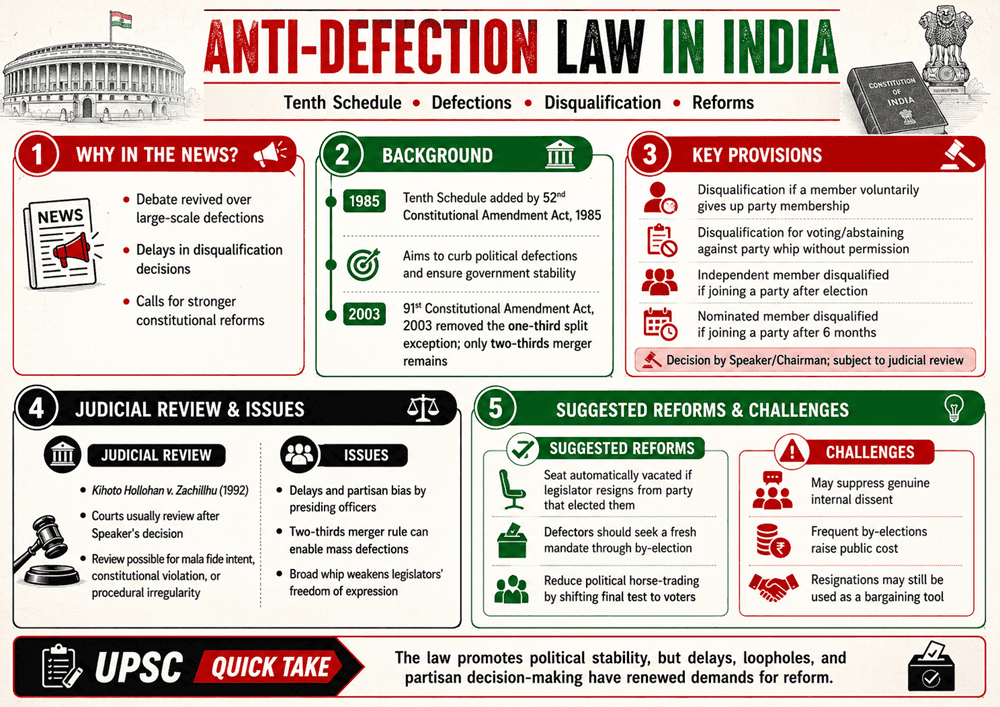
The anti-defection law has again come under debate due to increasing instances of large-scale defections, delays in deciding disqualification petitions, and demands for comprehensive reforms.
News in Brief
- The editorial argues that the present anti-defection framework has failed to prevent political opportunism.
- It highlights delays by Speakers/Chairpersons in deciding disqualification petitions.
- It proposes constitutional reforms, including automatic vacation of the seat when a legislator resigns from the party on whose ticket they were elected.
Anti-Defection Law – Background
- The Anti-Defection law in India is enshrined in the Tenth Schedule of the Constitution, inserted through the 52nd Constitutional Amendment Act, 1985.
- Designed to prevent political defections and ensure stability of elected governments.
- 91st Constitutional Amendment Act, 2003 removed the one-third split exception, retaining only the two-thirds merger exception.
Key Provisions
- Disqualification if a member voluntarily gives up party membership.
- Disqualification for voting or abstaining against the party whip without permission.
- Independent members lose membership if they join a political party after election.
- Nominated members are disqualified if they join a party after six months.
- Decision on disqualification rests with the Speaker/Chairman, subject to judicial review.
Judicial Review under the Anti-Defection Law
- The Speaker’s or Chairman’s decision on disqualification under the Tenth Schedule is subject to judicial review.
- The Supreme Court, in Kihoto Hollohan v. Zachillhu (1992), held that while courts cannot ordinarily interfere before the Speaker’s decision is made, they can review the decision afterward on grounds such as mala fide intent, violation of constitutional provisions, or procedural irregularities.
Issues with the Current Law
- Disqualification petitions often face prolonged delays, with Speakers frequently accused of partisan biases when resolving them.
- The two-thirds merger rule enables mass defections, often leading to strategic resignations rather than strict party-switching to avoid penalties.
- Broad party whips restrict legislators’ freedom of expression and limit intra-party debate
Suggested Reforms
- Automatically terminate the membership of any legislator who resigns from the party that elected them.
- Require defecting or resigning legislators to seek a fresh mandate from voters in a by-election.
- Shift the final decision-making power from the presiding officers directly to the voters via re-elections, reducing political horse-trading.
Challenges
- Strict re-election mandates may deter legitimate internal party dissent.
- Frequent by-elections increase the financial burden on the public exchequer.
- Governments may still face political instability if resignations become a routine tool for political bargaining
Conclusion
- The anti-defection law has helped reduce political instability and protect elected governments. However, delays and misuse have reduced its effectiveness.
- Reforms are needed to ensure fair decisions, accountability, and legislative independence. A stronger law will better protect the people’s mandate and strengthen democracy.
Key Takeaways
UPSC Prelims and Mains Practice Question
With reference to the Anti-Defection Law, consider the following statements:
- It was introduced through the 52nd Constitutional Amendment Act, 1985.
- The 91st Constitutional Amendment removed the one-third split exception.
- The Speaker’s decision under the Tenth Schedule is completely beyond judicial review.
Which of the statements given above are correct?
(a) 1 and 2 only
(b) 2 and 3 only
(c) 1 and 3 only
(d) 1, 2 and 3
Answer: A
Mains Practice Question
Q. “The Anti-Defection Law has ensured political stability but has weakened legislative independence and accountability. Critically examine. Suggest reforms to strengthen India’s anti-defection framework.” (250 Words)
Daily Current Affairs: Click Here