


Daily Current Affairs 21 July 2026 – IAS Current Affairs
Current Affairs 21 July 2026 focuses on the Prelims-Mains perspective. Major events are :
Anti-Defection Law In India: Challenges, Reforms And Constitutional Provisions
Source: Indian Express
GS II: Polity and Governance
Overview
- News in Brief
- Anti-Defection Law – Background
- Key Provisions
- Issues with the Current Law
- Suggested Reforms
Why in the News?
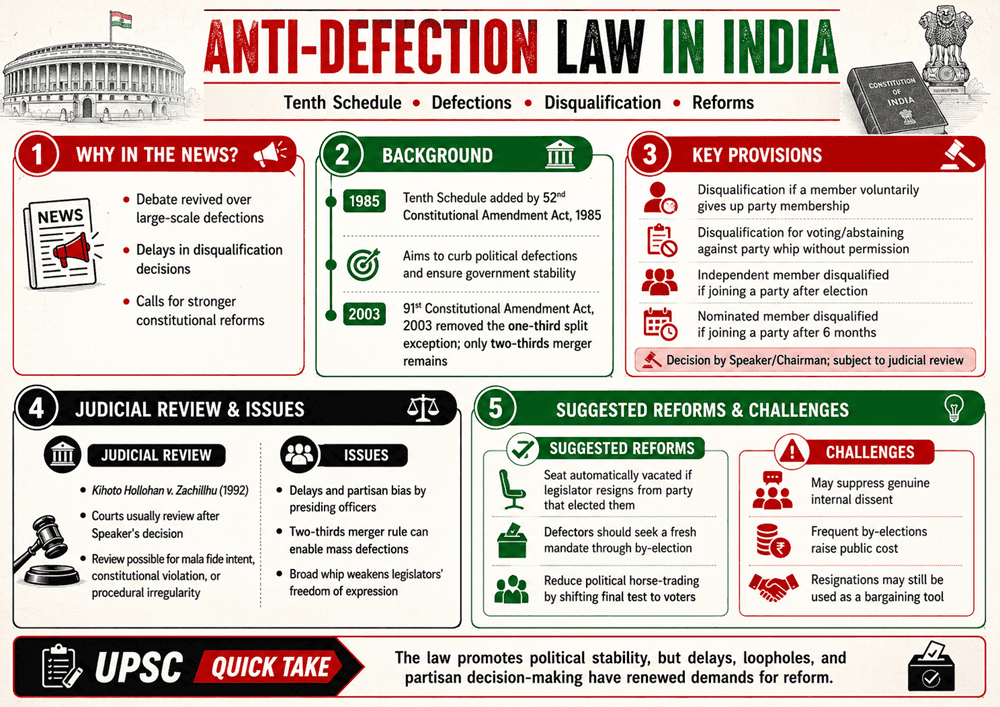
The anti-defection law has again come under debate due to increasing instances of large-scale defections, delays in deciding disqualification petitions, and demands for comprehensive reforms.
News in Brief
- The editorial argues that the present anti-defection framework has failed to prevent political opportunism.
- It highlights delays by Speakers/Chairpersons in deciding disqualification petitions.
- It proposes constitutional reforms, including automatic vacation of the seat when a legislator resigns from the party on whose ticket they were elected.
Anti-Defection Law – Background
- The Anti-Defection law in India is enshrined in the Tenth Schedule of the Constitution, inserted through the 52nd Constitutional Amendment Act, 1985.
- Designed to prevent political defections and ensure stability of elected governments.
- 91st Constitutional Amendment Act, 2003 removed the one-third split exception, retaining only the two-thirds merger exception.
Key Provisions
- Disqualification if a member voluntarily gives up party membership.
- Disqualification for voting or abstaining against the party whip without permission.
- Independent members lose membership if they join a political party after election.
- Nominated members are disqualified if they join a party after six months.
- Decision on disqualification rests with the Speaker/Chairman, subject to judicial review.
Judicial Review under the Anti-Defection Law
- The Speaker’s or Chairman’s decision on disqualification under the Tenth Schedule is subject to judicial review.
- The Supreme Court, in Kihoto Hollohan v. Zachillhu (1992), held that while courts cannot ordinarily interfere before the Speaker’s decision is made, they can review the decision afterward on grounds such as mala fide intent, violation of constitutional provisions, or procedural irregularities.
Issues with the Current Law
- Disqualification petitions often face prolonged delays, with Speakers frequently accused of partisan biases when resolving them.
- The two-thirds merger rule enables mass defections, often leading to strategic resignations rather than strict party-switching to avoid penalties.
- Broad party whips restrict legislators’ freedom of expression and limit intra-party debate
Suggested Reforms
- Automatically terminate the membership of any legislator who resigns from the party that elected them.
- Require defecting or resigning legislators to seek a fresh mandate from voters in a by-election.
- Shift the final decision-making power from the presiding officers directly to the voters via re-elections, reducing political horse-trading.
Challenges
- Strict re-election mandates may deter legitimate internal party dissent.
- Frequent by-elections increase the financial burden on the public exchequer.
- Governments may still face political instability if resignations become a routine tool for political bargaining
Conclusion
- The anti-defection law has helped reduce political instability and protect elected governments. However, delays and misuse have reduced its effectiveness.
- Reforms are needed to ensure fair decisions, accountability, and legislative independence. A stronger law will better protect the people’s mandate and strengthen democracy.
Key Takeaways
UPSC Prelims and Mains Practice Question
With reference to the Anti-Defection Law, consider the following statements:
- It was introduced through the 52nd Constitutional Amendment Act, 1985.
- The 91st Constitutional Amendment removed the one-third split exception.
- The Speaker’s decision under the Tenth Schedule is completely beyond judicial review.
Which of the statements given above are correct?
(a) 1 and 2 only
(b) 2 and 3 only
(c) 1 and 3 only
(d) 1, 2 and 3
Answer: A
Mains Practice Question
Q. “The Anti-Defection Law has ensured political stability but has weakened legislative independence and accountability. Critically examine. Suggest reforms to strengthen India’s anti-defection framework.” (250 Words)
Kerala Power Crisis: Rooftop Solar, Peak Demand And Storage
Source: Indian Express
GS III: Infrastructure – Energy
Overview
- News in Brief
- Key Issues Highlighted
- Government Measures & Grid Modernisation
- Significance for India’s Power Grid
Why in the News?
Kerala, despite becoming one of India’s leading states in rooftop solar adoption under the PM Surya Ghar Yojana, is witnessing power shortages and scheduled power cuts due to a mismatch between solar power generation and peak electricity demand.
News in Brief
- Kerala has over 2,500 MW of installed solar capacity, with rooftop solar contributing the majority of it.
- Peak electricity demand in Kerala occurs during 6 PM–11 PM, when solar generation is unavailable.
- The state is planning Battery Energy Storage Systems (BESS) to store daytime solar power for use during night-time demand.
Key Facts and Figures
- Kerala’s rooftop solar capacity has nearly doubled since 2023, registering a growth rate of close to 100%.
- The state now ranks fourth nationally in rooftop solar capacity, behind Gujarat, Maharashtra, and Rajasthan, having overtaken most southern states.
- By late 2024, Kerala had over 1.5 lakh rooftop solar systems installed, supplying a significant share of the state’s daytime electricity demand.
- Under PM Surya Ghar Yojana, Kerala has achieved one of the highest application-to-installation conversion rates in the country, supported by a dense network of registered local installers.
- Despite this success, rooftop solar penetration remains limited to a small fraction of the state’s total electricity consumers, indicating headroom for further growth alongside emerging structural constraints.
Background: How Kerala Became a Solar Leader
1. The Soura Scheme
Launched by KSEB in 2019-20, the Soura program was a pioneering model where KSEB financed rooftop installations, while households rented out roof space to the utility in exchange for a share of free power. This reduced upfront costs for consumers and built early public trust in solar technology — well before central schemes existed.
2. PM Surya Ghar: Muft Bijli Yojana
This central scheme offers subsidies for residential rooftop solar installations and aims to power one crore households nationally. Kerala’s pre-existing installer ecosystem, consumer awareness, and streamlined administrative processes allowed it to convert applications into installations faster than most states.
3. High Electricity Costs and Awareness
Kerala has traditionally had high domestic tariffs and a well-informed consumer base, both of which made rooftop solar an economically attractive proposition for households.
Key Issues Highlighted
- Mismatch Between Supply and Demand
- Over 60% of rooftop solar power is generated during the day, but electricity demand is highest in the evening after sunset, creating a supply gap.
- Dependence on Purchased Power
- Kerala generates domestically only a fraction (roughly 15 million units) of its 88+ million unit daily average demand.
- The state buys the remaining power from the national grid, but prices often spike to ₹10 per unit during peak hours.
- Reduced Hydropower Generation
- Traditionally dependent on hydel power, Kerala has faced reduced local generation due to weak monsoons and low reservoir levels.
- Inadequate Grid and Storage
- Excess solar power generated during the day cannot be stored due to inadequate battery storage.
- This leads to grid instability during daytime and electricity shortages during evening peak demand.
Government Measures & Grid Modernization
- Battery Energy Storage Systems (BESS)- Kerala is expanding battery storage to store surplus daytime solar power and supply it during peak evening demand.
- Grid Modernization– The Kerala State Electricity Board (KSEB) is upgrading distribution infrastructure and introducing smart grid technologies to improve grid stability and manage voltage fluctuations and prevent transformer blowouts.
- PM Surya Ghar Scheme– The state continues to promote rooftop solar installations under the PM Surya Ghar: Muft Bijli Yojana while implementing Time-of-Day (ToD) tariffs to encourage electricity use during off-peak hours and reduce pressure on the grid.
- PM Surya Ghar: Muft Bijli Yojana is a Central Government scheme launched in 2024 to promote rooftop solar installations in 1 crore households.
- It provides financial assistance for installing rooftop solar systems, enabling households to generate their own electricity, reduce power bills, and support India’s clean energy transition.
Significance for India’s Power Grid
- Intermittency Management
- As India scales its renewable capacity, Kerala’s reliance on power exchanges during solar and non-solar hours highlights the danger of depending on intermittent sources without complementary storage.
- Grid Modernisation Urgency
- Kerala’s challenges underscore the necessity for upgraded grid infrastructure, smart meters, and SCADA systems.
- SCADA (Supervisory Control and Data Acquisition): A system used to monitor, control, and automate electricity transmission and distribution networks in real time.
- The integration of pumped-storage hydroelectric projects and wave energy exploration are emerging as vital solutions.
- Kerala’s challenges underscore the necessity for upgraded grid infrastructure, smart meters, and SCADA systems.
- National Policy Adjustments
- Improve transmission networks to transfer electricity efficiently from power-surplus states to power-deficit regions like Kerala.
- Develop state-specific renewable energy strategies considering local constraints such as limited land availability and seasonal variations in power generation.
Significance for UPSC Aspirants
Relevance to GS Paper III (Environment and Infrastructure)
- Renewable energy transition, distributed vs. centralised generation models
- Grid integration challenges of variable renewable energy sources
- India’s climate commitments (Nationally Determined Contributions, net-zero target by 2070)
Relevance to GS Paper II (Governance)
- Centre-state coordination in scheme implementation (PM Surya Ghar)
- Role of state electricity regulatory commissions
- Federalism in energy pricing and subsidy design
Relevance to Economy/Prelims
- Concepts: net metering, gross metering, cross-subsidy, Renewable Purchase Obligation (RPO), Battery Energy Storage Systems (BESS), duck curve
- Institutions: KSEB, KSERC, MNRE, ANERT (Agency for New and Renewable Energy Research and Technology, Kerala).
Conclusion
- Kerala’s experience shows that increasing solar capacity alone cannot guarantee uninterrupted electricity.
- Achieving energy security requires a balanced approach combining renewable energy, battery storage, smart grids, and efficient demand management.
Key Takeaways

UPSC Prelims and Mains Practice Question
With reference to renewable energy integration in electricity grids, consider the following statements:
- Solar power generation is intermittent and depends on the availability of sunlight.
- Battery Energy Storage Systems (BESS) help store excess renewable energy and supply it during periods of high demand.
- Smart grids improve grid reliability by enabling better monitoring and management of electricity supply and demand.
Which of the statements given above is/are correct?
A. 1 only
B. 1 and 2 only
C. 2 and 3 only
D. 1, 2 and 3
Answer: D. 1, 2 and 3
Mains Practice Question
Q. “Renewable energy alone cannot ensure energy security unless supported by robust grid infrastructure and energy storage systems.” Discuss. (250 Words)
EPFO 3.0: Transforming India’s Social Security And Pension System
Source: Indian Express
GS II: Governance, Government Policies & Interventions for Development, Welfare Schemes for Vulnerable Sections, Social Justice, GS III: Indian Economy, Inclusive Growth, Employment
Overview
- News in Brief
- Key Proposals under EPFO 3.0
- Significance
- Challenges
Why in the News?
The Centre is considering EPFO 3.0 reforms to introduce a universal contributory pension scheme covering formal, unorganised, self-employed and gig workers.
News in Brief
- EPFO plans a universal pension system with flexible contributions and retirement options.
- Gig and platform workers may receive pension and provident fund benefits through aggregator contributions.
- EPFO 3.0 will leverage digital infrastructure for real-time account management and improved portability.
Key Proposals under EPFO 3.0
- Pension for Everyone
- It brings all types of workers into the pension net.
- including salaried employees, daily wage labourers, self-employed individuals, and gig or platform workers, will have access to social security.
- Target Retirement Sum (TRS)
- Members can choose a desired retirement corpus.
- Based on factors such as age, expected investment returns, and retirement timeline, the system calculates the periodic contributions required to achieve the target.
- Flexible Contribution Framework
- Contributions may be made by workers, employers, the government (for eligible low-income workers), and digital platform aggregators, ensuring shared responsibility for retirement savings.
- Inflation-Linked Pension Planning
- Pension projections are adjusted to account for inflation, enabling members to assess different contribution scenarios and estimate the future value of their retirement savings more accurately.
- Tech Upgrades (CBS & Dashboard)
- A unified digital dashboard will enable members to track provident fund balances, pension savings, and contributions through a single platform.
- A single Universal Account Number (UAN) will be linked to multiple employers or digital platforms, ensuring seamless transfer of provident fund accounts and consolidation of contributions across different employments.
- Social Security for Gig Workers
- Digital platforms and app aggregators will be required to contribute to the social security funds for the gig workers they employ, as per the Code on Social Security, 2020.
- Building and construction workers are also included.
- Family Pension Benefit
- The proposals include creating a combined Family Benefit Fund to ensure that your family or dependents receive financial support in case of emergencies or death.
Code on Social Security, 2020
- It merges and replaces nine central enactments, including the EPF Act, ESI Act, Maternity Benefit Act, and Payment of Gratuity Act.
- Extends social security coverage to gig workers, platform workers, and unorganised workers for the first time.
- Guarantees 26 weeks of maternity leave, work-from-home provisions, and mandatory childcare facilities.
- Fixed-term employees are now eligible for gratuity after completing just one continuous year of service instead of the previous five-year wait.
- A uniform definition of “wages” was established to ensure consistency in calculating pension, gratuity, and provident fund deductions.
Significance
- Expands social security to millions of workers outside the formal sector.
- Enhances retirement income security.
- Supports financial inclusion and formalisation of labour.
- Promotes portability and ease of doing business through digital reforms.
- Advances the vision of universal social protection.
Challenges
- Ensuring sustained contributions from informal workers.
- Compliance by digital platform aggregators.
- Managing the financial sustainability of the pension system.
- Raising awareness among unorganised workers.
- Effective implementation across states and sectors.
Way Forward & Conclusion
Effective implementation of the Code on Social Security, 2020, strengthened digital infrastructure, wider enrolment, and sustainable financing are essential for the success of EPFO 3.0.
Universal pension coverage can enhance income security, promote labour formalisation, and advance India’s goal of inclusive social protection.
Key Takeaways

UPSC Prelims and Mains Practice Question
With reference to the proposed EPFO 3.0 reforms, consider the following statements:
- The proposal aims to extend pension coverage to gig and unorganised workers.
- The proposed Target Retirement Sum (TRS) helps estimate the retirement corpus required to achieve a desired pension.
- The Code on Social Security, 2020 provides for the inclusion of gig and platform workers in the social security framework.
Which of the statements given above is/are correct?
(a) 1 and 2 only
(b) 2 and 3 only
(c) 1 and 3 only
(d) 1, 2 and 3
Answer: (d)
Mains Practice Question
Q. “Universal social security is a key pillar of an inclusive welfare state.” Discuss the need for expanding social security coverage in India. Highlight the challenges and suggest measures to ensure effective implementation. (15 Marks, 250 Words)
SMILE Scheme For Rehabilitation Of Persons Engaged In Begging
Source: PIB
GS II: Governance, Welfare Schemes for Vulnerable Sections, Social Justice, Government Policies and Interventions.
Overview
- News in Brief
- SMILE Scheme
- Significance of the Scheme
- Key Challenges in Implementation
Why in the News?
The Ministry of Social Justice & Empowerment announced that the SMILE Beggary Scheme is operational in 216 cities across India.
News in Brief
- More than 10,200 persons engaged in begging have been rehabilitated so far.
- The scheme aims to cover 295 cities and rehabilitate 35,000 persons by FY 2030–31.
- The government has strengthened monitoring through the SMILE-Beggary National Portal.
SMILE Scheme
- The SMILE (Support for Marginalised Individuals for Livelihood and Enterprise) scheme is a central government initiative in India.
- Launched by the Ministry of Social Justice and Empowerment.
- It focuses on the social and economic rehabilitation of the transgender community and individuals engaged in begging.
The umbrella scheme is divided into two major sub-schemes, covering several key initiatives,
- Comprehensive Rehabilitation of Transgender Persons
- Shelter Homes- Funds “Garima Grehs” to provide safe, secure housing, food, and clothing to transgender individuals.
- Education & Healthcare- Offers scholarships for transgender students (from Class IX to post-graduation) and up to ₹5 lakh in annual health coverage under Ayushman Bharat TG Plus (covering hormone therapy and gender-affirming surgeries).
- Skill Development- Provides skill and livelihood training in convergence with schemes like PM-DAKSH to foster financial independence.
- Comprehensive Rehabilitation of Persons Engaged in Begging
- Rescue & Rehabilitation- Aims for a “Bhiksha Vritti Mukt Bharat” (Begging-Free India) by conducting surveys to rescue and rehabilitate people engaged in begging.
- Provision of shelter, safe drinking water, nutritious food, clothing, and medical facilities to transform their living conditions.
- Support Services- Provides medical facilities, counseling, education, and skill development to integrate individuals into mainstream society with dignity.
- Rescue & Rehabilitation- Aims for a “Bhiksha Vritti Mukt Bharat” (Begging-Free India) by conducting surveys to rescue and rehabilitate people engaged in begging.
- The scheme adopts a convergence-based approach – The implementation is handled through State and UT Governments, District Administrations, and Urban Local Bodies.
- Metropolitan cities, religious centres, tourist destinations, and historical places are priority areas under the expanded implementation plan.
PM-DAKSH Scheme
- Pradhan Mantri Dakshta Aur Kushalta Sampann Hitgrahi Yojana.
- A Ministry of Social Justice & Empowerment initiative that provides free skill development, entrepreneurship training, and placement support to SCs, OBCs, EBCs, De-notified, Nomadic and Semi-Nomadic Tribes (DNTs), Safai Karamcharis, and Waste Pickers to improve employability and livelihoods.
Significance of the Scheme
- Rights & Dignity– It aligns directly with Article 21 of the Indian Constitution, guaranteeing the right to life and dignity for society’s most vulnerable.
- SDG Alignment– Directly supports SDG 1 (No Poverty), SDG 8 (Decent Work), and SDG 10 (Reduced Inequalities).
- Targeted Support– Features provisions like Garima Grehs (shelter homes) and Ayushman Bharat TG Plus (for gender-affirming care and health coverage).
- Social Equity- Promotes justice and social inclusion by mainstreaming the most vulnerable populations.
Key Challenges in Implementation
- Social Stigma– Deep-rooted societal discrimination creates barriers to employment and community integration.
- Livelihood Hurdles– Translating short-term vocational training into stable, long-term employment remains difficult due to background gaps.
- Agency Coordination– Requires complex, multi-stakeholder collaboration between local urban bodies, state ministries, and NGOs.
- Ensuring Sustainable Rehabilitation– Ensuring individuals do not return to beggary requires sustained, lifelong follow-up support, which is resource-intensive.
Way Forward & Conclusion
India’s vision of a “Bhiksha Vritti Mukt Bharat” can be achieved by strengthening rehabilitation through coordinated action among governments, urban local bodies, civil society, and communities.
Expanding skill development, livelihood opportunities, digital monitoring, and access to social security will enable the sustainable reintegration of persons engaged in begging, advancing the constitutional ideals of social justice, dignity, and inclusive development.
Key Takeaways

UPSC Prelims and Mains Practice Question
Consider the following statements regarding the SMILE Scheme:
- It is implemented by the Ministry of Social Justice & Empowerment.
- It includes a Central Sector Scheme for the rehabilitation of persons engaged in begging.
- It is implemented exclusively by State Governments.
Which of the statements given above is/are correct?
A. 1 only
B. 1 and 2 only
C. 2 and 3 only
D. 1, 2 and 3
Answer: B
Mains Practice Question
Q. “Discuss the significance of rehabilitation-based welfare policies in ensuring social justice and inclusive development for vulnerable and marginalized sections in India.” (15 Marks, 250 Words)
Daily Current Affairs: Click Here
Rate this Article and Leave Feedback
Source: The Hindu
GS III: Science and Technology
Overview
Why in the News?
Daily Current Affairs: Click Here