


Daily Current Affairs 27 July 2026 – IAS Current Affairs
Current Affairs 27 July 2026 focuses on the Prelims-Mains perspective. Major events are :
Quantum Computing And Artificial Intelligence In Healthcare
Source: Indian Express
GS III: Science and Technology
Overview
- News in Brief
- What are Peptides?
- AI and Quantum Computing in Peptide Design
- Significance
Why in the News?
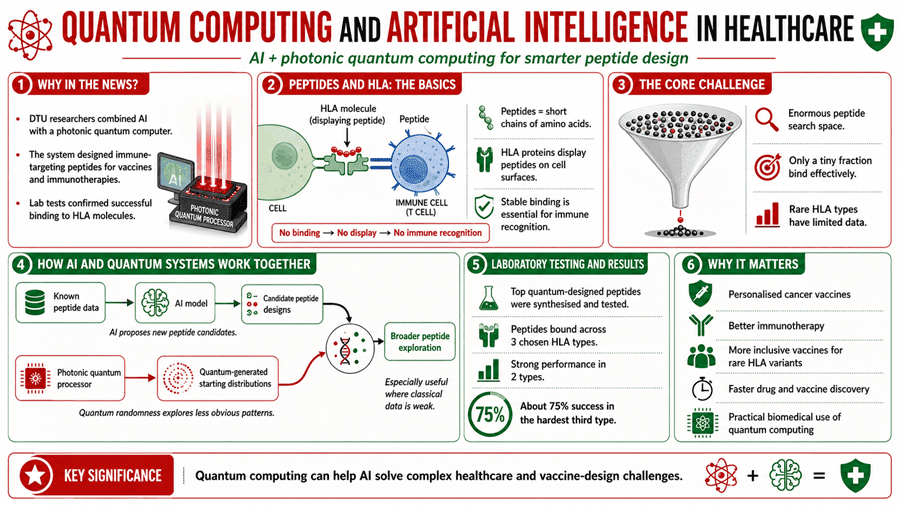
Researchers at the Technical University of Denmark (DTU) demonstrated that combining quantum computing with AI can improve the design of immune-targeting peptides for vaccines and immunotherapies.
News in Brief
- Scientists used a photonic quantum computer with AI to design peptides that bind effectively to Human Leukocyte Antigen (HLA) molecules.
- Laboratory validation confirmed that the AI-designed peptides successfully bound to HLA proteins, a crucial step in activating immune responses.
- The approach could support the development of personalised cancer vaccines, immunotherapies, and more inclusive vaccine design for genetically diverse populations.
What are Peptides?
- Peptides are short chains of amino acids, the building blocks of proteins.
- In immunology, peptides are important because cells display them on their surface, allowing the immune system to distinguish between healthy and foreign substances.
- Many vaccines work by presenting the right peptide to the immune system, training it to recognize and fight harmful pathogens.
Role of HLA molecules
- Human Leukocyte Antigen (HLA) proteins are found on the surface of almost all cells.
- They act like a display shelf, picking up short peptides from inside the cell and presenting them on the cell surface.
- Immune cells inspect these displayed peptides to detect infections or abnormal cells.
- A peptide is displayed to the immune system only if it binds stably to the groove of an HLA molecule.
- No binding → No display → No immune recognition.
Challenges
- Designing a peptide that binds to a specific HLA molecule is the first step in developing vaccines and immune-based therapies.
- The main challenge is the enormous search space:
- Even a short peptide can have hundreds of billions of possible sequences.
- Only a tiny fraction of these sequences can bind effectively to a person’s HLA molecules.
- Finding these effective peptides is like searching for a needle in a haystack, especially for HLA types that are poorly represented in existing datasets.
AI and Quantum Computing in Peptide Design
- Combining artificial intelligence with a photonic quantum processor helps design new immune-binding peptides.
How AI and Quantum Systems Work Together
- The AI learns known immune-binding peptides to propose brand-new candidate peptides.
- Every new design requires a random starting point (initial distribution), which is usually generated by a classical computer.
- The quantum computer provides a different, quantum-generated starting distribution.
- A photonic quantum processor produces richer and more correlated randomness that is difficult for classical computers to replicate.
- This enables AI to explore a broader and less obvious range of peptide designs, instead of converging on familiar patterns.
Helping Rare and Understudied HLA Types
- HLA genes are among the most variable genes in the human genome, with thousands of variants inherited from parents.
- Differences in HLA types explain why individuals respond differently to the same infection or vaccine.
- Common HLA types have plenty of data, while rare types lack information making AI predictions less accurate.
- The quantum-derived starting distribution showed the greatest improvement for these data-poor, understudied HLA types.
Laboratory Testing and Results
- Computational predictions alone are insufficient, particularly for rare HLA types where prediction accuracy is lower.
- Researchers synthesised the top quantum-designed peptides and tested whether they actually bound to HLA molecules in laboratory experiments.
- Tested peptides bound to targets across all three chosen HLA types.
- Results were very strong for two types and reached about 75% success for the hardest third type.
- Laboratory validation confirms that the approach works in practice, distinguishing a genuine scientific demonstration from a computer simulation.
Significance
- Advances personalised medicine by enabling the development of cancer vaccines tailored to an individual’s immune profile.
- Enhances immunotherapy through more accurate identification of peptides that effectively activate the immune system.
- Improves vaccine effectiveness for people with rare or underrepresented HLA variants, making healthcare more inclusive.
- Speeds up drug and vaccine discovery by reducing the time and computational effort needed to identify promising therapeutic candidates.
- Demonstrates a practical use of quantum computing, showing its potential to solve complex biomedical problems beyond theoretical research.
Way Forward & Conclusion
Strengthen investment, research collaboration, and diverse genomic databases while establishing robust ethical and regulatory frameworks to accelerate the safe adoption of quantum-AI technologies in healthcare.
The convergence of quantum computing and AI has the potential to transform vaccine development, cancer immunotherapy, and personalised medicine by making healthcare faster, more precise, and inclusive.
India’s Initiatives
- National Quantum Mission (2023) for indigenous quantum technologies.
- IndiaAI Mission to strengthen AI innovation.
- Biotechnology Industry Research Assistance Council (BIRAC) for biotech research.
- Ayushman Bharat Digital Mission (ABDM) promoting digital healthcare.
Key Takeaways
UPSC Prelims and Mains Practice Question
Consider the following statements regarding Human Leukocyte Antigen (HLA):
- HLA proteins present peptide fragments to T-cells.
- HLA genes are among the most genetically diverse genes in humans.
- Successful peptide binding to HLA molecules is essential for triggering many immune responses.
Which of the statements given above is/are correct?
A. 1, 2 and 3
B. 1 and 2 only
C. 2 and 3 only
D. 1 only
Answer: A
Mains Practice Question
Q. Discuss how the convergence of Artificial Intelligence and Quantum Computing can transform vaccine development and personalised medicine. Examine the opportunities and challenges associated with their application in healthcare. (15 Marks, 250 Words)
UNESCO World Heritage List 2026: D-Day Beaches & Mount Olympus Added
Source: Indian Express
GS I: UNESCO, World History
Overview
- News in Brief
- Key Highlights
- India and UNESCO
Why in the News?
UNESCO has added new sites to the World Heritage List during the UNESCO World Heritage Committee meeting in July 2026.
News in Brief
- UNESCO has inscribed new cultural, natural and mixed heritage sites on the World Heritage List during the latest session of the World Heritage Committee.
- The newly recognised sites include locations of exceptional historical, ecological and cultural significance, highlighting the importance of preserving humanity’s shared heritage.
- The latest inscriptions also include archaeological and migratory landscape sites, reflecting UNESCO’s commitment to protecting diverse forms of global heritage.
Key Highlights
- Normandy D-Day Landing Beaches (France)- Recognized for their historic role in the June 6, 1944, Allied operations that liberated Europe.
- Mount Olympus (Greece)- Inscribed as a mixed site for its rich plant and animal life alongside its fame as the mythical home of ancient Greek gods.
- Asuka-Fujiwara Archaeological Sites (Japan)- Added for their ancient political and cultural capitals reflecting early Japanese state development.
- Boma-Badingilo Migratory Landscape (South Sudan)- Recognized for holding one of the largest land mammal migrations in the world.
- The country’s first addition to the World Heritage List.
- The UNESCO World Heritage Centre maintains the official list of cultural, natural, and mixed properties of Outstanding Universal Value established by the 1972 World Heritage Convention.
- It is governed by a 21-state World Heritage Committee to protect global landmarks for future generations.
Core Categories
- Cultural sites- Monuments, groups of buildings, and archaeological sites (e.g., temples, historic cities).
- Natural sites- Physical and biological formations, geological habitats, and areas vital for science or conservation.
- Mixed sites- Properties combining both significant cultural and natural elements.
Committee and Operations
- Membership– 21 countries elected by the General Assembly of States Parties.
- Function– Evaluates nominations, monitors conservation states, and manages the List of World Heritage in Danger.
- Advisory Bodies– Includes groups like ICOMOS and IUCN that review technical and scientific merits of nominations.
India and UNESCO
- India features 44 UNESCO World Heritage Sites—ranking 6th globally.
- This includes,
- Cultural Sites (36)- Historical monuments, ancient temples, architectural complexes, and urban designs like the Taj Mahal and Agra Fort.
- Natural Sites (7)- National parks and ecological biodiversity hotspots recognized for exceptional ecological value, such as Kaziranga National Park and the Western Ghats.
- Mixed Site (1)- Khangchendzonga National Park, valued for both its profound cultural beliefs and unique natural ecosystem.
Protection and Management
- The 1972 Convention– Sets international rules to identify, protect, and preserve cultural and natural heritage.
- National Agency- The Archaeological Survey of India (ASI) oversees the conservation and maintenance of a large share of the protected national monuments.
Key Takeaways

UPSC Prelims and Mains Practice Questions
With reference to the recent UNESCO World Heritage Committee meeting, consider the following statements:
- Mount Olympus has been inscribed as a Mixed World Heritage Site.
- The Normandy D-Day Landing Beaches were recognised for their historical significance during World War II.
- South Sudan received its first UNESCO World Heritage Site with the inscription of the Boma-Badingilo Migratory Landscape.
Which of the statements given above is/are correct?
A. 1 only
B. 1 and 2 only
C. 2 and 3 only
D. 1, 2 and 3
Answer: D
India’s Soil Health Mission
Source: PIB
GS III: Agriculture
Overview
- News in Brief
- Soil- Foundation of Agricultural Strength
- Major Government Initiatives
Why in the News?
The PIB highlights that India is promoting scientific soil management through soil testing, balanced fertiliser use, natural farming, and digital agriculture.
News in Brief
- India showcases progress in scientific soil management through the Soil Health Card Scheme, National Mission on Natural Farming (NMNF), and National Mission for Sustainable Agriculture (NMSA).
- Highlights digital technologies such as geospatial soil mapping, AgriStack, and AI-based advisory systems for precision agriculture.
- It also emphasizes soil conservation’s role in climate resilience, carbon sequestration, and sustainable agricultural productivity.
Soil- Foundation of Agricultural Strength
India’s Diverse Soil Types
- Alluvial Soils
- Found in the Indo-Gangetic and Brahmaputra plains and river deltas (Mahanadi, Krishna, Godavari).
- States: Punjab, Haryana, Uttar Pradesh, Bihar, Assam, West Bengal, Odisha, Andhra Pradesh.
- Highly fertile and ideal for intensive agriculture.
- Black Soils (Regur)
- Found mainly in Maharashtra, Madhya Pradesh and Gujarat.
- Clayey, retain moisture well, rich in lime and calcium.
- Best suited for cotton cultivation.
- Red Soils
- Found in parts of Tamil Nadu, Karnataka, north-east Andhra Pradesh, eastern Madhya Pradesh, Bihar, West Bengal and Rajasthan.
- Red colour due to iron content.
- Generally porous and deficient in major nutrients.
- Laterite Soils
- Found in eastern Andhra Pradesh, Karnataka, Kerala,
- Madhya Pradesh, Odisha, Assam and parts of Maharashtra.
- Formed under high rainfall and intense leaching.
- Comparatively low in nutrients.
- Desert Soils
- Found in Rajasthan, Gujarat and Leh-Ladakh.
- Sandy texture, low moisture retention and high soluble salts.
- Forest and Hill Soils
- Found in the Himalayan and North-Eastern regions.
- Characteristics vary with altitude, climate and vegetation.
- Saline and Alkaline Soils
- Found in arid and semi-arid regions, coastal and delta areas.
- States/regions: Parts of Uttar Pradesh, Punjab, Haryana, Bihar, Rajasthan, coastal Odisha, Sundarbans (West Bengal) and Kutch (Gujarat).
- High salt accumulation reduces crop productivity.
- Marshy Soils
- Found in parts of Tamil Nadu, Bihar and Uttar Pradesh.
- Formed under prolonged waterlogging.
- Rich in organic matter.
Major Government Initiatives
- Soil plays a critical role in climate change mitigation and adaptation by acting as a significant natural carbon sink.
- Soils absorb carbon dioxide from the atmosphere and store it as soil organic carbon.
- This process is facilitated by vegetation growth, roots, and soil microorganisms, which strengthens soil fertility and resilience to climate variability.
- Promotes scientific nutrient management through soil testing.
- Provides crop-specific fertiliser recommendations.
- Encourages balanced fertiliser use and improves soil productivity.
- Supports farmers through demonstrations and grassroots soil advisory services.
National Mission for Sustainable Agriculture (NMSA)
- A mission under the National Action Plan on Climate Change (NAPCC).
- Promotes climate-resilient agriculture and efficient water use.
- Improves soil health through sustainable farming practices.
- Supports integrated farming systems and rainfed agriculture.
- Enhances soil organic carbon and supporting practices aligned with carbon farming.
National Mission on Natural Farming (NMNF)
- Promotes nature-based farming with minimal chemical inputs.
- Encourages improvement of soil fertility and biodiversity.
- Strengthens Bio-input Resource Centres and community-based training.
- Focuses on reducing farmers’ input costs while encouraging safe, environmentally responsible food production
National Mission for a Green India
- One of the eight missions under National Action Plan on Climate Change (NAPCC).
- NAPCC cover areas such as solar energy, water, green India, agriculture, ecosystems and knowledge systems, providing a comprehensive framework for climate action.
- Enhances forest and tree cover to strengthen carbon sinks.
- Supports India’s climate commitments through ecosystem restoration.
- Improves soil and biomass carbon storage.
Carbon Credit Trading Scheme
- Enables farmers to earn tradable carbon credits by adopting sustainable and eco-friendly agricultural practices.
- Encourages greenhouse gas emission reduction.
- Creates an additional source of farm income.
- Promotes climate-smart agriculture.
Balanced Fertiliser Management
- Nutrient Based Subsidy (NBS) Scheme promotes balanced fertiliser use.
- Neem-coated urea slows nitrogen release, improves nutrient-use efficiency, and reduces diversion for non-agricultural purposes.
- Aadhaar-enabled PoS devices ensure transparent fertiliser subsidy delivery through DBT.
- The Integrated Fertiliser Management System further strengthens monitoring and logistics, ensuring better control over fertiliser availability and use.
Khet Bachao Abhiyan
- Awareness campaign led by ICAR and the Department of Agriculture & Farmers Welfare.
- The campaign promoted scientific nutrient management practices among farmers.
- Encourages balanced fertiliser use and sustainable agriculture.
- Conducts awareness camps, demonstrations, and farmer training programmes.
Digital Soil Ecosystem
- Uses geospatial soil mapping for scientific land-use planning.
- AgriStack integrates soil, land, and farmer data.
- Krishi Decision Support System (KDSS) provides AI-based location-specific advisories.
- Supports precision farming, soil diagnostics, and agri-robotics.
Conclusion
Healthy soil is the foundation of India’s food security, farmer prosperity, and climate resilience.
Strengthening scientific soil management, sustainable farming, digital technologies, and community participation will ensure long-term agricultural productivity while conserving this vital natural resource.
Key Takeaways

UPSC Prelims and Mains Practice Question
Consider the following statements:
- The Soil Health Card Scheme provides crop-specific fertiliser recommendations based on soil testing.
- The National Mission on Natural Farming was launched in 2024.
- The Carbon Credit Trading Scheme enables farmers to earn tradable carbon credits through verified emission reduction practices.
- Khet Bachao Abhiyan promotes soil test-based nutrient management, balanced fertiliser use, and sustainable agricultural practices through farmer awareness and training programmes.
Which of the statements given above is/are correct?
A. 1 and 2 only
B. 1, 2 and 4 only
C. 2, 3 and 4 only
D. 1, 2, 3 and 4
Answer: D
Mains Practice Question
Q. “Discuss the role of soil health management in achieving sustainable agriculture and climate resilience in India.(10 Marks)
Start-Up Village Entrepreneurship Programme (SVEP)
Source: PIB
GS II: Government Policies & Interventions, GS III: Inclusive Growth, Employment
Overview
- News in Brief
- About SVEP
- Key features
- Implementation Mechanism
- Achievements
Why in the News?
The Press Information Bureau (PIB) highlighted the achievements of the Start-up Village Entrepreneurship Programme (SVEP) in promoting rural entrepreneurship.
News in Brief
- As of 30 June 2026, SVEP has supported 4.32 lakh rural enterprises across India.
- Promoted inclusive entrepreneurship with a strong focus on SC, ST, OBC, Minority communities and women.
- The programme is emerging as a key model for poverty reduction, employment generation and rural economic development.
About SVEP
- SVEP is a sub-scheme of the Deendayal Antyodaya Yojana – National Rural Livelihoods Mission (DAY-NRLM), launched in 2016.
- To promote non-farm enterprises through training, finance, mentoring, and community-led institutional support.
Key features
- It supports Self Help Groups (SHGs) and their family members in establishing small enterprises in the non-farm sector.
- It provides financial assistance through the Community Enterprise Fund (CEF)., institutional support, business management training, soft skill development, and business development services.
- Facilitates access to banking linkages and convergence with government schemes, like Pradhan Mantri Mudra Yojana.
- The strategic focus has been on achieving long-term economic growth and wider social benefits.
- A key feature of SVEP has been community-based decision-making for funding and supporting enterprises locally.
Implementation Mechanism
- Implemented through State Rural Livelihoods Missions (SRLMs).
- Block Resource Centres–Enterprise Promotion (BRC-EPs) coordinate implementation.
- Community Resource Persons–Enterprise Promotion (CRP-EPs) provide mentoring and technical support.
- SHGs identify entrepreneurs, while banks provide financial assistance.
Achievements
- Expanded rural entrepreneurship by supporting non-farm enterprises across the country.
- Around 86% of entrepreneurs belong to SC, ST, OBC and Minority communities, reflecting its inclusive approach.
- Strengthened the Self-Help Group (SHG) movement under DAY-NRLM to enhance rural livelihoods.
- Achieved wide implementation across several states, particularly in eastern and central India.
Impact
- Improved the profitability and sustainability of rural enterprises.
- Enhanced household incomes through enterprise-based livelihoods.
- Increased financial inclusion, savings and access to institutional credit.
- Promoted women-led entrepreneurship, livelihood security and socio-economic empowerment.
Significance of the Programme
- Promotes inclusive rural growth– It drives equitable economic development by uplifting remote and backward village economies.
- Encourages women-led entrepreneurship– A vast majority of supported small businesses are owned and run by women from self-help groups.
- Reduces dependence on agriculture– It creates alternative non-farm income streams outside traditional farming work.
- Generates local employment– It builds community-level jobs, which helps lower distress migration to crowded cities.
- Supports national visions– It directly promotes self-reliance goals under Atmanirbhar Bharat and Viksit Bharat.
Challenges
- Limited market access for rural enterprises.
- Difficulty in scaling businesses.
- Credit access remains uneven in some regions.
- Need for stronger digital and business management skills.
Conclusion
SVEP has demonstrated that it can transform rural entrepreneurship into a major driver of inclusive growth, employment generation and sustainable rural development.
Key Takeaways

UPSC Prelims and Mains Practice Question
With reference to the Start-up Village Entrepreneurship Programme (SVEP), consider the following statements:
- It is a sub-scheme of Deendayal Antyodaya Yojana–National Rural Livelihoods Mission.
- It promotes only agriculture-based enterprises.
- It supports entrepreneurs through training, finance and mentoring.
Select the correct answer:
(a) 1 and 2 only
(b) 2 and 3 only
(c) 1 and 3 only
(d) 1, 2 and 3
Answer: (c) 1 and 3 only
Mains Practice Question
Q. “Discuss the role of entrepreneurship in promoting inclusive and sustainable rural development in India. Examine the challenges and suggest measures to strengthen the rural entrepreneurial ecosystem.” (15 Marks)
Daily Current Affairs: Click Here