
Daily Current Affairs 05 August 2026 – IAS Current Affairs
Current Affairs 05 August 2026 focuses on the Prelims-Mains perspective. Major events are :
India–Uzbekistan: Historical, Cultural And Civilizational Ties
Source: PIB
GS II: Bilateral, regional and global groupings and agreements involving India and/or affecting India’s interests.
Overview
- India and Uzbekistan share a longstanding relationship rooted in centuries-old civilizational links.
- This has evolved into a Comprehensive Strategic Partnership marked by regular political engagement, expanding economic cooperation, parliamentary exchanges, defence collaboration, digital partnerships, and strong cultural and people-to-people ties.
- The recent meeting between the Lok Sabha Speaker and Uzbekistan’s Foreign Minister reflects the growing importance of parliamentary diplomacy in advancing bilateral relations and strengthening India’s strategic engagement with Central Asia.
Why in the News?
Lok Sabha Speaker Shri Om Birla met Uzbekistan’s Foreign Minister H.E. Bakhtiyor Saidov at Parliament House on 4 August 2026.
News in Brief
- Both sides reaffirmed their commitment to deepen parliamentary, political, economic, educational, and cultural cooperation.
- The meeting highlighted the role of the India–Uzbekistan Parliamentary Friendship Group, constituted in March 2026, in strengthening bilateral ties.
- The discussions reflected the growing India–Central Asia partnership and cooperation on regional and global issues.
India–Uzbekistan Relations
Historical Background
- India and Uzbekistan share centuries-old civilizational ties that date back to the ancient Silk Route.
- India was among the first countries to recognize Uzbekistan after it gained independence following the dissolution of the Soviet Union.
- The Protocol establishing diplomatic relations was signed in Tashkent on 18 March 1992, and the relationship was elevated to the level of a Strategic Partnership in 2011.
- Since then, both countries have maintained regular political dialogue through institutional mechanisms and high-level exchanges.
Political Relations
- India and Uzbekistan maintain close political relations through frequent exchanges of visits by heads of state, ministers, parliamentarians, and senior officials.
- Prime Minister Narendra Modi has visited Uzbekistan on several occasions, while President Shavkat Mirziyoyev has undertaken multiple visits to India.
- The leaders have also met regularly on the sidelines of multilateral forums such as the SCO, BRICS, COP Summits, and the India–Central Asia Summit.
- The two countries have established several institutional mechanisms, including the Inter-Governmental Commission (IGC), Foreign Office Consultations (FoC), India–Central Asia Dialogue, and the India–Uzbekistan Parliamentary Friendship Group, which ensure continuous engagement across various sectors.
- India–Uzbekistan Parliamentary Friendship Group established in March 2026.
- It encourages exchanges between legislators, parliamentary best practices, and stronger democratic institutions.
Economic and Trade Cooperation
- India is among Uzbekistan’s top ten trading partners, although bilateral trade remains below its full potential.
- India primarily exports pharmaceutical products, machinery, automobile components, optical instruments, mobile phones, frozen buffalo meat, and services to Uzbekistan.
- In return, India imports fruits, vegetables, fertilizers, juice extracts, lubricants, and services from Uzbekistan.
- Indian investments in Uzbekistan are estimated at approximately US$451 million and are concentrated in sectors such as pharmaceuticals, healthcare, education, and residential infrastructure.
Development Partnership
- India has emerged as an important development partner for Uzbekistan by implementing several High Impact Community Development Projects (HICDPs).
- These projects include the establishment of an Allergological Centre in Tashkent, the creation of an Information Technology laboratory for the Academy of Armed Forces, and the supply of computers to ICT centres in schools.
- India is also supporting healthcare initiatives, solar power projects for agriculture, and the renovation of sports infrastructure, reflecting its commitment to sustainable development in Uzbekistan.
Digital and Technology Cooperation
- Under the bilateral agreement between India’s Ministry of Electronics and Information Technology (MeitY) and Uzbekistan’s Ministry of Digital Technologies, India supported the redrafting of Uzbekistan’s IT policy and assisted in establishing the country’s first IT Park in Tashkent.
- The two countries have also institutionalized cooperation through the Joint Working Group on Digital Technologies, which focuses on artificial intelligence, cybersecurity, digital education, digital public infrastructure, and skill development.
- Uzbekistan’s participation in the India AI Impact Summit further reflects the growing emphasis on emerging technologies.
Defence and Security Cooperation
- India and Uzbekistan have developed a comprehensive defence partnership based on regular military exchanges, training programmes, and counter-terrorism cooperation.
- The bilateral military exercise DUSTLIK has become a major pillar of defence cooperation by enhancing interoperability between the armed forces of the two countries.
- Defence cooperation is further supported through the Joint Working Group on Defence, collaboration between defence industries, and regular meetings of the Joint Working Group on Counter Terrorism.
- Both countries also cooperate closely under the India–Central Asia National Security Advisers’ Dialogue, particularly in addressing terrorism, extremism, and regional security challenges.
Education Cooperation
- India has established India Study Centres in several Uzbek universities and supports academic cooperation through ICCR Chairs and ITEC training programmes.
- Indian universities such as Amity University, Sharda University, Sambhram University, and Acharya University have established campuses in Uzbekistan, thereby promoting higher education collaboration and people-to-people exchanges.
Cultural Cooperation
- India and Uzbekistan enjoy strong cultural ties rooted in their shared historical interactions.
- Indian films, music, and actors have remained highly popular in Uzbekistan for decades.
- The two countries regularly organize Indian film festivals, cultural performances, yoga conferences, and International Day of Yoga celebrations.
- The Lal Bahadur Shastri Centre for Indian Culture plays a key role in promoting yoga, Kathak, Hindi language, and other aspects of Indian culture in Uzbekistan.
- Both shared heritage through Buddhism, Sufism, and Timurid-Mughal links.
People-to-People Relations
- People-to-people contacts have expanded considerably in recent years through education, tourism, and cultural exchanges.
- The Indian community in Uzbekistan is estimated to be around 21,000, including more than 16,000 Indian students pursuing higher education.
- The establishment of the India–Uzbekistan Consular Dialogue has further strengthened cooperation in visa facilitation, student welfare, tourism, and consular services.
Multilateral Cooperation
- India and Uzbekistan cooperate closely in several regional and global forums, including the United Nations, Shanghai Cooperation Organisation (SCO), BRICS, G20, India–Central Asia Dialogue, and the Voice of Global South Summit.
- India has also supported Uzbekistan’s accession to the World Trade Organization (WTO) through the signing of the Bilateral Market Access Protocol in May 2026.
Conclusion
India and Uzbekistan are steadily broadening their partnership beyond traditional diplomacy to encompass parliamentary engagement, connectivity, trade, and people-to-people exchanges.
Sustained cooperation will strengthen India’s strategic presence in Central Asia, reinforce mutual trust and promote inclusive regional development.
Key Takeaways

UPSC Prelims and Mains Practice Question
Consider the following statements regarding India–Uzbekistan relations:
- India and Uzbekistan established a Parliamentary Friendship Group in 2026.
- India and Uzbekistan conduct the joint military exercise DUSTLIK.
- Uzbekistan has direct maritime access to the Indian Ocean.
Which of the statements given above is/are correct?
A. 1 and 2 only
B. 2 and 3 only
C. 1 only
D. 1, 2 and 3
Answer: A
Mains Practice Question
Q. “Parliamentary diplomacy has emerged as an important pillar of India’s engagement with Central Asia.” Discuss with reference to India–Uzbekistan relations. (250 words)
Minimum Support Price (MSP)
Source: PIB
GS III: Issues related to Direct and Indirect Farm Subsidies and Minimum Support Prices
Overview
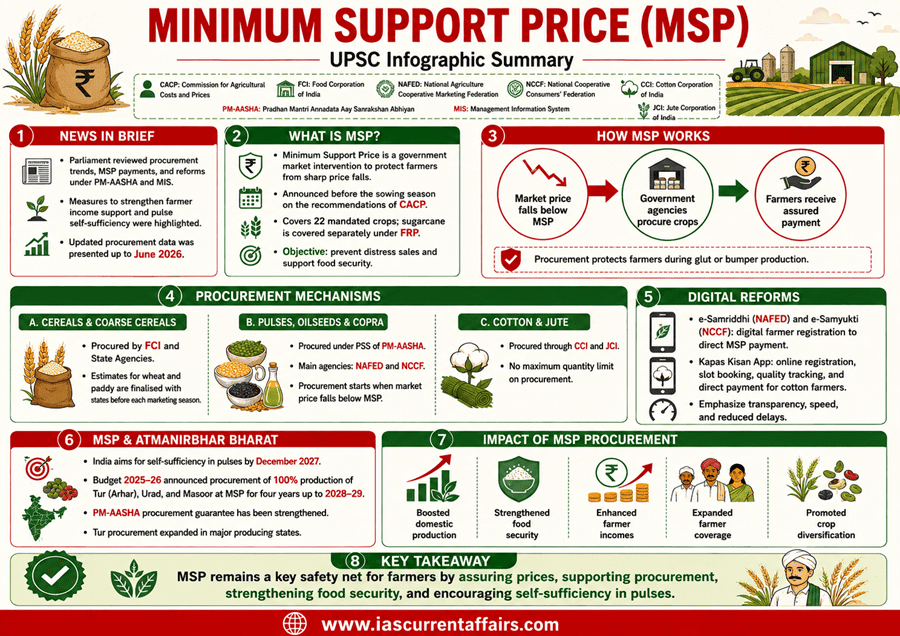
- The Minimum Support Price (MSP) is a key agricultural price support mechanism that safeguards farmers against distress sales by assuring remunerative prices for selected crops.
- Recommended by the Commission for Agricultural Costs and Prices (CACP), MSP forms the backbone of India’s procurement system, supporting farmer incomes, ensuring food security, and maintaining stable agricultural markets.
- Recent government initiatives have strengthened MSP implementation through digital procurement reforms, expanded support under PM-AASHA, and a renewed focus on achieving Atmanirbhar Bharat in pulses by promoting domestic production and reducing import dependence.
- These measures reflect the evolving role of MSP not only as an income support mechanism but also as a tool for enhancing agricultural resilience and national food security.
Why in the News?
The Government informed Parliament about the implementation of the Minimum Support Price (MSP) system for 22 notified crops.
News in Brief
- It highlighted procurement trends, MSP payments, and reforms undertaken under PM-AASHA and the Market Intervention Scheme (MIS).
- The reply also reviewed measures to strengthen farmer income support and achieve self-sufficiency in pulses.
- Updated procurement data up to June 2026 was presented in Parliament.
About Minimum Support Prices (MSP)
- Minimum Support Price (MSP) is a form of market intervention by the Government of India to insure agricultural producers against any sharp fall in farm prices.
- Announced by the Government of India at the beginning of the sowing season for certain crops on the basis of the recommendations of the Commission for Agricultural Costs and Prices (CACP).
- The Government announces support prices for 22 mandated agricultural crops, while sugarcane is covered separately under the Fair and Remunerative Price (FRP) mechanism.
- Objective– To support the farmers from distress sales and to procure food grains for public distribution.
- How it Works– In case the market price for the commodity falls below the announced minimum price due to bumper production and glut in the market, govt. agencies purchase the entire quantity offered by the farmers at the announced minimum price.
Procurement Mechanisms
Cereals and coarse cereals
- These are procured by the Food Corporation of India (FCI) and designated State Agencies.
- The procurement estimates for wheat and paddy are finalized by the Government of India in consultation with State Governments and FCI before each marketing season.
- These estimates are based on factors like estimated production, marketable surplus, and crop patterns.
Pulses, oilseeds, and copra
- Procured under the Price Support Scheme (PSS) of the umbrella scheme Pradhan Mantri Annadata Aay Sanrakshan Abhiyan (PM-AASHA), in consultation with the concerned State Government.
- Procurement is triggered when the market price of these crops falls below MSP.
- The main agencies for procurement under PM-AASHA are the National Agricultural Cooperative Marketing Federation of India Ltd. (NAFED) and the National Co-operative Consumers’ Federation of India Ltd. (NCCF).
During the 15th Finance Commission Cycle, the Government of India has approved the continuation of PM-AASHA scheme up to 2025-26.
Cotton and jute
- Procured at MSP through the Cotton Corporation of India (CCI) and the Jute Corporation of India (JCI) respectively.
- There is no maximum limit on the quantity of jute and cotton procured from farmers.
Digital Reforms in MSP Procurement
- e-Samriddhi (NAFED) and e-Samyukti (NCCF) digitise the procurement process from farmer registration to direct MSP payment, improving transparency and reducing delays.
- The Kapas Kisan App enables online registration, slot booking, quality tracking, and direct payment for cotton farmers, ensuring faster and transparent procurement.
MSP And Atmanirbhar Bharat
- India aims to achieve self-sufficiency in pulses by December 2027.
- In Budget 2025-26, the Government announced procurement of 100% of the production of Tur (Arhar), Urad and Masoor at MSP for four years (up to 2028-29).
- The PM-AASHA procurement guarantee has been enhanced to strengthen MSP-based procurement of pulses.
- The Government has expanded Tur (Arhar) procurement across major producing states, benefiting a large number of farmers.
Impact of MSP Procurement
- Boosted domestic production – Encouraged cultivation of pulses and oilseeds while reducing import dependence.
- Strengthened food security – Higher procurement of food grains ensured stable public stocks and food availability.
- Enhanced farmer incomes – Assured MSP procurement and direct payments improved income security and reduced distress sales.
- Expanded farmer coverage – Increased procurement operations enabled more farmers to benefit from the MSP framework.
- Promoted crop diversification – Greater emphasis on pulses, oilseeds, and millets supported sustainable agriculture and Atmanirbhar Bharat.
Conclusion
The MSP framework continues to provide assured price support to farmers while promoting income security.
Digital procurement reforms, targeted support for pulses and oilseeds, and improved procurement mechanisms are strengthening agricultural diversification, reducing import dependence, and advancing the goal of Atmanirbhar Bharat.
Key Takeaways
Click image to enlarge for better readability
UPSC Prelims and Mains Practice Question
Consider the following statements:
- MSP is announced for 22 mandated agricultural crops.
- CACP recommends MSP to the Government.
- Sugarcane is covered under the MSP system.
Which of the statements given above are correct?
A. 1 and 2 only
B. 2 and 3 only
C. 1 and 3 only
D. 1, 2 and 3
Answer: A
Mains Practice Question
Q. “Minimum Support Price (MSP) plays a crucial role in ensuring farmers’ income security, but procurement reforms are necessary for its equitable implementation.” Discuss. (250 Words)
Crop Diversification And Micro-Irrigation In India
Source: PIB
GS III: Major Crops – Cropping Patterns in various parts of the country, – Different Types of Irrigation and Irrigation Systems
Overview
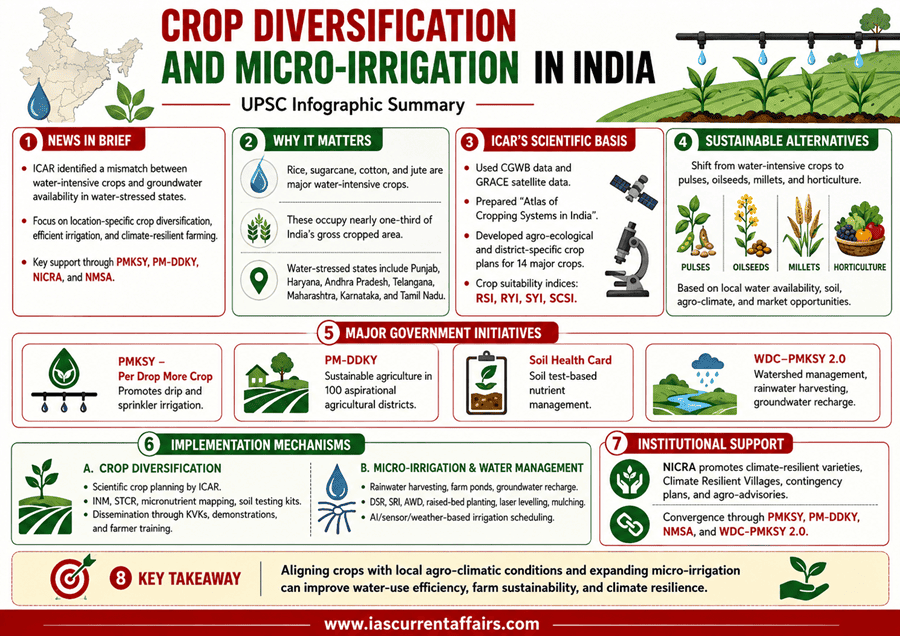
- Crop diversification and micro-irrigation are key strategies for promoting water-efficient, climate-resilient, and sustainable agriculture in India.
- Based on scientific assessments of cropping patterns and groundwater availability, ICAR is promoting location-specific cropping systems, efficient irrigation technologies, and water-saving agricultural practices.
- These efforts are supported by flagship government schemes such as PMKSY, PM-DDKY, NICRA, and NMSA, with the objective of improving water-use efficiency, conserving natural resources, and strengthening farmers’ livelihoods.
Why in the News?
The Ministry of Agriculture and Farmers’ Welfare informed Parliament about ICAR’s initiatives to promote crop diversification and micro-irrigation based on scientific assessment of cropping patterns and groundwater availability.
News in Brief
- Indian Council of Agricultural Research (ICAR) identified a mismatch between water-intensive cropping patterns and groundwater availability in several states facing water stress.
- The government highlighted location-specific crop diversification, efficient irrigation technologies, and climate-resilient farming practices to improve agricultural sustainability.
- The reply also outlined the role of flagship schemes such as PMKSY, PM-DDKY, NICRA, and NMSA in enhancing water-use efficiency and climate resilience.
ICAR’s Role in Crop Diversification and Micro-Irrigation
Scientific Basis for Crop Diversification
- ICAR studied the prevailing cropping pattern and hydrological realities in different regions of India, using Central Ground Water Board (CGWB) data and monthly gridded GRACE satellite data.
- States such Punjab, Haryana, Andhra Pradesh, Telangana, Maharashtra, Karnataka, and Tamil Nadu, show significant groundwater stress and due to water-intensive crops.
- ICAR has prepared ‘Atlas of cropping systems in India’ and also identified sustainable alternatives to cereal-dominated systems considering the prevailing agro-climatic conditions, resource availability including water availability and market opportunities.
- It has developed the agro-ecological and district specific crop plan for 14 major crops using scientific indices and groundwater assessments.
Crop suitability was assessed using,
- Relative Spread Index (RSI)
- Relative Yield Index (RYI)
- Sustainable Yield Index (SYI)
- Soil-Climate Suitability Index (SCSI)
Need for Water-efficient Agriculture
- Rice, sugarcane, cotton and jute are among the major water-intensive crops grown in India.
- These occupy nearly one-third of the country’s gross cropped area.
- ICAR’S scientific assessment identified cultivation of rice and sugarcane even in low-rainfall districts,
- This highlights the need for promoting location-specific crop diversification, while balancing water security, farmer livelihoods and agricultural productivity.
Government Initiatives
- Pilot Crop Diversification Project in 47 districts – Promoting location specific crop diversification from water-intensive crops to relatively low water-requiring crops. such as pulses, oilseeds, millets and horticultural crops, taking into account local water availability, soil characteristics, agro-climatic suitability and sustainable use of natural resources.
- Per Drop More Crop (PDMC) component of the Pradhan Mantri Krishi Sinchayee Yojana (PMKSY)- Promotes efficient use of irrigation water through adoption of drip and sprinkler irrigation systems.
- PM Dhan-Dhaanya Krishi Yojana (PM-DDKY)- Promotes sustainable agriculture in 100 aspirational agricultural districts through convergence of interventions such as crop diversification, irrigation development, post-harvest infrastructure, natural and organic farming, Integrated Pest Management (IPM) and Integrated Nutrient Management (INM).
- Soil Health Card Programme- Promotes soil test-based balanced and integrated nutrient management by providing farmers with crop-specific fertilizer recommendations for improving soil fertility and nutrient use efficiency.
- Watershed Development Component of PMKSY (WDC–PMKSY 2.0) – Promotes integrated watershed management through soil and water conservation, rainwater harvesting, groundwater recharge, restoration of degraded lands and sustainable management of natural resources.
Implementation Mechanisms
Crop Diversification
- ICAR identifies suitable cropping patterns based on scientific planning and using groundwater assessments, agro-ecological studies, and crop suitability indices to promote location-specific crop diversification.
- Promotes Integrated Nutrient Management (INM), Soil Test Crop Response (STCR) recommendations, micronutrient mapping, soil testing kits, and digital decision-support tools for balanced nutrient management.
- Technologies and best practices are disseminated through Krishi Vigyan Kendras (KVKs), frontline demonstrations, State extension agencies, and farmer training programmes.
Micro Irrigation and Water Management
- Encourages rainwater harvesting, groundwater recharge, farm ponds, conservation agriculture, protective irrigation, and micro-irrigation, supported by AI, sensor, and weather-based irrigation scheduling.
- Promotes Direct Seeded Rice (DSR), System of Rice Intensification (SRI), Alternate Wetting and Drying (AWD), raised-bed planting, laser land levelling, mulching, and drip/sprinkler irrigation to reduce water consumption while maintaining productivity.
Institutional Support
- Through NICRA (National Innovation in Climate Resilient Agriculture), ICAR promotes climate-resilient crop varieties, Climate Resilient Villages (CRVs), District Agriculture Contingency Plans, and weather-based agro-advisories to improve resilience against climate variability.
- Implementation is reinforced through flagship schemes such as PMKSY (Per Drop More Crop), PM-DDKY, NMSA (National Mission for Sustainable Agriculture), and WDC-PMKSY 2.0, ensuring convergence for sustainable agriculture and efficient natural resource management.
Conclusion
Aligning cropping patterns with local agro-climatic conditions and expanding micro-irrigation can enhance resource-use efficiency while balancing agricultural productivity, environmental sustainability, and farmers’ livelihoods.
Key Takeaways
UPSC Prelims and Mains Practice Question
With reference to crop diversification and micro-irrigation in India, consider the following statements:
- ICAR (Indian Council of Agricultural Research) uses groundwater and satellite-based assessments to recommend location-specific cropping patterns.
- The Per Drop More Crop (PDMC) component of PMKSY (Pradhan Mantri Krishi Sinchayee Yojana) promotes drip and sprinkler irrigation.
- NICRA focuses on improving climate resilience in Indian agriculture.
Which of the statements given above is/are correct?
A. 1 and 2 only
B. 2 and 3 only
C. 1, 2 and 3
D. 1 only
Answer: C. 1, 2 and 3
Mains Practice Question
Q. “Crop diversification and efficient water management are essential for ensuring sustainable agriculture in India.” Discuss the role of scientific planning, micro-irrigation, and government initiatives in achieving this objective. (250 Words)
Government Forest Conservation Schemes In India
Source: PIB
GS III: Environment, Biodiversity and Conservation
Overview
- India adopts an integrated approach to forest conservation that balances ecological protection with sustainable development.
- The framework combines participatory governance, landscape restoration, habitat conservation, forest fire management, and a robust legal framework to address emerging environmental challenges.
- These measures aim to strengthen ecosystem resilience, conserve biodiversity, enhance carbon sinks, and secure the livelihoods of forest-dependent communities.
Why in the News?
The Ministry of Environment, Forest and Climate Change informed the Lok Sabha about the Government’s initiatives for forest conservation, community participation, and sustainable forest management.
News in Brief
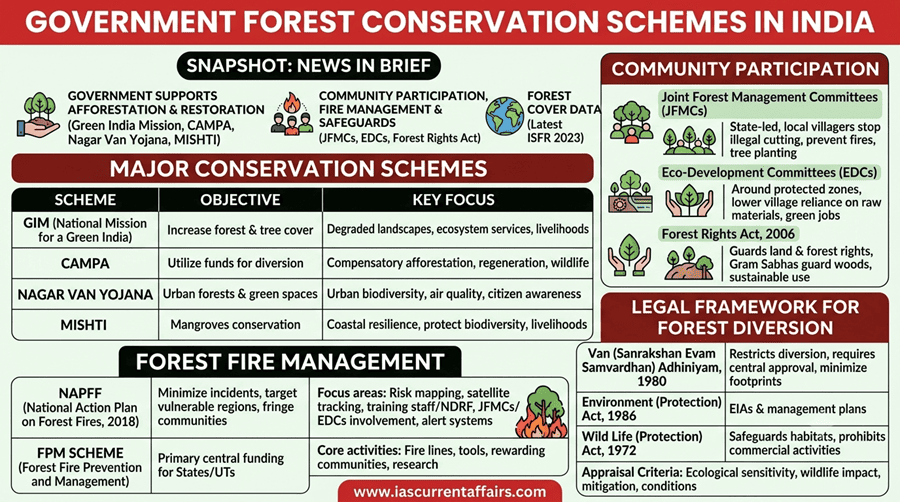
- The Government supports afforestation and restoration through schemes such as Green India Mission, CAMPA, Nagar Van Yojana, and MISHTI.
- The reply highlighted the role of local communities, major afforestation schemes, forest fire management, and safeguards for diversion of forest land.
- The Government also presented the latest forest cover data from the India State of Forest Report (ISFR) 2023.
Community Participation in Forest Conservation
Joint Forest Management Committees (JFMCs)
- State governments set up JFMCs to promote joint management.
- Local villagers help stop illegal tree cutting.
- Members assist in fighting and preventing forest fires.
- Communities take part in tree planting and fixing damaged forests.
- People learn to use forest goods in a smart, sustainable way.
Eco-Development Committees (EDCs)
- EDCs form around protected zones and wildlife parks.
- They help lower village reliance on raw forest materials.
- Programs support local wildlife protection and green jobs.
Forest Rights Act, 2006
- This law guards individual and community land and forest rights.
- Gram Sabhas gain the power to guard local woods and nature.
- Villagers manage community forest areas for sustainable use.
Major Forest Conservation Schemes
| Scheme | Objective | Key Focus |
|---|---|---|
| National Mission for a Green India (GIM) | Part of the National Action Plan on Climate Change (NAPCC) to increase forest and tree cover. | Restoration of degraded forest landscapes, enhancement of ecosystem services, and improved livelihoods for forest-dependent communities. |
| Compensatory Afforestation Fund Management and Planning Authority (CAMPA) | Utilises funds collected for diversion of forest land for non-forest purposes. | Compensatory afforestation, forest regeneration, wildlife conservation, and ecosystem restoration. |
| Nagar Van Yojana | Develops urban forests and green spaces in cities. | Enhances urban biodiversity, improves air quality, and promotes ecological awareness among citizens. |
| MISHTI (Mangrove Initiative for Shoreline Habitats & Tangible Incomes) | Conserves and restores mangrove ecosystems along India’s coastline. | Strengthens coastal resilience, protects biodiversity, supports livelihoods, and mitigates the impact of climate change and coastal erosion. |
Forest Fire Management
National Action Plan on Forest Fires (NAPFF), 2018
The Ministry of Environment, Forest and Climate Change (MoEF&CC) launched the NAPFF to minimize fire incidents by targeting vulnerable regions and engaging fringe communities (Communities living in and around forests).
- Uses risk zonation mapping, clearing of dry biomass/pine needles, and real-time satellite tracking via MODIS and INSAT managed by the Forest Survey of India (FSI).
- Trains frontline forest staff, state officials, and specialized disaster teams (including the National Disaster Response Force – NDRF).
- Empowers Joint Forest Management Committees (JFMCs), Eco-Development Committees (EDCs), and local village groups through active involvement, awareness drives, and mock drills.
- Relies on GIS, remote sensing, and SMS/email-based instant alert systems sent directly to local managers.
- Improves coordination between state forest departments, district administrations, and disaster management authorities.
Forest Fire Prevention and Management (FPM) Scheme
- The FPM Scheme is the primary funding vehicle used by the central government to support state-level execution.
- Financial Assistance: Provides dedicated funds to States and Union Territories on a cost-sharing or designated grant basis for fire control.
- Core Activities Funded
- Creation and maintenance of fire lines and water storage structures.
- Buying fire-fighting tools, protective clothing, and leaf blowers.
- Rewarding and incentivizing local communities and Van Panchayats for active protection support.
- Research, educational workshops, and post-fire ecological restoration.
Legal Framework for Mining and Forest Diversion
- Van (Sanrakshan Evam Samvardhan) Adhiniyam, 1980- Serves as the primary statute restricting the diversion of forest land for non-forest purposes, requiring prior Central Government approval, and prioritizing minimal land footprints and reduced habitat fragmentation.
- Environment (Protection) Act, 1986- Provides the overarching umbrella for environmental impact assessments (EIA) and site-specific management plans.
- Wild Life (Protection) Act, 1972– Safeguards designated wildlife habitats, prohibiting detrimental commercial activities inside and around sensitive zones.
- Core Appraisal Criteria- Focuses heavily on ecological sensitivity, direct wildlife impact, mandatory mitigation parameters, and site-specific environmental conditions.
India’s Protected Area Network
- Government data highlights a robust conservation network that safeguards biodiversity and maintains ecological connectivity across the country.
- The Protected Area network includes National Parks, Wildlife Sanctuaries, Conservation Reserves, and Community Reserves spread across 1,134 protected areas.
- India has 58 Tiger Reserves and 33 Elephant Reserves dedicated to the conservation of flagship species and their habitats.
- To maintain ecological connectivity, 32 tiger corridors and 150 elephant corridors have been identified for safe wildlife movement.
India State of Forest Report (ISFR) 2023
- The latest assessment by the Forest Survey of India reflects a gradual improvement in the country’s forest resources.
- India’s forest and tree cover stands at 8,27,356.95 sq km, accounting for 25.17% of the country’s geographical area.
- Compared with ISFR 2021, the forest and tree cover has increased by 1,445.81 sq km, indicating continued progress in afforestation and forest conservation efforts.
Way Forward and Conclusion
Achieving long-term forest sustainability requires integrating conservation priorities into development planning, strengthening community stewardship, restoring degraded ecosystems, and adopting technology-driven management practices.
Such an approach will enhance ecological resilience, protect biodiversity, and contribute to India’s climate and sustainable development goals.
Key Takeaways
UPSC Prelims and Mains Practice Question
With reference to forest conservation in India, consider the following statements:
- Gram Sabhas are empowered under the Forest Rights Act, 2006 to manage Community Forest Resources.
- CAMPA funds are used for compensatory afforestation and forest regeneration.
- MISHTI is aimed at restoring mangrove ecosystems along India’s coastline.
Which of the statements given above is/are correct?
A. 1 and 2 only
B. 2 and 3 only
C. 1 and 3 only
D. 1, 2 and 3
Answer: D
Mains Practice Question
Q. Examine the challenges in balancing developmental needs with forest conservation in India. Suggest suitable measures. (250 words)
Daily Current Affairs: Click Here