
Government Forest Conservation Schemes In India
Source: PIB
GS III: Environment, Biodiversity and Conservation
Overview
- India adopts an integrated approach to forest conservation that balances ecological protection with sustainable development.
- The framework combines participatory governance, landscape restoration, habitat conservation, forest fire management, and a robust legal framework to address emerging environmental challenges.
- These measures aim to strengthen ecosystem resilience, conserve biodiversity, enhance carbon sinks, and secure the livelihoods of forest-dependent communities.
Why in the News?
The Ministry of Environment, Forest and Climate Change informed the Lok Sabha about the Government’s initiatives for forest conservation, community participation, and sustainable forest management.
News in Brief
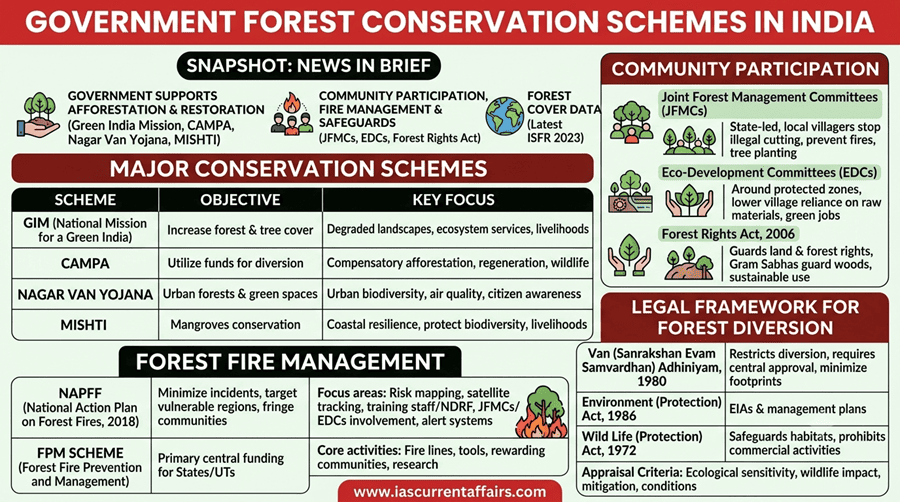
- The Government supports afforestation and restoration through schemes such as Green India Mission, CAMPA, Nagar Van Yojana, and MISHTI.
- The reply highlighted the role of local communities, major afforestation schemes, forest fire management, and safeguards for diversion of forest land.
- The Government also presented the latest forest cover data from the India State of Forest Report (ISFR) 2023.
Community Participation in Forest Conservation
Joint Forest Management Committees (JFMCs)
- State governments set up JFMCs to promote joint management.
- Local villagers help stop illegal tree cutting.
- Members assist in fighting and preventing forest fires.
- Communities take part in tree planting and fixing damaged forests.
- People learn to use forest goods in a smart, sustainable way.
Eco-Development Committees (EDCs)
- EDCs form around protected zones and wildlife parks.
- They help lower village reliance on raw forest materials.
- Programs support local wildlife protection and green jobs.
Forest Rights Act, 2006
- This law guards individual and community land and forest rights.
- Gram Sabhas gain the power to guard local woods and nature.
- Villagers manage community forest areas for sustainable use.
Major Forest Conservation Schemes
| Scheme | Objective | Key Focus |
|---|---|---|
| National Mission for a Green India (GIM) | Part of the National Action Plan on Climate Change (NAPCC) to increase forest and tree cover. | Restoration of degraded forest landscapes, enhancement of ecosystem services, and improved livelihoods for forest-dependent communities. |
| Compensatory Afforestation Fund Management and Planning Authority (CAMPA) | Utilises funds collected for diversion of forest land for non-forest purposes. | Compensatory afforestation, forest regeneration, wildlife conservation, and ecosystem restoration. |
| Nagar Van Yojana | Develops urban forests and green spaces in cities. | Enhances urban biodiversity, improves air quality, and promotes ecological awareness among citizens. |
| MISHTI (Mangrove Initiative for Shoreline Habitats & Tangible Incomes) | Conserves and restores mangrove ecosystems along India’s coastline. | Strengthens coastal resilience, protects biodiversity, supports livelihoods, and mitigates the impact of climate change and coastal erosion. |
Forest Fire Management
National Action Plan on Forest Fires (NAPFF), 2018
The Ministry of Environment, Forest and Climate Change (MoEF&CC) launched the NAPFF to minimize fire incidents by targeting vulnerable regions and engaging fringe communities (Communities living in and around forests).
- Uses risk zonation mapping, clearing of dry biomass/pine needles, and real-time satellite tracking via MODIS and INSAT managed by the Forest Survey of India (FSI).
- Trains frontline forest staff, state officials, and specialized disaster teams (including the National Disaster Response Force – NDRF).
- Empowers Joint Forest Management Committees (JFMCs), Eco-Development Committees (EDCs), and local village groups through active involvement, awareness drives, and mock drills.
- Relies on GIS, remote sensing, and SMS/email-based instant alert systems sent directly to local managers.
- Improves coordination between state forest departments, district administrations, and disaster management authorities.
Forest Fire Prevention and Management (FPM) Scheme
- The FPM Scheme is the primary funding vehicle used by the central government to support state-level execution.
- Financial Assistance: Provides dedicated funds to States and Union Territories on a cost-sharing or designated grant basis for fire control.
- Core Activities Funded
- Creation and maintenance of fire lines and water storage structures.
- Buying fire-fighting tools, protective clothing, and leaf blowers.
- Rewarding and incentivizing local communities and Van Panchayats for active protection support.
- Research, educational workshops, and post-fire ecological restoration.
Legal Framework for Mining and Forest Diversion
- Van (Sanrakshan Evam Samvardhan) Adhiniyam, 1980- Serves as the primary statute restricting the diversion of forest land for non-forest purposes, requiring prior Central Government approval, and prioritizing minimal land footprints and reduced habitat fragmentation.
- Environment (Protection) Act, 1986- Provides the overarching umbrella for environmental impact assessments (EIA) and site-specific management plans.
- Wild Life (Protection) Act, 1972– Safeguards designated wildlife habitats, prohibiting detrimental commercial activities inside and around sensitive zones.
- Core Appraisal Criteria- Focuses heavily on ecological sensitivity, direct wildlife impact, mandatory mitigation parameters, and site-specific environmental conditions.
India’s Protected Area Network
- Government data highlights a robust conservation network that safeguards biodiversity and maintains ecological connectivity across the country.
- The Protected Area network includes National Parks, Wildlife Sanctuaries, Conservation Reserves, and Community Reserves spread across 1,134 protected areas.
- India has 58 Tiger Reserves and 33 Elephant Reserves dedicated to the conservation of flagship species and their habitats.
- To maintain ecological connectivity, 32 tiger corridors and 150 elephant corridors have been identified for safe wildlife movement.
India State of Forest Report (ISFR) 2023
- The latest assessment by the Forest Survey of India reflects a gradual improvement in the country’s forest resources.
- India’s forest and tree cover stands at 8,27,356.95 sq km, accounting for 25.17% of the country’s geographical area.
- Compared with ISFR 2021, the forest and tree cover has increased by 1,445.81 sq km, indicating continued progress in afforestation and forest conservation efforts.
Way Forward and Conclusion
Achieving long-term forest sustainability requires integrating conservation priorities into development planning, strengthening community stewardship, restoring degraded ecosystems, and adopting technology-driven management practices.
Such an approach will enhance ecological resilience, protect biodiversity, and contribute to India’s climate and sustainable development goals.
Key Takeaways
UPSC Prelims and Mains Practice Question
With reference to forest conservation in India, consider the following statements:
- Gram Sabhas are empowered under the Forest Rights Act, 2006 to manage Community Forest Resources.
- CAMPA funds are used for compensatory afforestation and forest regeneration.
- MISHTI is aimed at restoring mangrove ecosystems along India’s coastline.
Which of the statements given above is/are correct?
A. 1 and 2 only
B. 2 and 3 only
C. 1 and 3 only
D. 1, 2 and 3
Answer: D
Mains Practice Question
Q. Examine the challenges in balancing developmental needs with forest conservation in India. Suggest suitable measures. (250 words)
Daily Current Affairs: Click Here