


Minimum Support Price (MSP)
Source: PIB
GS III: Issues related to Direct and Indirect Farm Subsidies and Minimum Support Prices
Overview
- The Minimum Support Price (MSP) is a key agricultural price support mechanism that safeguards farmers against distress sales by assuring remunerative prices for selected crops.
- Recommended by the Commission for Agricultural Costs and Prices (CACP), MSP forms the backbone of India’s procurement system, supporting farmer incomes, ensuring food security, and maintaining stable agricultural markets.
- Recent government initiatives have strengthened MSP implementation through digital procurement reforms, expanded support under PM-AASHA, and a renewed focus on achieving Atmanirbhar Bharat in pulses by promoting domestic production and reducing import dependence.
- These measures reflect the evolving role of MSP not only as an income support mechanism but also as a tool for enhancing agricultural resilience and national food security.
Why in the News?
The Government informed Parliament about the implementation of the Minimum Support Price (MSP) system for 22 notified crops.
News in Brief
- It highlighted procurement trends, MSP payments, and reforms undertaken under PM-AASHA and the Market Intervention Scheme (MIS).
- The reply also reviewed measures to strengthen farmer income support and achieve self-sufficiency in pulses.
- Updated procurement data up to June 2026 was presented in Parliament.
About Minimum Support Prices (MSP)
- Minimum Support Price (MSP) is a form of market intervention by the Government of India to insure agricultural producers against any sharp fall in farm prices.
- Announced by the Government of India at the beginning of the sowing season for certain crops on the basis of the recommendations of the Commission for Agricultural Costs and Prices (CACP).
- The Government announces support prices for 22 mandated agricultural crops, while sugarcane is covered separately under the Fair and Remunerative Price (FRP) mechanism.
- Objective– To support the farmers from distress sales and to procure food grains for public distribution.
- How it Works– In case the market price for the commodity falls below the announced minimum price due to bumper production and glut in the market, govt. agencies purchase the entire quantity offered by the farmers at the announced minimum price.
Procurement Mechanisms
Cereals and coarse cereals
- These are procured by the Food Corporation of India (FCI) and designated State Agencies.
- The procurement estimates for wheat and paddy are finalized by the Government of India in consultation with State Governments and FCI before each marketing season.
- These estimates are based on factors like estimated production, marketable surplus, and crop patterns.
Pulses, oilseeds, and copra
- Procured under the Price Support Scheme (PSS) of the umbrella scheme Pradhan Mantri Annadata Aay Sanrakshan Abhiyan (PM-AASHA), in consultation with the concerned State Government.
- Procurement is triggered when the market price of these crops falls below MSP.
- The main agencies for procurement under PM-AASHA are the National Agricultural Cooperative Marketing Federation of India Ltd. (NAFED) and the National Co-operative Consumers’ Federation of India Ltd. (NCCF).
During the 15th Finance Commission Cycle, the Government of India has approved the continuation of PM-AASHA scheme up to 2025-26.
Cotton and jute
- Procured at MSP through the Cotton Corporation of India (CCI) and the Jute Corporation of India (JCI) respectively.
- There is no maximum limit on the quantity of jute and cotton procured from farmers.
Digital Reforms in MSP Procurement
- e-Samriddhi (NAFED) and e-Samyukti (NCCF) digitise the procurement process from farmer registration to direct MSP payment, improving transparency and reducing delays.
- The Kapas Kisan App enables online registration, slot booking, quality tracking, and direct payment for cotton farmers, ensuring faster and transparent procurement.
MSP And Atmanirbhar Bharat
- India aims to achieve self-sufficiency in pulses by December 2027.
- In Budget 2025-26, the Government announced procurement of 100% of the production of Tur (Arhar), Urad and Masoor at MSP for four years (up to 2028-29).
- The PM-AASHA procurement guarantee has been enhanced to strengthen MSP-based procurement of pulses.
- The Government has expanded Tur (Arhar) procurement across major producing states, benefiting a large number of farmers.
Impact of MSP Procurement
- Boosted domestic production – Encouraged cultivation of pulses and oilseeds while reducing import dependence.
- Strengthened food security – Higher procurement of food grains ensured stable public stocks and food availability.
- Enhanced farmer incomes – Assured MSP procurement and direct payments improved income security and reduced distress sales.
- Expanded farmer coverage – Increased procurement operations enabled more farmers to benefit from the MSP framework.
- Promoted crop diversification – Greater emphasis on pulses, oilseeds, and millets supported sustainable agriculture and Atmanirbhar Bharat.
Conclusion
The MSP framework continues to provide assured price support to farmers while promoting income security.
Digital procurement reforms, targeted support for pulses and oilseeds, and improved procurement mechanisms are strengthening agricultural diversification, reducing import dependence, and advancing the goal of Atmanirbhar Bharat.
Key Takeaways
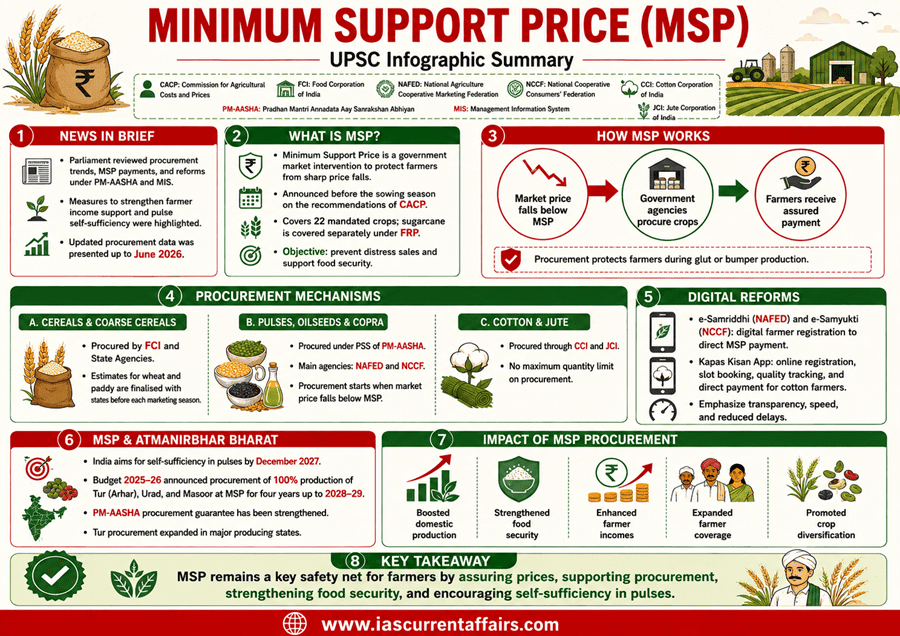
Click image to enlarge for better readability
UPSC Prelims and Mains Practice Question
Consider the following statements:
- MSP is announced for 22 mandated agricultural crops.
- CACP recommends MSP to the Government.
- Sugarcane is covered under the MSP system.
Which of the statements given above are correct?
A. 1 and 2 only
B. 2 and 3 only
C. 1 and 3 only
D. 1, 2 and 3
Answer: A
Mains Practice Question
Q. “Minimum Support Price (MSP) plays a crucial role in ensuring farmers’ income security, but procurement reforms are necessary for its equitable implementation.” Discuss. (250 Words)
Daily Current Affairs: Click Here