


Daily Current Affairs 10 August 2026 – IAS Current Affairs
Current Affairs 10 August 2026 focuses on the Prelims-Mains perspective. Major events are :
PAIMANA: Digital Infrastructure Monitoring In India
Source: PIB
GS II: Governance, GS III: Infrastructure
Overview
- PAIMANA represents a shift towards technology-enabled and data-driven infrastructure governance in India.
- Developed by MoSPI, it brings project monitoring, infrastructure data and performance assessment onto a common digital framework.
- Its expanded approach goes beyond tracking expenditure and physical progress to examine access, quality, utilisation, affordability and fiscal performance.
- This can improve project implementation, public expenditure management and evidence-based planning.
- However, its effectiveness depends on reliable data, inter-agency coordination, digital capacity and standardised reporting systems.
- Overall, PAIMANA can strengthen infrastructure governance by linking investment, implementation and outcomes.
Why in the News?
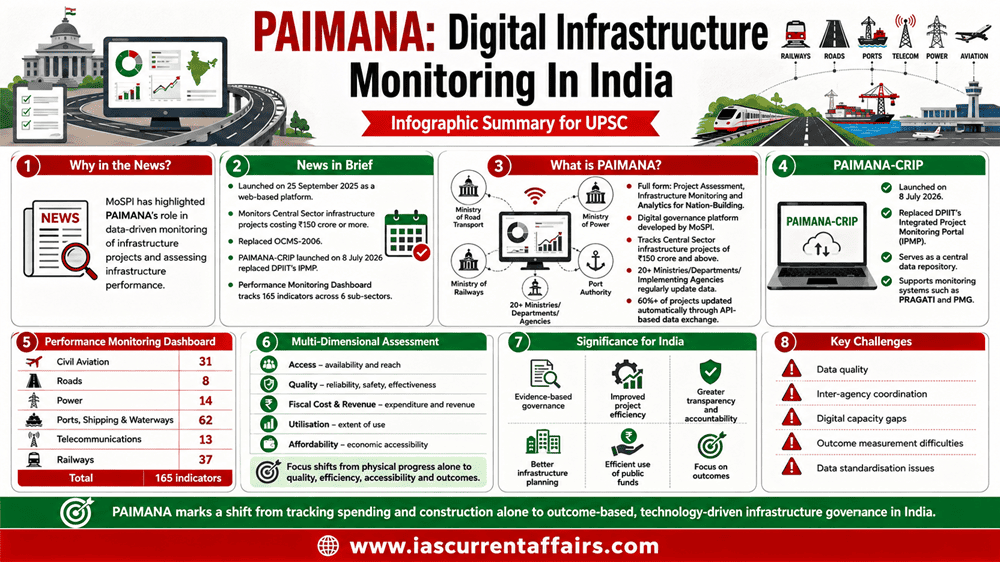
The Ministry of Statistics and Programme Implementation (MoSPI) has highlighted the role of PAIMANA (Project Assessment, Infrastructure Monitoring and Analytics for Nation-Building) in strengthening data-driven monitoring of infrastructure projects and assessing infrastructure performance.
News in Brief
- PAIMANA was launched on 25 September 2025 as a web-based platform for monitoring Central Sector infrastructure projects costing ₹150 crore or more.
- It replaced the earlier OCMS-2006 (Online Computerized Monitoring System).
- PAIMANA-CRIP, launched on 8 July 2026, replaced DPIIT’s Integrated Project Monitoring Portal (IPMP) and is intended to evolve as a Central Repository of Infrastructure Projects.
- Its Performance Monitoring Dashboard tracks infrastructure performance through 165 indicators across six major sub-sectors.
PAIMANA (Project Assessment, Infrastructure Monitoring and Analytics for Nation-Building)
- It is a digital governance platform developed by MoSPI (Ministry of Statistics and Programme Implementation) to track Central Sector infrastructure projects costing ₹150 crore and above.
- More than 20 Ministries/Departments/Implementing Agencies regularly update project information.
- Over 60% of projects are updated automatically through API-based data exchange.
PAIMANA – CRIP
- Launched on 8 July 2026 to replace DPIIT’s Integrated Project Monitoring Portal (IPMP).
- It serves as a central data repository supporting monitoring mechanisms such as PRAGATI and PMG.
Performance Monitoring Dashboard
- Launched on 16 April 2026, it moves beyond merely tracking project expenditure and physical progress.
- It assesses infrastructure performance through sector-specific indicators covering,
- Civil Aviation – 31 indicators
- Roads – 8
- Power – 14
- Ports, Shipping & Waterways – 62
- Telecommunications – 13
- Railways – 37
- Total: 165 indicators.
Multi-Dimensional Assessment
- The revamped PAIMANA approach assesses infrastructure on multiple dimensions rather than focusing only on project completion.
- Access- Availability and reach of infrastructure to users.
- Quality- Reliability, safety and effectiveness of infrastructure services.
- Fiscal Cost & Revenue- Public expenditure involved and revenue generated.
- Utilisation- Extent to which the available infrastructure is being used.
- Affordability- Economic accessibility of infrastructure services to users.
- The approach shifts infrastructure monitoring from physical output and expenditure tracking towards quality, efficiency, accessibility and outcomes.
Significance for India
- Evidence-based governance- PAIMANA provides updated project information, allowing governments to base infrastructure decisions on actual implementation data rather than relying only on periodic reports.
- Improved project efficiency– Regular monitoring can help identify delays, cost overruns and other implementation bottlenecks at an early stage, allowing corrective measures to be taken.
- Greater transparency and accountability– A common digital monitoring framework brings information from different ministries and agencies onto a common platform, making project implementation easier to track.
- Better infrastructure planning– Data collected across sectors can help policymakers compare performance, identify gaps and plan future infrastructure investments according to actual requirements.
- Efficient use of public funds- Monitoring expenditure along with utilisation and performance helps assess whether public investment is translating into effective infrastructure services.
- Focus on outcomes– The framework goes beyond measuring how much infrastructure has been created.
- It also considers access, quality, utilisation and affordability, giving a better picture of its actual benefits.
Challenges
- Data quality- The effectiveness of the system depends on the accuracy and reliability of data provided by implementing agencies.
- Inter-agency coordination- Different ministries and agencies need compatible systems for smooth data sharing.
- Digital capacity- Some agencies may lack adequate technological infrastructure and technical expertise.
- Outcome measurement- Indicators such as quality, utilisation and affordability are more difficult to measure than physical progress.
- Data standardisation- Differences in data formats and reporting practices can affect comparability across sectors.
Way Forward and Conclusion
PAIMANA marks a move towards data-driven and outcome-oriented infrastructure governance in India. By integrating project monitoring with performance assessment, it can improve implementation efficiency, transparency and public resource utilisation.
Strengthening data quality, inter-agency coordination and digital capacity will be essential to realise its full potential.
Key Takeaways
UPSC Prelims and Mains Practice Question
Consider the following statements regarding PAIMANA:
- It is developed by the Ministry of Statistics and Programme Implementation.
- It monitors Central Sector infrastructure projects costing ₹150 crore and above.
- Its Performance Monitoring Dashboard covers only transport-related infrastructure sectors.
- PAIMANA-CRIP is envisaged to evolve as a Central Repository of Infrastructure Projects.
Which of the statements given above are correct?
(a) 1, 2 and 4 only
(b) 1 and 3 only
(c) 2, 3 and 4 only
(d) 1, 2, 3 and 4
Answer: (a) 1, 2 and 4 only
Mains Practice Question
Q. Data-driven monitoring can significantly improve the efficiency and accountability of infrastructure development in India. Discuss the role of PAIMANA in this context. Also examine the challenges involved in adopting technology-driven infrastructure governance. (250 Words)
AISHE Report: Growth And Asymmetries In India’s Higher Education
Source: Indian Express
GS II: Issues relating to Education
Overview
- India’s higher education sector has witnessed significant quantitative expansion in institutions, enrolment and private participation, reflecting the transition towards mass higher education.
- However, this growth remains uneven, with regional, gender, disciplinary and skill-related disparities affecting the quality and inclusiveness of educational opportunities.
- The emerging challenge is therefore to move beyond expanding access and focus on quality, affordability, employability, research and equity.
- In this context, the NEP 2020 provides a policy framework for strengthening India’s higher education system and developing a skilled and inclusive human capital base.
Why in the News?
The latest All India Survey on Higher Education (AISHE) data by the Ministry of Education highlights the rapid expansion of India’s higher-education system.
News in Brief
- India’s higher-education system has entered an era of massification, with expansion in institutions and student enrolment.
- Private universities and institutions have expanded rapidly, increasing their role in higher education.
- Expansion is uneven across states, disciplines and social groups, indicating that access has not translated uniformly into equitable opportunities.
- The challenge is increasingly shifting from merely creating more seats to ensuring quality, employability and equitable access.
Ministry of Education has endeavoured to conduct an annual web-based All India Survey on Higher Education (AISHE) since 2010-11.
Key Highlights
Massification of Higher Education
- Higher education has expanded considerably in terms of:
- Number of universities and colleges
- Student enrolment
- Availability of professional and specialised programmes.
- This represents a shift from elite higher education to mass higher education.
- However, quantitative expansion alone does not guarantee better learning outcomes or employment.
Rapid Expansion of Private Universities
- Private universities have become an important driver of institutional expansion.
- Between 2013-14 and 2023-24, the number of privately managed universities increased from 219 to 546 — nearly 149% growth.
- Private universities therefore expanded much faster than government universities.
- Concern- Rapid private-sector expansion raises questions regarding affordability, regulation, quality assurance and geographical concentration.
Regional Asymmetry
- The Gross Enrollment Ratio (GER) in higher education has increased over the years, indicating greater participation of the 18–23 age group.
- However, higher education opportunities remain unevenly distributed across states.
- Factors behind regional disparities,
- Differences in economic development
- Unequal institutional infrastructure
- Variations in faculty availability
- Urban concentration of quality institutions
- Differences in state expenditure on education.
- Implication– Students from economically weaker and educationally backward regions may face restricted access to high-quality higher education.
Gender Dimension
- The Gender Parity Index (GPI) has improved, reflecting India has made considerable progress in women’s participation in higher education.
- Female participation has increased significantly in several undergraduate disciplines.
- However, gender disparities continue in STEM, technical education and higher academic positions.
- For example, engineering and technology continue to show a considerable male dominance.
Discipline-Wise Imbalance
- Student preferences are increasingly concentrated in certain disciplines.
- BA continues to have very high enrolment.
- Computing and technology-related disciplines are gaining popularity.
- Traditional engineering branches coexist with rapidly growing computing-oriented fields.
Skill-Mismatch
- Skills imparted through higher education do not always align with evolving industry and labour-market requirements.
- This gap can reduce the employability of graduates despite rising degree attainment.
- Implication- Higher enrolment and educational attainment may not necessarily translate into productive employment.
NEP 2020- Towards Quality and Inclusive Higher Education
- The expansion of higher education, along with persistent quality, employability and regional disparities, highlights the need for reforms envisioned under the National Education Policy (NEP) 2020.
- The policy seeks to,
- Increase higher-education GER to 50% by 2035.
- Promote multidisciplinary education.
- Strengthen research and innovation.
- Improve vocational education.
- Increase institutional autonomy.
- Promote internationalisation of higher education.
- Reduce fragmentation of higher-education institutions.
Way Forward and Conclusion
India needs to move from “expansion of seats” to “expansion with quality and equity.” This requires greater public investment, addressing regional gaps in institutions and faculty, strengthening accreditation and quality regulation, expanding affordable and multidisciplinary education, and integrating vocational learning with academic education.
Aligning curricula with emerging employment opportunities, strengthening research and university–industry linkages, improving women’s participation in STEM, and using technology judiciously can help ensure that higher-education expansion translates into employability, innovation and inclusive human-capital development.
Key Takeaways

UPSC Prelims and Mains Practice Question
Consider the following statements regarding the All India Survey on Higher Education (AISHE):
- AISHE is conducted by the Ministry of Education.
- It collects data on students, teachers and institutional infrastructure in higher education.
- The Gross Enrolment Ratio (GER) in higher education is calculated for the 14–18 years age group.
Which of the statements given above is/are correct?
(a) 1 only
(b) 1 and 2 only
(c) 2 and 3 only
(d) 1, 2 and 3
Answer: (b) 1 and 2 only
Mains Practice Question
Q. India’s higher education system has witnessed significant quantitative expansion, but regional, institutional and disciplinary asymmetries continue to persist. Discuss the major challenges associated with this transformation and suggest measures to ensure equitable and quality higher education. (250 Words)
Digital Agriculture Mission In India
Source: PIB
GS III: Agriculture, E-technology in the aid of farmers, Technology Missions.
Overview
- Digital Agriculture Mission in India represents the shift from conventional, fragmented agricultural administration towards a data-driven and technology-enabled ecosystem.
- At its core, AgriStack creates digital farmer and land-related records, while initiatives such as the Digital Crop Survey, YES-TECH and DGCES improve the quality of crop and yield information.
- These initiatives aim to improve farmer service delivery, credit and insurance access, crop-yield estimation and agricultural policymaking.
- However, the transition must remain inclusive and farmer-centric, with safeguards against exclusion, inaccurate land records, privacy violations and cybersecurity threats.
- Thus, the real measure of digital agriculture will be not merely the creation of digital databases, but their ability to deliver accessible, accurate and accountable agricultural services to farmers.
Why in the News?
The Ministry of Agriculture and Farmers Welfare highlighted the implementation of AgriStack and digital agriculture initiatives.
News in Brief
- Farmer IDs are being created by integrating farmer details with digitised land records.
- Digital Crop Surveys are being used to capture plot-level information on crops cultivated.
- Technology-based crop-yield estimation is being promoted through initiatives such as YES-TECH.
- As of 3 August 2026, more than 10.31 crore Farmer IDs had been created across India.
Agristack
- AgriStack is a digital agricultural ecosystem designed to create a comprehensive profile of farmers, including:
- Farmer details
- Digitised land records
- Crops cultivated
- Livestock and fisheries assets
Three Foundational Registries
- Farmer Registry– Issues a unique 11-digit digital identity (Farmer ID) linking basic demographics with verified land ownership.
- Geo-Referenced Village Maps– Precision maps linking farm plot boundaries and geographic coordinates to specific land records.
- Crop Sown Registry- Seasonal database compiled through smartphone-based digital crop surveys tracking actual crop cultivation.
- These registries are created and maintained by States/UTs.
Key Objectives & Services
- Direct Benefit Transfers- Eliminates intermediaries, ensuring fertilizer subsidies, PM-KISAN, and MSP procurement funds reach genuine owners.
- Easy Credit & Insurance- Banks and fintechs use verified digital credentials for faster Kisan Credit Card (KCC) loans and risk-assessed crop insurance (PMFBY).
- AI & Precision Farming- Integrates with platforms like Bharat-VISTAAR to deliver real-time, localized advisories on weather, soil health, and pest management.
Farmer ID
- Farmer ID is generated by synchronising farmer information with digitised land records.
- Over 10.31 crore Farmer IDs had been generated as of 3 August 2026.
- It can facilitate access to agricultural credit, insurance, procurement and other government services.
Digital Crop Survey (DCS)
- The Digital Crop Survey (DCS) is an initiative by India’s Ministry of Agriculture and Farmers Welfare designed to capture information on crops cultivated on agricultural plots.
- DCS relies on geo-fencing, high-resolution satellite imagery, and mobile-based interfaces to log real-time crop data right from the field.
- The survey successfully expanded to cover 648 districts.
- States like Karnataka have begun piloting advanced versions like the Composite Digital Crop Survey (CDCS) which introduces AI, drones, and Synthetic Aperture Radar (SAR) for ultimate validation accuracy.
Data Governance and Privacy
- The Farmer Registry uses a federated architecture where States own the data.
- Data collection requires consent, and farmers control sharing.
- The system stores encrypted data, complies with the Digital Personal Data Protection Act (DPDP) 2023 and Rules 2025, and follows MeitY and CERT-In cybersecurity guidelines.
Technology in Crop Insurance
- Under the YES-TECH initiative of the Pradhan Mantri Fasal Bima Yojana (PMFBY), technology-based yield estimation blends remote sensing models, satellite data, Machine Learning and Artificial Intelligence (AI) with traditional methods like Crop Cutting Experiments.
- It is actively applied to paddy, wheat, and soybean to make crop loss assessments faster and more transparent.
Digital General Crop Estimation System
- The Digital General Crop Estimation System (DGCES) is a key nationwide digital initiative launched by the Government of India.
- It uses mobile applications and web portals to conduct scientifically designed Crop Cutting Experiments (CCEs), providing reliable, plot-level, and timely crop-yield data to improve national agricultural production estimates.
Significance
For Farmers
- Faster access to credit- Enables paperless crop loans and institutional financing.
- Simplified scheme delivery- Facilitates direct delivery of subsidies, PM-KISAN payouts and disaster relief.
- Better insurance and procurement- Enables faster verification for MSP-based crop selling and insurance claims.
- Personalised advisories- Provides farming insights and weather updates based on real-time data.
- Enhanced advisory support- Helps farmers make informed decisions and access credit faster.
For Government
- Accurate agricultural data- Uses geo-referenced plots and automated digital records to improve crop and yield estimation.
- Evidence-based policymaking- Provides live agricultural statistics for food-security planning, market forecasting and disaster response.
- Better scheme delivery- Improves the transparency and speed of MSP, crop insurance and credit-linked programmes.
- Reduced errors- Digital processes can minimise manual estimation errors and human intervention.
- Improved risk assessment- Better crop and land information strengthens agricultural risk management.
For Agriculture Sector
- Data-driven crop planning- Helps map fragmented landholdings and identify crops and crop varieties.
- Better yield estimation- Replaces conventional manual approaches with technology-based and field-level crop assessment.
- Improved resource management- Supports better decisions on production, markets, credit and insurance.
- Integrated agricultural ecosystem- Connects farmer data with credit, insurance, procurement and advisory services.
Challenges
Digital Agriculture in India faces major challenges including,
Farm Access and Equity
- Digital divide- Small and marginal farmers lack smartphones, high-speed internet, and digital literacy.
- Exclusion errors- Wrong data in digital portals can block genuine farmers from getting welfare schemes and subsidies.
- Uneven infrastructure- Rural areas in different states have huge gaps in power supply and network coverage.
Data and System Security
- Land records- Ownership data is often outdated, disputed, or poorly mapped.
- Privacy concerns- Farmers share personal and land data without clear, informed consent.
- Cybersecurity risks- Centralized agricultural databases face threats of data theft and hacking.
- System interoperability- Different state and national farm databases cannot share or read each other’s data easily.
Way Forward & Conclusion
Digital agriculture can make Indian agriculture more data-driven, transparent and farmer-centric by integrating land, crop, credit, insurance and welfare-related information.
However, its success will depend on accurate databases, data privacy, cybersecurity, digital inclusion and effective coordination between the Centre and States.
Key Takeaways

UPSC Prelims and Mains Practice Question
Consider the following statements
- AgriStack includes facilitating access to agricultural credit, crop insurance and other farmer services.
- AI and Machine Learning are being explored for crop-yield estimation under YES-TECH.
- The Digital Crop Survey is intended to capture information on crops cultivated on agricultural plots.
Which of the statements given above is/are correct?
A. 1 and 2 only
B. 2 and 3 only
C. 1 and 3 only
D. 1, 2 and 3
Answer: D
Mains Practice Question
Q. Discuss the potential of digital technologies in transforming agricultural governance and improving the delivery of services to farmers in India. (250 Words)
Daily Current Affairs: Click Here