
PAIMANA: Digital Infrastructure Monitoring In India
Source: PIB
GS II: Governance, GS III: Infrastructure
Overview
- PAIMANA represents a shift towards technology-enabled and data-driven infrastructure governance in India.
- Developed by MoSPI, it brings project monitoring, infrastructure data and performance assessment onto a common digital framework.
- Its expanded approach goes beyond tracking expenditure and physical progress to examine access, quality, utilisation, affordability and fiscal performance.
- This can improve project implementation, public expenditure management and evidence-based planning.
- However, its effectiveness depends on reliable data, inter-agency coordination, digital capacity and standardised reporting systems.
- Overall, PAIMANA can strengthen infrastructure governance by linking investment, implementation and outcomes.
Why in the News?
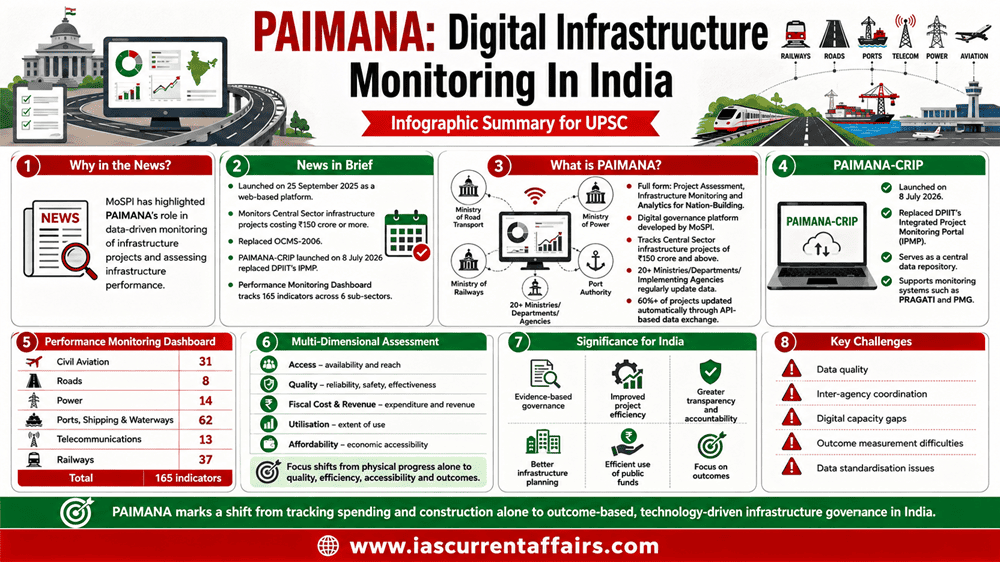
The Ministry of Statistics and Programme Implementation (MoSPI) has highlighted the role of PAIMANA (Project Assessment, Infrastructure Monitoring and Analytics for Nation-Building) in strengthening data-driven monitoring of infrastructure projects and assessing infrastructure performance.
News in Brief
- PAIMANA was launched on 25 September 2025 as a web-based platform for monitoring Central Sector infrastructure projects costing ₹150 crore or more.
- It replaced the earlier OCMS-2006 (Online Computerized Monitoring System).
- PAIMANA-CRIP, launched on 8 July 2026, replaced DPIIT’s Integrated Project Monitoring Portal (IPMP) and is intended to evolve as a Central Repository of Infrastructure Projects.
- Its Performance Monitoring Dashboard tracks infrastructure performance through 165 indicators across six major sub-sectors.
PAIMANA (Project Assessment, Infrastructure Monitoring and Analytics for Nation-Building)
- It is a digital governance platform developed by MoSPI (Ministry of Statistics and Programme Implementation) to track Central Sector infrastructure projects costing ₹150 crore and above.
- More than 20 Ministries/Departments/Implementing Agencies regularly update project information.
- Over 60% of projects are updated automatically through API-based data exchange.
PAIMANA – CRIP
- Launched on 8 July 2026 to replace DPIIT’s Integrated Project Monitoring Portal (IPMP).
- It serves as a central data repository supporting monitoring mechanisms such as PRAGATI and PMG.
Performance Monitoring Dashboard
- Launched on 16 April 2026, it moves beyond merely tracking project expenditure and physical progress.
- It assesses infrastructure performance through sector-specific indicators covering,
- Civil Aviation – 31 indicators
- Roads – 8
- Power – 14
- Ports, Shipping & Waterways – 62
- Telecommunications – 13
- Railways – 37
- Total: 165 indicators.
Multi-Dimensional Assessment
- The revamped PAIMANA approach assesses infrastructure on multiple dimensions rather than focusing only on project completion.
- Access- Availability and reach of infrastructure to users.
- Quality- Reliability, safety and effectiveness of infrastructure services.
- Fiscal Cost & Revenue- Public expenditure involved and revenue generated.
- Utilisation- Extent to which the available infrastructure is being used.
- Affordability- Economic accessibility of infrastructure services to users.
- The approach shifts infrastructure monitoring from physical output and expenditure tracking towards quality, efficiency, accessibility and outcomes.
Significance for India
- Evidence-based governance- PAIMANA provides updated project information, allowing governments to base infrastructure decisions on actual implementation data rather than relying only on periodic reports.
- Improved project efficiency– Regular monitoring can help identify delays, cost overruns and other implementation bottlenecks at an early stage, allowing corrective measures to be taken.
- Greater transparency and accountability– A common digital monitoring framework brings information from different ministries and agencies onto a common platform, making project implementation easier to track.
- Better infrastructure planning– Data collected across sectors can help policymakers compare performance, identify gaps and plan future infrastructure investments according to actual requirements.
- Efficient use of public funds- Monitoring expenditure along with utilisation and performance helps assess whether public investment is translating into effective infrastructure services.
- Focus on outcomes– The framework goes beyond measuring how much infrastructure has been created.
- It also considers access, quality, utilisation and affordability, giving a better picture of its actual benefits.
Challenges
- Data quality- The effectiveness of the system depends on the accuracy and reliability of data provided by implementing agencies.
- Inter-agency coordination- Different ministries and agencies need compatible systems for smooth data sharing.
- Digital capacity- Some agencies may lack adequate technological infrastructure and technical expertise.
- Outcome measurement- Indicators such as quality, utilisation and affordability are more difficult to measure than physical progress.
- Data standardisation- Differences in data formats and reporting practices can affect comparability across sectors.
Way Forward and Conclusion
PAIMANA marks a move towards data-driven and outcome-oriented infrastructure governance in India. By integrating project monitoring with performance assessment, it can improve implementation efficiency, transparency and public resource utilisation.
Strengthening data quality, inter-agency coordination and digital capacity will be essential to realise its full potential.
Key Takeaways
UPSC Prelims and Mains Practice Question
Consider the following statements regarding PAIMANA:
- It is developed by the Ministry of Statistics and Programme Implementation.
- It monitors Central Sector infrastructure projects costing ₹150 crore and above.
- Its Performance Monitoring Dashboard covers only transport-related infrastructure sectors.
- PAIMANA-CRIP is envisaged to evolve as a Central Repository of Infrastructure Projects.
Which of the statements given above are correct?
(a) 1, 2 and 4 only
(b) 1 and 3 only
(c) 2, 3 and 4 only
(d) 1, 2, 3 and 4
Answer: (a) 1, 2 and 4 only
Mains Practice Question
Q. Data-driven monitoring can significantly improve the efficiency and accountability of infrastructure development in India. Discuss the role of PAIMANA in this context. Also examine the challenges involved in adopting technology-driven infrastructure governance. (250 Words)
Daily Current Affairs: Click Here