


Daily Current Affairs 12 August 2026 – IAS Current Affairs
Current Affairs 12 August 2026 focuses on the Prelims-Mains perspective. Major events are :
Financial Inclusion In India
Source: PIB
GS III: Indian Economy, Inclusive Growth
Overview
- India has made significant progress in building an inclusive financial ecosystem through expanded banking infrastructure, digital payments, social-security protection and formal credit.
- Government initiatives have particularly improved the participation of unbanked and underserved sections in the financial system.
- The focus is now shifting from mere access to effective and informed usage, supported by financial literacy, digital infrastructure and consumer-oriented services.
- Sustaining this progress requires greater attention to financial capability, digital security, responsible lending and equitable access, thereby making financial inclusion a stronger driver of inclusive growth.
Why in the News?
PIB highlighted India’s progress in financial inclusion through banking access, digital payments, social security, inclusive credit and financial literacy.
News in Brief
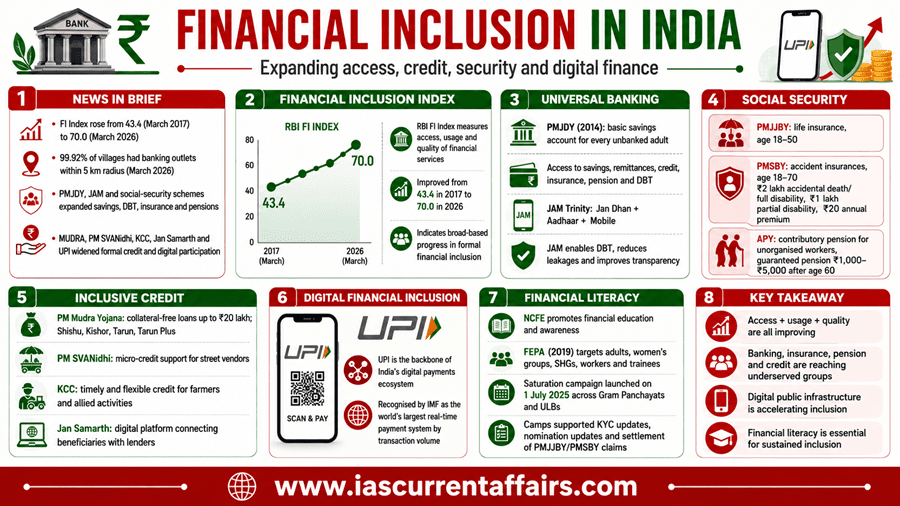
- India’s Financial Inclusion Index rose from 43.4 in March 2017 to 70.0 in March 2026, reflecting improvement in access, usage and quality of financial services.
- Banking outreach has expanded substantially, with 99.92% of villages having banking outlets within a 5-km radius as of March 2026.
- PMJDY, JAM Trinity and social-security schemes have strengthened access to savings, DBT, insurance and pension services, particularly for underserved sections.
- MUDRA, PM SVANidhi, KCC and Jan Samarth have widened access to formal credit, while UPI has accelerated digital financial participation.
Key Highlights
- The RBI’s FI Index measures the extent of financial inclusion across access, usage and quality of financial services.
- It serves as a comprehensive indicator of progress in expanding formal financial services nationwide.
- The FI Index increased from 43.4 in March 2017 to 70.0 in March 2026, reflecting broad-based improvements across all three dimensions.
Universal Banking
Pradhan Mantri Jan – Dhan Yojana (PMJDY)
- PMJDY (2014) provides every unbanked adult with a basic savings bank account where minimum balance needs to be maintained.
- It offers access to savings, remittances, credit, insurance, pension and Direct Benefit Transfer (DBT).
- It facilitates enrolment under Pradhan Mantri Jeevan Jyoti Bima Yojana (PMJJBY), Pradhan Mantri Suraksha Bima Yojana (PMSBY), Atal Pension Yojana (APY), and access to MUDRA loans.
JAM Trinity – Jan Dhan + Aadhaar + Mobile
- The JAM Trinity Integrates Jan Dhan accounts, Aadhaar and mobile connectivity to strengthen financial inclusion.
- It enables Direct Benefit Transfer (DBT) for transparent and efficient delivery of government benefits.
- DBT reduces leakages, eliminates fake beneficiaries and minimises intermediaries in welfare delivery.
- The JAM Trinity strengthens formal banking access and promotes trust in digital financial services.
Improved Social Security
Pradhan Mantri Jeevan Jyoti Bima Yojana (PMJJBY)
- PMJJBY (2015) is an annual renewable life insurance scheme- 18 to 50 years.
- It provides financial security to families in the event of the insured person’s death.
- The scheme provides immediate cover for accidental death and a 30-day waiting period for non-accidental death.
Pradhan Mantri Suraksha Bima Yojana (PMSBY)
- PMSBY (2015) is also an annual renewable accident insurance scheme- 18 to 70 years.
- It provides ₹2 lakh cover for accidental death or full disability, and ₹1 lakh for partial disability.
- The insurance is available at an annual premium of ₹20 which is auto-debited from the linked bank account.
Atal Pension Yojana (APY)
- APY (2015) is a contributory pension scheme for workers in the unorganised sector, launched in 2015.
- It provides a guaranteed monthly pension ranging from ₹1,000 to ₹5,000 after attaining 60 years of age.
Inclusive Credit
PM Mudra Yojana
- PM Mudra Yojana (2015) provides collateral-free loans up to ₹20 lakh to non-corporate, non-farm micro and small enterprises across manufacturing, trading, services, and allied agricultural activities.
- Mudra loans are extended for a wide range of activities that promote income generation and employment creation.
- It offers four loan categories based on enterprise growth: Shishu, Kishor, Tarun and Tarun Plus.
- PM SVANidhi is a first-of-its-kind micro-credit initiative focused on street vendors with government-backed credit guarantee support.
- The scheme offers interest subsidy and credit guarantee support to eligible street vendors.
Kisan Credit Card (KCC)
- KCC provides timely and adequate credit to farmers through the banking system.
- It offers an ATM-enabled debit card, one-time documentation and flexible withdrawals.
- KCC provides credit for crop cultivation, post-harvest needs, marketing, farm maintenance, household expenses and allied activities.
Jan Samarth
- Jan Samarth is a unified digital platform for credit-linked government schemes.
- It connects beneficiaries directly with lenders, simplifying access to government-sponsored credit.
Digital Financial Inclusion
Unified Payment Interface (UPI)
- UPI has emerged as the backbone of India’s digital payments ecosystem, driving financial inclusion and digital transactions.
- The IMF has recognised UPI as the world’s largest real-time payment system by transaction volume, highlighting India’s digital public infrastructure leadership.
Financial Literacy
National Centre for Financial Education (NCFE)
- The centre promotes financial education and awareness across all sections of society under the National Strategy for Financial Education.
- It conducts seminars, workshops, training programmes and awareness campaigns to strengthen financial literacy.
- It also develops targeted financial education materials covering financial markets and digital financial services
Financial Education Programme for Adults (FEPA)
- FEPA was launched in September 2019 by NCFE to promote financial awareness among adults.
- The programme covers farmers, women’s groups, ASHA and Anganwadi workers, SHGs, employees and skill development trainees.
- It focuses on Special Focused Districts (SFDs), aligned with the National Strategy for Financial Education.
Nationwide Financial Inclusion Saturation Campaign
- The four-month campaign was launched on 1 July 2025 to expand financial inclusion across Gram Panchayats and Urban Local Bodies (ULBs).
- Financial inclusion camps were organised across villages and towns to improve access to formal financial services.
- The campaign facilitated KYC re-verification and nomination updates, strengthening account management and beneficiary access.
- Insurance claims under PMJJBY and PMSBY were settled, improving access to social-security benefits.
Conclusion
India’s financial inclusion journey has moved beyond bank account ownership towards meaningful participation in the formal financial system. Expanded banking networks, digital infrastructure and targeted government schemes have improved access to savings, credit, insurance and pension services.
PMJDY, JAM, social-security initiatives and inclusive credit mechanisms have strengthened financial resilience, while digital payments and financial literacy are enabling wider and more informed participation. Together, these measures are contributing to a more accessible, resilient and inclusive financial ecosystem that supports inclusive growth.
Key Takeaways
UPSC Prelims and Mains Practice Question
Consider the following pairs
| Scheme/Initiative | Primary Objective |
|---|---|
| 1. Pradhan Mantri Jan-Dhan Yojana (PMJDY) | Providing universal access to basic banking and financial services |
| 2. Pradhan Mantri Jeevan Jyoti Bima Yojana (PMJJBY) | Providing affordable life insurance cover to eligible subscribers |
| 3. Atal Pension Yojana (APY) | Providing guaranteed pension support, especially to workers in the unorganised sector |
How many of the above pairs are correctly matched?
(a) Only one
(b) Only two
(c) All three
(d) None
Answer: (c) All three
Mains Practice Question
Q. “Financial inclusion is not merely about opening bank accounts but about ensuring meaningful and sustainable participation in the formal financial system.” Discuss the role of digital public infrastructure and government schemes in achieving this objective. (250 Words)
Precision Agriculture In India
Source: PIB
GS III: Agriculture – E-technology in aid of farmers
Overview
- Precision agriculture is becoming an important approach to make Indian agriculture more productive, resource-efficient and climate-resilient.
- ICAR’s Network Programme on Precision Agriculture brings together multiple research institutes to develop technologies suited to Indian conditions.
- The approach integrates AI, IoT, sensors, drones, remote sensing, GIS and satellite data across crop production, fisheries and livestock management.
- Applications range from precision irrigation and nutrient management to disease surveillance, smart aquaculture and automated farming systems.
- ICAR and KVKs are also focusing on farmer adoption through demonstrations, training, capacity building and digital advisory services.
- Precision agriculture can support the transition towards sustainable, technology-enabled and climate-resilient farming, particularly by making advanced technologies more accessible to small and marginal farmers.
Why in the News?
ICAR’s Network Programme on Precision Agriculture brings together 16 research institutes to develop precision technologies suited to Indian farming conditions.
News in Brief
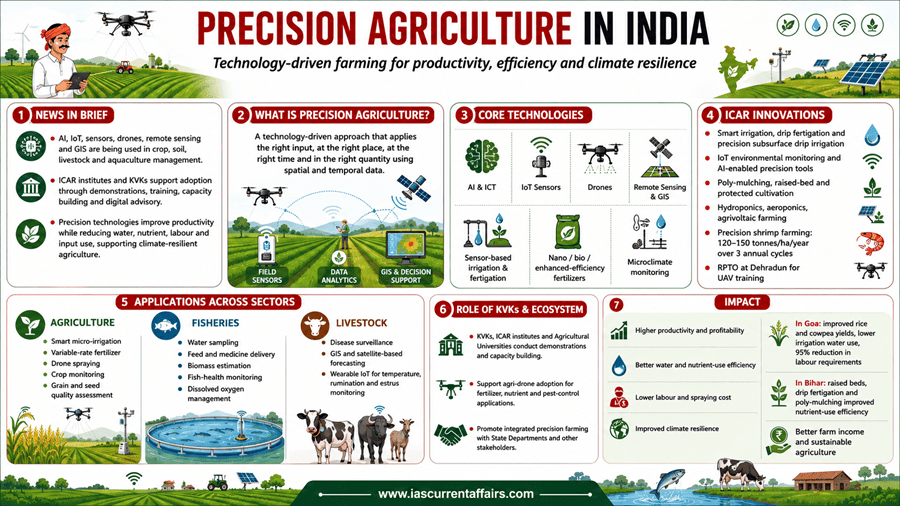
- AI, IoT, sensors, drones, remote sensing and GIS are being applied across crop, soil, livestock and aquaculture management.
- ICAR institutes and KVKs are supporting technology adoption through demonstrations, training, capacity building and digital advisory services.
- Precision technologies have improved productivity while reducing water, nutrient, labour and input requirements, strengthening climate-resilient agriculture.
Precision Agriculture
- ICAR is promoting precision agriculture by combining AI, IoT and ICT with conventional farming practices.
- These technologies are being used to monitor crops, assess crop health and manage natural resources more efficiently.
- Drones are used for crop monitoring and precise application of agricultural inputs, while remote sensing, GIS and satellite data help in crop assessment and resource mapping.
- Sensor-based irrigation and fertigation systems support better management of water and nutrients, complemented by the use of enhanced-efficiency fertilizers, nano-fertilizers and biofertilizers.
- ICAR has also developed tools such as the Dweep Microclimate Monitor and AI-based models for assessing water stress and managing livestock.
- To support wider adoption, a Remote Pilot Training Organisation (RPTO) at Dehradun has been established for UAV training, while ICAR Institutes, AICRPs and KVKs provide demonstrations, farmer training, capacity building and digital advisory services.
Precision Agriculture- A technology-driven approach that uses spatial and temporal data to apply the right input, at the right place, at the right time and in the right quantity.
Technologies Developed and Validated by ICAR
- Irrigation & Water Management– Sensor-based irrigation, drip fertigation, precision subsurface drip irrigation and other water-efficient irrigation technologies.
- Digital & Smart Technologies– IoT-enabled environmental monitoring, AI-enabled precision planters, remote sensing and GIS applications, and drone-based spraying.
- Advanced Cultivation practices– Poly-mulching, raised-bed cultivation, modified raised and sunken conservation beds, agro-aqua land configuration and low-cost protected cultivation.
- Modern Farming Systems– Hydroponics, aeroponics, agrivoltaic farming and automated livestock management systems.
- These technologies aim to improve productivity, resource-use efficiency and sustainability, particularly in smallholder farming systems.
- Precision Aquaculture- ICAR has developed and demonstrated a tank-based super-intensive precision shrimp farming system.
- It integrates smart automation, strict biosecurity and eco-efficient management and yields 120–150 tonnes/ha/year over three annual cycles.
AI, IoT and Sensor Applications in Agriculture, Fisheries and Livestock
Agriculture
- ICAR has developed AI-, sensor- and IoT-based technologies for smart micro-irrigation, variable-rate fertilizer application, jute grading, cold-room management, aflatoxin detection, banana supply-chain traceability, fruit-quality monitoring, grain analysis, seed-quality assessment and computer-vision-based crop and ginning assessment.
- Drone demonstrations covered 230 ha and benefited 2,487 farmers, while drones and mobile apps are also used to demonstrate AI-based fertilizer and pesticide spraying.
Fisheries
- AI and drones are being used for water sampling, feed and medicine distribution, biomass estimation, fish-health monitoring and transportation.
- ICAR has also developed an IoT-based dissolved oxygen management system and uses AI and Big Data for fisheries resource assessment and prediction.
- Automated systems are being used for smart production and hatcheries.
Livestock
- AI, IoT sensors, drones and satellite imagery are being used for disease surveillance, biosecurity and livestock management.
- ICAR-NIVEDI uses GIS, satellite data and machine-learning models to forecast 15 economically important livestock diseases up to two months in advance.
- Wearable IoT devices monitor body temperature, rumination and estrus cycles, enabling early detection of health problems.
Krishi Vigyan Kendra (KVK)
- The KVK scheme promotes the adoption of new technologies in agriculture and allied sectors, including agri-drones, through technology assessment, demonstrations and farmer capacity building.
- KVKs, ICAR Institutes and Agricultural Universities conduct agri-drone demonstrations for nutrient, fertilizer and pest-control applications.
- These institutions also support farmers through field demonstrations, technology assessment and capacity development to encourage wider adoption of agri-drones.
Integrated Precision Farming Ecosystem
- ICAR promotes an integrated precision farming ecosystem by developing location-specific technologies for precision irrigation, nutrient management, protected cultivation, mechanization, digital decision support and climate-smart agriculture.
- These technologies are being disseminated through field demonstrations, farmer training, capacity building programmes and collaboration with State Departments, Krishi Vigyan Kendras (KVKs) and other stakeholders to facilitate their adoption by farmers.
Impact on Productivity, Profitability and Resource Efficiency
- Precision agriculture technologies have improved productivity, profitability, resource-use efficiency and climate resilience.
- Precision irrigation, including solar-powered systems, farm ponds and micro-irrigation, has improved cropping intensity, crop diversification and farmer incomes while reducing dependence on diesel and electricity.
- In Goa, precision agriculture improved rice and cowpea yields while significantly reducing irrigation water use and 95% of labour requirements.
- Farm pond-based rainwater harvesting has increased crop yields, while polyhouse cultivation combined with automated drip irrigation and fertigation has improved farm returns.
- In Bihar, raised beds, drip fertigation and poly-mulching improved nutrient-use efficiency.
- Drip irrigation and protected cultivation have reduced water requirements, while hydroponics further improves water-use efficiency.
- Drone-based foliar nutrient application has improved crop yields, reduced spraying costs and enabled faster, more uniform application while minimizing crop damage.
- Overall, these technologies help increase farm income, optimize water and fertilizer use, reduce production costs and promote sustainable, climate-resilient agriculture.
Conclusion
Precision agriculture can help Indian farming move towards higher productivity, efficient resource use and greater climate resilience.
Wider adoption of AI, IoT, drones and other digital technologies, supported by farmer training and field-level demonstrations, can make these benefits more accessible to small and marginal farmers.
Key Takeaways
UPSC Prelims and Mains Practice Question
Consider the following statements regarding precision farming in Agriculture
- The ICAR Network Programme on Precision Agriculture (ICAR-NePPA) involves multiple ICAR research institutes and focuses on technologies such as AI, IoT, sensors and remote sensing.
- Precision agriculture applications are limited to crop production and do not extend to livestock or aquaculture.
- ICAR uses AI, IoT sensors, drones and satellite imagery for livestock disease surveillance and management.
Which of the statements given above is/are correct?
(a) 1 and 2 only
(b) 1 and 3 only
(c) 2 and 3 only
(d) 1, 2 and 3
Answer: (b) 1 and 3 only
Mains Practice Question
Q. Precision agriculture can simultaneously improve farm productivity, resource-use efficiency, and climate resilience. Discuss the opportunities and challenges of its adoption in India. (250 Words)
National Farm Mechanisation Policy
Source: PIB
GS III: Agriculture- Technology Missions
Overview
- India is promoting agricultural mechanisation through financial support, shared machinery services, technology and private-sector participation.
- The focus is on improving machinery access for small and marginal farmers facing high ownership costs and small landholdings.
- Key initiatives include SMAM, CRM, MIDH and AIF, supported by agricultural mechanisation research through ICAR.
- The broader aim is to make mechanisation productive, affordable and sustainable while reducing farm drudgery.
- International cooperation supports research, technology transfer and capacity building in agricultural mechanisation.
Why in the News?
The Ministry of Agriculture & Farmers Welfare highlighted measures being implemented to promote agricultural mechanisation, particularly for small and marginal farmers.
News in Brief
- The government’s mechanisation approach seeks to address the low level of farm power availability and the challenges posed by India’s predominantly small and fragmented holdings.
- Agricultural mechanisation is being complemented by R&D, private-sector participation and domestic manufacturing, including support for agri-startups developing machinery and digital solutions.
- India also undertakes bilateral and multilateral cooperation in agricultural mechanisation through research, technology transfer, capacity building and exchange of expertise.
Key Highlights
Sub-Mission on Agricultural Mechanization (SMAM)
- It is centrally sponsored scheme under the umbrella of Rashtriya Krishi Vikas Yojana (RKVY) .
- It aims to increase the reach of farm mechanization to small and marginal farmers and to the regions where availability of farm power is low.
- Promote ‘Custom Hiring Centers’ to offset the adverse economies of scale arising due to small land holding and high cost of individual ownership of agricultural machines.
- Encourage adoption of modern farm machinery, including precision agriculture tools, drones and other advanced mechanization technologies and women-friendly farm implements.
- Under SMAM, farmers receive 40–50% financial assistance for purchasing agricultural machinery and equipment.
- The scheme also provides 40% assistance for establishing Custom Hiring Centres (CHCs) for projects costing up to ₹250 lakh, while Farm Machinery Banks (FMBs) receive 80% assistance for projects up to ₹30 lakh. In the North-Eastern States, assistance for FMBs is higher at 95% of the project cost.
Crop Residue Management (CRM) Scheme
- The CRM Scheme aims to reduce stubble burning by promoting sustainable crop residue management through the provision of subsidized agricultural machinery, establishment of Custom Hiring Centres (CHCs), including other measures.
- Implemented in the State of Punjab, Haryana, Uttar Pradesh, Madhya Pradesh and NCT of Delhi.
Mission for Integrated Development of Horticulture (MIDH)
- Under this mission Horticulture mechanization is promoted to improve farm efficiency and reduce drudgery of farm work force.
- Provide assistance for procurement of power operated machines and tools including plant protection equipment including import of new machines.
Agriculture Infrastructure Fund (AIF)
- Support is provided in the form of interest subvention, credit guarantee coverage, and medium to long term debt financing for eligible agriculture infrastructure projects like CHCs and FMBs.
Indian Council of Agricultural Research (ICAR)
- ICAR undertakes Research and Development in agricultural mechanization.
- Reviews global technological developments and adopts suitable innovations and best practices, wherever appropriate, to improve the efficiency, productivity and sustainability of Indian agriculture.
Foreign Direct Investment (FDI)
- The Government permits 100% Foreign Direct Investment (FDI) under the automatic route in the agricultural machinery manufacturing sector.
- This encourage global Original Equipment Manufacturers (OEMs) to establish domestic production units.
- This promotes domestic manufacturing, strengthens the agricultural machinery ecosystem and facilitates the induction of advanced technologies in Indian agriculture.
Private-Sector Participation- Agri Startups
- Participation of domestic and private sector enterprises in manufacturing, innovation, and mechanization services are also encouraged to accelerate the adoption of modern agricultural technologies.
- The Agri Startups develops innovative agricultural machinery and digital mechanization solutions.
- They receive support through incubation, innovation challenges and funding under RKVY- Remunerative Approaches for Agriculture and Allied Sector Rejuvenation (RAFTAAR) programme.
- The Government promotes private-sector-led mechanization service delivery through CHCs and machinery rental platforms, allowing farmers to hire equipment instead of purchasing it.
- The Government has also simplified testing and certification procedures for agricultural machinery to promote quality standards and ensure faster market access for manufacturers.
Bilateral and Multilateral Cooperation
- International cooperation in the field of agriculture, including agricultural mechanization, is undertaken with various countries.
- Such cooperation encompasses collaborative research, technology transfer, capacity building, exchange of expertise, and other mutually agreed activities in accordance with the provisions of the respective agreements.
Conclusion
A farmer-centric approach to mechanisation, supported by affordable access to modern technology, shared machinery services and capacity building, can enhance farm productivity while reducing cultivation costs and drudgery.
Strengthening such interventions can make agricultural mechanisation more inclusive, efficient and sustainable.
Key Takeaways

UPSC Prelims and Mains Practice Question
Consider the following statements regarding agricultural mechanisation in India:
- SMAM is implemented under the Rashtriya Krishi Vikas Yojana (RKVY).
- Custom Hiring Centres (CHCs) enable farmers to access agricultural machinery without purchasing it individually.
- The Government permits 100% FDI under the automatic route in agricultural machinery manufacturing.
Which of the statements given above is/are correct?
(a) 1 only
(b) 1 and 2 only
(c) 2 and 3 only
(d) 1, 2 and 3
Answer: (d) 1, 2 and 3
Mains Practice Question
Q. “Agricultural mechanisation can play a significant role in improving farm productivity and reducing the cost of cultivation in India. Discuss the challenges and suggest measures to promote inclusive agricultural mechanisation.” (250 Words)
Tribunals Reforms Bill, 2026
Source: Indian Express
GS II: Separation of Powers between various organs Dispute Redressal Mechanisms and Institutions.
Overview
- The Tribunals Reforms Bill, 2026 seeks to overhaul India’s tribunal system by creating a uniform and transparent framework for appointments, tenure and service conditions.
- A key proposal is the National Tribunals Commission (NTC), which would provide centralised administrative oversight, monitor tribunal performance and improve accountability.
- The Bill also introduces time-bound appointments and standardised service rules to address vacancies and delays.
- At the broader level, tribunal reforms aim to deliver specialised and speedy justice, while addressing concerns relating to executive influence, judicial independence and separation of powers.
Why in the News?
Parliament passed the Tribunals Reforms Bill, 2026 proposing a new commission for national tribunals.
News in Brief
- The bill seeks to establish a uniform framework and standards for tribunals.
- Proposed with the goal to ensure transparent selection and appointment of Chairpersons and Members.
- The bill provides clear and uniform qualifications, tenure, and service conditions.
- Aims to improve efficiency, independence, transparency and institutional governance.
Key Highlights
- The Tribunals Reforms Bill, 2026 replaces the 2021 Act after several of its provisions were challenged in court over concerns about separation of powers and judicial independence.
- It establishes an independent National Tribunal Commission (NTC) to handle transparent appointments, tenure oversight, and service conditions across central tribunals.
- Addresses executive dominance and judicial independence.
- The bill aims to provide speedy justice by targeting high case pendency and prolonged vacancies through structured administrative timelines.
- Issue of adequate representation of SC/ST communities were raised during the Parliamentary discussions.
- Government responded it by noting historical gaps in top-tier judicial representation while asserting that ongoing administrative frameworks continue to expand avenues and opportunities for marginalized and tribal groups across public governance role.
National Tribunals Commission (NTC)
- NTC functions as a centralized statutory authority to oversee the functioning of tribunals and bring greater uniformity to their administration.
- It will consists of five members,
- A Chairperson who is a former Supreme Court judge or former Chief Justice of a High Court
- Two Judicial Members
- Two Technical Members
- The NTC will play a role in appointments, performance monitoring and disciplinary matters.
- It will maintain a National Tribunals Data Grid to track tribunal functioning and performance, supporting data-based monitoring and greater accountability.
Selection and Service Rules
- Search-cum-Selection Committees- Employs specialized search-cum-selection committees to recommend candidates for tribunal posts.
- Mandatory Waitlists- Replaces older dual-name recommendation panels and requires selection committees to propose one primary candidate plus one waiting-list candidate per vacancy.
- Binding Timelines- Directs the government to finalize appointments within a three-month window upon receiving recommendations.
- Tenure and age limits- Standardizes a fixed term of office (up to five years or a specified upper age limit).
Administrative Tribunals
- Established under Article 323A to resolve disputes related to the recruitment and service conditions of Public Servants.
- The Central Administrative Tribunal (CAT) deals with Central Government employees, while State Administrative Tribunal (SAT) deal with State Government employees.
- Matters concerning defence personnel and staff of High Courts are generally outside their jurisdiction.
Other Tribunals
- Established under Article 323B to deal with specific areas requiring specialised expertise.
- They may cover matters such as taxation, industrial disputes, land reforms, foreign exchange and related economic issues.
- Examples include the Income Tax Appellate Tribunal and the National Green Tribunal.
Highlighted Issues with Tribunals
- Faces long delays due to unfilled vacancies and a shortage of staff.
- Relies heavily on executive control for member appointments and tenure.
- Struggles with the constant legal question of whether they weaken judicial independence.
- Excessive executive control may raise concerns about the judicial independence and separation of powers.
Need for Tribunalisation
- Reduces heavy case backlogs in regular high courts and civil courts.
- Brings in subject experts alongside judicial members to judge technical cases.
- Offers faster and cheaper justice using simple rules instead of rigid court procedures.
Conclusion
Effective tribunalisation requires a clear division of responsibilities, professional functioning and strong accountability mechanisms.
The proposed reforms can help create a more coherent and reliable dispute-resolution system, while preserving the constitutional role of the judiciary.
Key Takeaways

UPSC Prelims and Mains Practice Question
Consider the following statements regarding tribunals in India:
- Article 323A deals with administrative tribunals concerning recruitment and service matters of public servants.
- Article 323B provides for tribunals dealing with specified matters such as taxation, industrial disputes and land reforms.
- The National Tribunals Commission is proposed to function as a central authority for the administrative oversight of tribunals.
Which of the statements given above is/are correct?
(a) 1 and 2 only
(b) 2 and 3 only
(c) 1 and 3 only
(d) 1, 2 and 3
Answer: (d) 1, 2 and 3
Mains Practice Question
Q. “Tribunalisation of justice seeks to provide specialised and efficient dispute resolution, but has raised concerns regarding institutional autonomy and judicial independence. Discuss the need for reforms in India’s tribunal system.” (250 Words)
Daily Current Affairs: Click Here