
Guru Ravidas and the Ravidassia Community
Source: Indian Express
GS I: Salient features of Indian Society, Diversity of India, Social Empowerment, GS-II: Fundamental Rights, Governance
Overview
- News in Brief
- Guru Ravidas
- Ravidassia Religion: Origin And History
Why in the News?
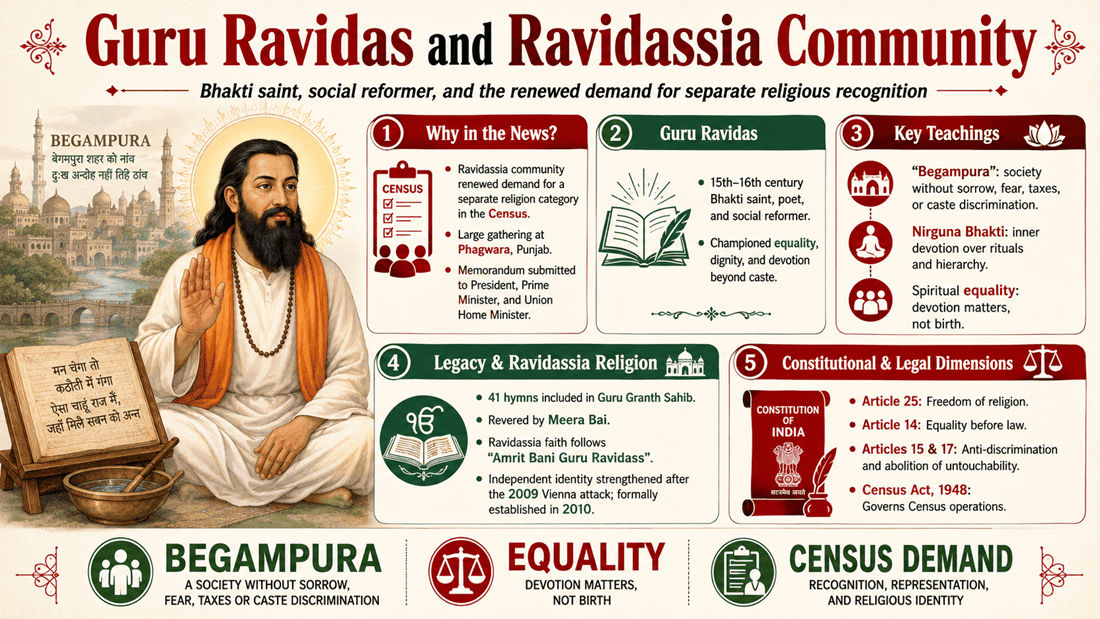
The Ravidassia community has renewed its demand for a separate religion category in the upcoming Census.
News in Brief
- Thousands of members of the Ravidassia community gathered at Phagwara, Punjab, and renewed their long-standing demand for a separate “Ravidassia religion” category in the Census.
- The programme, organized by the Akhil Bharatiya Ravidassia Dharam Sangathan, was attended by the head of Dera Sachkhand Ballan, the community’s largest religious institution.
- The gathering submitted a memorandum to the President, Prime Minister, and Union Home Minister, reviving the debate over separate religious recognition ahead of the Punjab Assembly elections.
Guru Ravidas
Guru Ravidas (also known as Raidas) was an influential 15th to 16th-century Indian mystic poet-saint, social reformer, and spiritual leader who played a pivotal role in the northern Indian Bhakti movement.
Key Teachings & Philosophy
- Egalitarian Society– He envisioned Begampura—a utopian “city without sorrow” free from grief, taxes, fear, and caste-based discrimination.
- Nirguna Bhakti– He rejected external rituals, idol worship, and rigid religious hierarchies in favour of inner purity and direct personal devotion.
- Spiritual Equality– Belonging to a marginalized leather-working community, he broke caste barriers by proving that spiritual enlightenment depends on devotion, not birth or social status.
Literary & Religious Legacy
- Sikhism Integration– A profound testament to his universal relevance is the inclusion of 41 of his devotional hymns and verses in the Guru Granth Sahib, the holy scripture of Sikhism.
- Prominent Disciples– The iconic Rajput princess and mystic poetess Meera Bai revered Guru Ravidas as her spiritual guide.
- Ravidassia Religion– His philosophy forms the bedrock of the 21st-century Ravidassia religion, which follows the holy book Amrit Bani Guru Ravidass.
- Panch Vani- Many of his poems are also preserved in the Panchvani tradition of the Hindu Dadupanthi sect.
- Annual Commemoration– His birth anniversary is celebrated annually as Guru Ravidas Jayanti on Magh Purnima (the full moon day of the January–February ).
Ravidassia Religion: Origin And History
- The Ravidassia religion is a distinct faith centered around the teachings of the 15th-century mystic poet-saint Guru Ravidas.
- Followers advocate for Begampura, an egalitarian society free of sorrow, fear, and caste divisions
- Emphasises equality, social justice, dignity, and devotion.
- While rooted in the broader Sikh tradition, the Ravidassia identity emerged as an independent faith following attacks on spiritual leaders at the Dera Sachkhand Ballan dera (temple) in Vienna in 2009.
- Following this tragic event the community formally established its own identity as Ravidassia in 2010.
Constitutional & Legal Dimensions
- Article 25 – Freedom of conscience and free profession, practice and propagation of religion.
- Article 14 – Equality before law.
- Articles 15 & 17 – Prohibition of discrimination and abolition of untouchability.
- Census Act, 1948 – Governs Census operations in India.
Key Takeaways
UPSC Prelims and Mains Practice Question
Consider the following statements regarding the Ravidassia community:
- The Ravidassia religion traces its origins to the teachings of Guru Ravidas, a Bhakti saint.
- The demand for a separate religion category seeks official recognition of Ravidassia as a distinct religion in the Census.
- The Dera Sachkhand Ballan is a major religious institution associated with the Ravidassia community.
Which of the statements given above are correct?
A. 1, 2 and 3 only
B. 1 and 3 only
C. 2, and 3 only
D. 1, and 2 only
Answer: A
Mains Practice Question
Q. “Identity-based demands in a diverse society pose both opportunities and challenges for democratic governance.” Discuss.
Daily Current Affairs: Click Here