
AI Data Centres: Need, Challenges And Way Forward
Source: Indian Express
GS III: Infrastructure, Environment, Science & Technology
Overview
- News in Brief
- Need for Responsible Data Centre Regulation
- Challenges
- Global Best Practices
Why in the News?
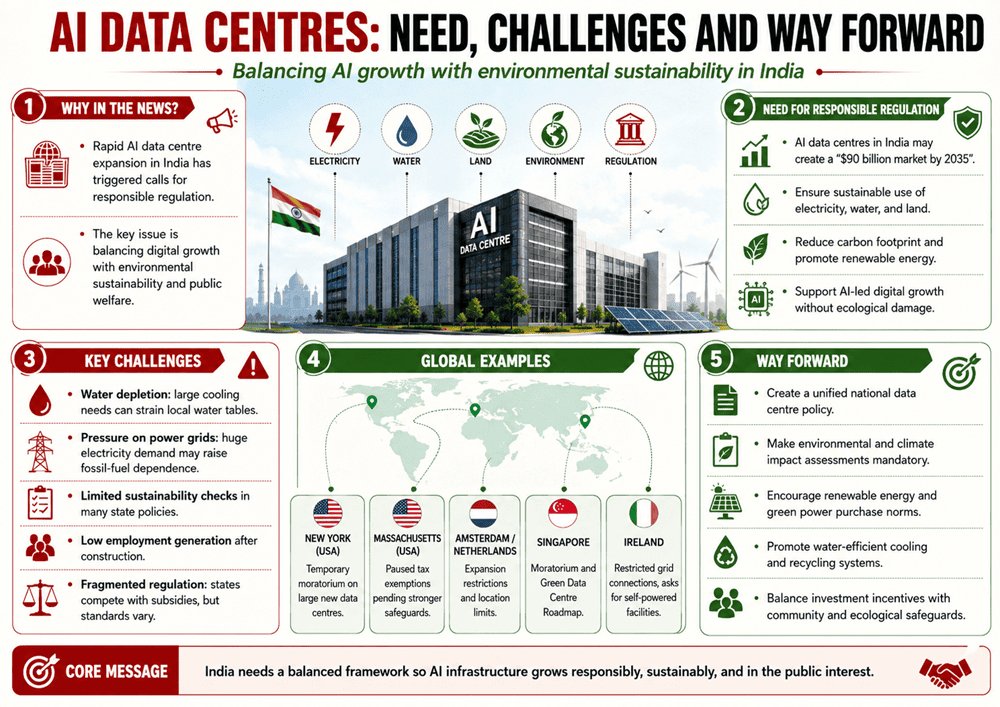
The rapid expansion of AI data centres in India has sparked debate on the need for a responsible regulatory framework to balance digital growth with environmental sustainability.
News in Brief
- Several countries are tightening regulations due to concerns over electricity, water use, and environmental impacts.
- India is encouraging investments through state incentives but needs safeguards to ensure responsible and sustainable expansion.
- The issue raises concerns over balancing AI growth with environmental sustainability and public welfare.
Need for Responsible Data Centre Regulation
- India urgently needs responsible data centre regulation in the AI era.
- Rapid AI-driven data centre expansion is projected to create a $90 billion market by 2035.
- Unchecked state-level incentives are prioritising infrastructure expansion over ecological sustainability.
- A balanced regulatory framework is needed to,
- Ensure sustainable use of electricity, water, and land.
- Minimise environmental and carbon footprint.
- Promote renewable energy and resource-efficient infrastructure.
- Support AI-led digital growth.
Challenges
Environmental and Resource Pressures
- Water depletion– Data centres require large amounts of water for liquid cooling, which threatens local communities in a water-stressed nation.
- For example, facilities in Uttar Pradesh have drastically depleted local water tables from 30 meters down to 250 meters.
- Pressure on power grids– AI Data Centres demand massive amounts of electricity, increasing fossil-fuel reliance and higher consumer power costs unless strict green energy mandates are enforced.
- Limited Sustainability Checks- Most state policies lack strong environmental and climate impact assessments.
Socio-Economic Realities
- Low Employment Generation– Hyperscale data centres demand huge footprints of land and resources, but create very few long-term, permanent local jobs after construction is complete.
- Fragmented Regulation– India lacks a unified national data centre framework, leaving individual states to compete through aggressive subsidies without uniform environmental standards.
Global Best Practices
- New York (USA) – Imposed a one-year moratorium on large new data centres due to concerns over power costs, water use, and local infrastructure.
- Massachusetts (USA) – Paused data-centre tax exemptions until stronger safeguards and a responsible regulatory framework are established.
- Amsterdam (Netherlands) – Banned new data centres and expansions until at least 2030.
- Netherlands – Restricted hyperscale data centres to only two designated locations nationwide.
- Singapore – Imposed a moratorium (2019–2022) and later adopted a restrictive quota system under its Green Data Centre Roadmap.
- Ireland – Suspended new data-centre grid connections around Dublin and requires new facilities to provide their own on-site power generation.
Way Forward & Conclusion
India should adopt a balanced regulatory framework that promotes AI innovation while ensuring efficient use of energy, water, and land.
Sustainable data-centre policies will strengthen digital growth, environmental protection, and long-term economic resilience.
Key Takeaways
UPSC Prelims and Mains Practice Question
Consider the following statements regarding AI Data Centres:
- They provide computing infrastructure for AI applications and cloud services.
- They require significant electricity and water for operation.
- India already has a dedicated law regulating AI data centres.
Which of the statements given above are correct?
A. 1 and 2 only
B. 2 and 3 only
C. 1 and 3 only
D. 1, 2 and 3
Answer: A
Mains Practice Question
Q. Rapid expansion of AI data centres presents both opportunities and sustainability challenges. Discuss the need for a balanced regulatory framework for AI data centres in India. (15 Marks)
Daily Current Affairs: Click Here