
Daily Current Affairs 11 August 2026 – IAS Current Affairs
Current Affairs 11 August 2026 focuses on the Prelims-Mains perspective. Major events are :
Government E-Marketplace: Key Features And Significance
Source: Indian Express
GS II: Governance, GS III: Indian Economy
Overview
- GeM represents India’s shift towards technology-driven public procurement.
- By providing a common marketplace for government organisations and suppliers, it has simplified access to goods and services while reducing procedural delays and improving market access for smaller enterprises.
- Its decade-long journey reflects the wider use of digital tools to improve public expenditure and ease of doing business.
- The next phase should focus on strengthening quality standards, cybersecurity, supplier accountability and data-based oversight to make the system more robust.
Why in the News?
Government e-Marketplace has completed 10 years since its launch in 2016, transforming government procurement through a unified digital platform.
News in Brief
- The platform connects government buyers with sellers and service providers, promoting wider market participation.
- It strengthens transparency, competition and efficiency by digitising the procurement process and creating an auditable trail.
- GeM has also expanded opportunities for MSMEs, start-ups and small businesses, supporting inclusive growth and domestic production.
Government e-Marketplace
- Government e-Marketplace (GeM) is a secure, end-to-end digital portal launched on August 9, 2016, by the Ministry of Commerce and Industry, Government of India.
- It is an important component of digital governance and public procurement reform.
- It facilitates online procurement of common-use goods and services by central and state government ministries, departments, public sector units (PSUs), and local bodies.
Objectives and Pillars
- Transparency– Eliminates manual, discretionary processes to curb corruption and provide real-time visibility of prices and bids.
- Efficiency– Streamlines cycles from vendor registration to payments via a paperless, cashless, and contactless framework.
- Inclusivity– Promotes access for Micro, Small and Medium enterprises (MSMEs), startups, and women entrepreneurs.
Key Features
- Wide range of products and services- GeM provides thousands of product and service categories ranging from office supplies to specialized transport and IT solutions.
- Competitive procurement- Buyers can use e-bidding, reverse auctions and demand aggregation to obtain competitive prices.
- Integrated payments- The platform is linked with banking and payment systems, enabling smoother and faster transaction settlement.
- Supports government policies- GeM incorporates procurement preferences linked to initiatives such as Make in India and Aatmanirbhar Bharat.
Benefits of Government e-Marketplace
- Transparency and Accountability
- Digital record- The procurement process is recorded digitally, making transactions easier to track and audit.
- Reduced discretion- Standardised procedures help minimise human intervention and reduce the scope for favouritism and irregularities.
- Fair Competition
- Wider participation- Government buyers can access a large pool of sellers and service providers.
- Inclusive procurement- The platform creates opportunities for MSMEs, start-ups and women-led enterprises to participate directly.
- Fewer Intermediaries- Direct interaction between buyers, and sellers can improve market access.
- Support for Local Industry
- Boost to MSMEs- GeM provides smaller businesses with access to government procurement opportunities.
- Promotes self-reliance- Procurement preferences support initiatives such as Make in India and Aatmanirbhar Bharat.
- Local Supply Chains- Increased participation of domestic suppliers can contribute to a stronger production ecosystem.
- Ease of Doing Business
- Simplified processes- Online registration and standardised procedures make participation easier for buyers and sellers.
Reduced paperwork- Digital procurement saves time and lowers transaction and administrative costs.
- Simplified processes- Online registration and standardised procedures make participation easier for buyers and sellers.
- Better Use of Public Funds
- Competitive pricing- Bidding and price comparison help government departments obtain goods and services at competitive rates.
- Greater efficiency- Faster and more streamlined procurement enables better utilisation of public resources.
- Low administrative burden- Digital processes reduce the time and resources required for procurement.
Way Forward and Conclusion
GeM has emerged as a significant digital governance reform, making public procurement more transparent, competitive, efficient and inclusive.
As it enters its second decade, the focus should be on strengthening the quality and resilience of the platform through better support for MSMEs, stronger quality assurance and grievance redressal, improved cybersecurity, and greater use of data analytics to detect irregularities. Further integration with other digital government platforms can reduce transaction costs and improve coordination.
Key Takeaways

UPSC Prelims and Mains Practice Question
Consider the following statements regarding Government e-Marketplace (GeM):
- GeM was launched in 2016 as a digital platform for government procurement.
- It facilitates participation of MSMEs and other suppliers in public procurement.
- GeM eliminates the need for competitive bidding in government procurement.
Which of the statements given above is/are correct?
(a) 1 only
(b) 1 and 2 only
(c) 2 and 3 only
(d) 1, 2 and 3
Answer: 1 and 2 only
Mains Practice Question
Q. Government e-Marketplace (GeM) has transformed public procurement in India by improving transparency, competition and inclusiveness. Examine its significance and discuss the challenges that need to be addressed for its next phase of growth.
(150 words)
Mecca Agreement: Strategic Implications For India
Source: Indian Express
GS II: Bilateral, Regional and Global groupings and agreements involving India and/or affecting India’s interests
Overview
- The Mecca Agreement marks a significant development in the evolving security architecture of West Asia.
- The trilateral defence pact between Saudi Arabia, Türkiye and Pakistan seeks to strengthen collective defence and military cooperation amid growing regional tensions.
- While the agreement reflects Saudi Arabia’s efforts to diversify its security partnerships, it also strengthens the strategic ties between Türkiye and Pakistan.
- For India, the development has implications for its regional security interests, particularly given Türkiye–Pakistan defence ties.
- However, India’s strong and growing partnership with Saudi Arabia makes strategic autonomy, balanced diplomacy and deeper engagement with Gulf countries important for protecting its energy, economic and security interests.
Why in the News?
Saudi Arabia, Pakistan and Türkiye have signed the Mecca Agreement, a trilateral defence pact aimed at strengthening collective security and cooperation among the three countries.
News in Brief
- The Mecca Agreement provides for collective defence cooperation among Saudi Arabia, Pakistan and Türkiye.
- It reportedly treats an armed attack against one member as an attack against all, though detailed operational provisions remain undisclosed.
- The pact comes amid growing Pakistan–Türkiye defence cooperation and Saudi Arabia’s efforts to strengthen its military capabilities.
- For India, the development raises concerns regarding the evolving geopolitical alignment in West Asia, while Saudi Arabia remains an important economic and strategic partner.
Key Highlights
Core Signatories and Their Strengths
- Saudi Arabia- Provides financial resources, economic strength and improves influence in the Gulf.
- Türkiye- Brings strong military capabilities, NATO experience and a growing defence industry.
- Pakistan- Contributes military expertise, strategic capabilities and nuclear deterrence.
Objectives and Scope
- Collective Defence- An attack on one member is intended to be treated as an attack on all, creating a framework for a joint response.
- Military Cooperation- The agreement can promote joint exercises, intelligence-sharing, training and defence technology cooperation.
- Security Diversification- Saudi Arabia can utilize the partnership to broaden its security options beyond dependence on traditional Western allies.
- Regional Stability- The pact comes amid growing tensions and security threats in West Asia, particularly around the Gulf.
- Geopolitical Impact- Strengthened Saudi–Türkiye–Pakistan cooperation could reshape the regional security balance and has implications for India’s strategic interests.
Strategic Context
- Growing Pakistan–Türkiye ties- The two countries have been expanding defence cooperation, including military exercises and defence technology.
- Türkiye’s regional role- Türkiye has become more active in Pakistan and West Asia, increasing its strategic influence in the region.
- Saudi Arabia’s Security Strategy- Saudi Arabia is strengthening its own defence capabilities while building partnerships with different countries to reduce dependence on a single security partner.
- Changing West Asian Political Landscape- Competition and tensions involving Iran, Israel, Türkiye, Pakistan and the Gulf countries are reshaping the region’s security environment.
- China’s growing presence– China is expanding its economic, diplomatic and defence engagement in West Asia, adding another important dimension to the regional balance.
Implications for India
- Enhanced Pakistan’s strategic position- Greater Saudi–Pakistan–Türkiye defence cooperation could strengthen Islamabad’s diplomatic and military leverage.
- The Türkiye Factor- Ankara’s close defense ties with Pakistan and its historically critical stance on Kashmir add concerns for India.
- Indirect China link– Deeper cooperation among Pakistan, Türkiye and Saudi Arabia could indirectly complement broader China’s infrastructure and regional influence.
- Shifting West Asian balance- A new collective security arrangements risk altering traditional regional dynamics in the Gulf and West Asia.
However, Saudi Arabia remains an important partner for India in,
- Energy security
- Trade and investment
- Indian diaspora and remittances
- Counter-terrorism cooperation
- Maritime security
- Connectivity initiatives
- India–Middle East–Europe Economic Corridor (IMEC)
Therefore, India needs to,
- Protect and expand the core strategic partnership with Saudi Arabia.
- Manage direct differences and maintain firm diplomatic boundaries with Türkiye and Pakistan.
- Accelerate domestic defence manufacturing under Atmanirbhar Bharat to offset emerging regional technology transfers.
India’s Approach towards West Asia
- India follows a multi-alignment and strategic autonomy approach in West Asia.
- It maintains relations with countries such as Saudi Arabia, Iran, Israel, Türkiye and other Arab states, despite their differences and rivalries.
- This approach helps India protect its energy, trade, diaspora and security interests without becoming part of any single regional bloc.
Way Forward and Conclusion
The Mecca Agreement reflects the changing security architecture of West Asia and the growing importance of regional partnerships.
For India, the development calls for strategic autonomy, deeper engagement with Gulf countries and continued diplomatic outreach to safeguard its economic, energy and security interests in the region.
Key Takeaways

UPSC Prelims and Mains Practice Question
Consider the following statements regarding the Mecca Agreement:
- The agreement brings Saudi Arabia, Türkiye and Pakistan together under a defence framework.
- Defence technology cooperation and joint military activities are among the areas of cooperation envisaged under the agreement.
- India is not a signatory to the Mecca Agreement but has strategic and economic interests in Saudi Arabia and the wider West Asian region.
Which of the statements given above is/are correct?
(a) 1 and 2 only
(b) 2 and 3 only
(c) 1 and 3 only
(d) 1, 2 and 3
Answer: (d) 1, 2 and 3
Mains Practice Question
Q. The emerging security architecture in West Asia is becoming increasingly complex due to overlapping strategic partnerships and new defence alignments. Examine the implications of the Mecca Agreement for India’s strategic interests in West Asia. (250 Words)
NAVYA Programme: Vocational Skills And Women Empowerment
Source: PIB
GS I: Society, Role of Women, GS III: Employment
Overview
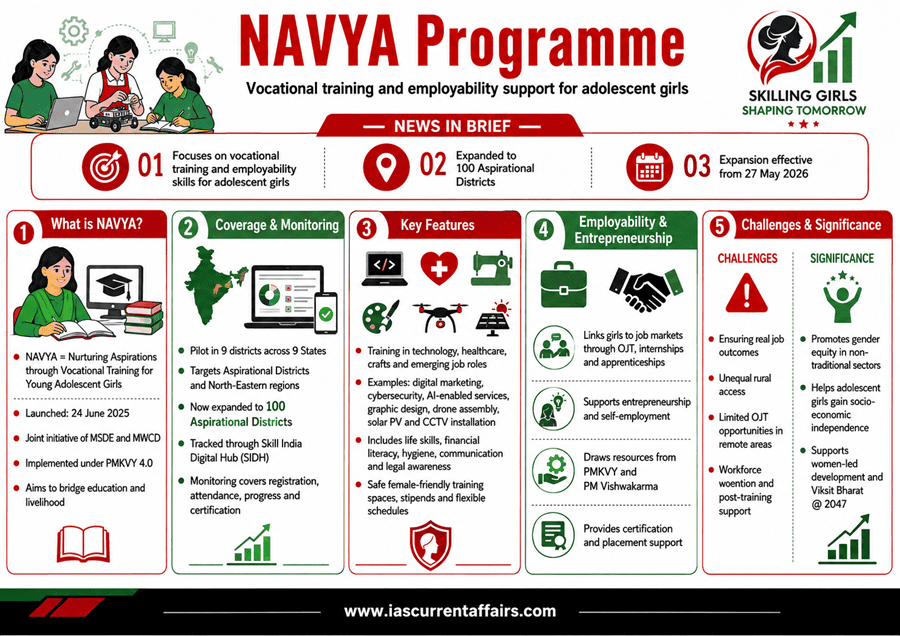
- The NAVYA programme is a joint initiative of the Ministry of Skill Development and Entrepreneurship and the Ministry of Women and Child Development aimed at improving the vocational skills, employability and economic empowerment of adolescent girls.
- Launched in 2025 and implemented under PMKVY 4.0, it combines industry-oriented training with On-the-Job Training, life skills, digital and financial literacy, entrepreneurship and placement support.
- Its expansion to Aspirational Districts seeks to improve access to skill development and livelihood opportunities for girls from disadvantaged regions.
Why in the News?
The Ministry of Skill Development and Entrepreneurship has reported that 1,060 adolescent girls have been trained under the NAVYA programme across 15 States/UTs.
News in Brief
- NAVYA focuses on vocational training and employability skills for adolescent girls.
- The programme has been expanded to 100 Aspirational Districts.
- The expansion came into effect from 27 May 2026, strengthening skill development opportunities for girls in disadvantaged districts.
The NAVYA Programme
- The NAVYA (Nurturing Aspirations through Vocational Training for Young Adolescent Girls) initiative, launched on June 24, 2025.
- It is a joint effort by the Ministry of Skill Development and Entrepreneurship (MSDE) and the Ministry of Women and Child Development (MWCD).
- NAVYA programme is being implemented under the Pradhan Mantri Kaushal Vikas Yojana 4.0 (PMKVY 4.0).
- The initiative seeks to bridge the gap between education and livelihood.
- Currently, the initiative is being piloted in 9 districts across 9 states — Maharashtra, Gujarat, Karnataka, Punjab, Uttar Pradesh, Bihar, Madhya Pradesh, Jharkhand, and Himachal Pradesh.
- These districts have been identified as ’aspirational’ by NITI Aayog.
- The Government monitors and evaluates the implementation and outcomes of the programme through a robust monitoring framework.
- The Skill India Digital Hub (SIDH) is leveraged for real-time tracking of beneficiary registration, attendance, training progress, certification and other key performance indicators.
Key Objectives
- NAVYA offers tailored training in fields like technology, healthcare, and crafts, blending traditional skills with modern roles like AI and digital marketing.
- Courses are designed to meet current industry demands, ensuring relevance and employability.
- NAVYA integrates comprehensive training modules to empower adolescent girls with essential life skills.
- These include health and nutrition education, personal hygiene, Communication, financial literacy for economic independence, workplace safety and legal awareness to navigate rights and protections.
- The program connects trainees to job markets through On-the-Job Training (OJT)- internships and apprenticeships in high-demand sectors.
- It also fosters entrepreneurship by providing resources and mentorship for self-employment ventures.
- NAVYA integrates resources from flagship schemes like the Pradhan Mantri Kaushal Vikas Yojana (PMKVY) and PM Vishwakarma to deliver demand-driven training in non-traditional and emerging job roles, such as digital marketing, cybersecurity, AI-enabled services, graphic design, drone assembly, professional makeup artist, CCTV and solar PV installation.
- The initiative prioritises safe, female-friendly training spaces with stipends and flexible schedules.
- It promotes gender equity by encouraging girls to enter non-traditional, fields like cybersecurity.
- Targeting girls in Aspirational Districts and North-Eastern States, NAVYA links education to sustainable livelihoods.
- It provides certifications and job placements to overcome socio-economic barriers in remote regions.
Pradhan Mantri Kaushal Vikas Yojana (PMKVY)
- Launched on July 15, 2015.
- Promotes skill development by offering free, short-term training and monetary rewards for youth skill certification.
- Align with national initiatives like Make in India and Digital India to enhance industry relevance and youth employability.
- The PM Vishwakarma scheme was launched in September 2023.
- Empowers traditional artisans and craftspeople, such as potters, goldsmiths, sculptors, and artisans, among others, by providing skill training, modern tools, and financial support.
- It aims to enhance their livelihoods, promote self-employment, and preserve India’s cultural heritage through sustainable economic opportunities.
Challenges
- Employment outcomes- Training should lead to actual jobs and sustainable livelihoods.
- Unequal access- Girls from rural and economically weaker backgrounds may have limited access to training opportunities.
- Limited OJT opportunities- Finding suitable industries for on-the-job training can be difficult, especially in remote areas.
- Workforce retention- Social barriers and family responsibilities may make it difficult for trained girls to remain in employment.
- Post-training support- Regular career counselling, placement assistance and mentoring are needed to help girls build long-term careers.
Conclusion
NAVYA represents a shift from education access to employability-oriented skill development, particularly for adolescent girls.
By combining vocational training under PMKVY 4.0, OJT and entrepreneurship, it can empower young women with the tools to attain socio-economic independence and actively contribute to India’s vision of Viksit Bharat@2047.
Key Takeaways
UPSC Prelims and Mains Practice Question
Consider the following statements regarding the NAVYA programme:
- It focuses on vocational training for young adolescent girls.
- It is implemented under PMKVY 4.0.
- It provides training exclusively in traditional vocational occupations.
- Skill India Digital Hub is used for monitoring its implementation.
Which of the statements given above are correct?
(a) 1 and 2 only
(b) 1, 2 and 4 only
(c) 2, 3 and 4 only
(d) 1, 2, 3 and 4
Answer: 1, 2 and 4 only
Mains Practice Question
Q. “Skill development among adolescent girls can contribute significantly to India’s demographic dividend and women’s economic empowerment.” Discuss. (250 Words)
Delimitation In India: Issues, Constitutional Provisions & Federalism
Source: The Hindu
GS II: Indian Polity & Governance, Parliament, Constitutional Bodies, Federalism, Representation of People
Overview
- The upcoming delimitation exercise is a significant constitutional and federal issue as it may reshape the distribution of political representation among States.
- While delimitation seeks to ensure equitable representation based on population, differences in demographic trends have raised concerns, particularly among States that have achieved population stabilisation.
- The exercise therefore involves balancing “one person, one vote” with federal equity.
- The issue also has wider implications for Centre–State relations, North–South dynamics, parliamentary representation and women’s reservation.
- A transparent, consultative and consensus-based approach is essential to ensure that delimitation strengthens democratic legitimacy, cooperative federalism and national unity.
Why in the News?
The debate over delimitation of Lok Sabha constituencies after the 2026 Census has renewed concerns about balancing democratic representation with federal equity.
News in Brief
- The forthcoming delimitation exercise is expected to have far-reaching implications for India’s electoral and federal structure.
- The exercise has acquired greater significance as the constitutional freeze on inter-State seat allocation is linked to the first Census after 16 years.
- Differences in demographic trends across States have made equitable political representation a key concern in the delimitation debate.
- A broad-based political consensus among the Union, States and political parties is considered important before undertaking the exercise.
What is Delimitation?
- Delimitation refers to the process of fixing or redrawing the boundaries of electoral constituencies to ensure relatively equitable representation of voters.
- It involves adjusting constituency boundaries in response to changes in population and, where constitutionally permitted, readjusting the allocation of seats among States.
- The exercise may also lead to changes in constituencies reserved for Scheduled Castes (SCs) and Scheduled Tribes (STs) and the reorganisation of State Assembly constituencies.
- In India, delimitation is undertaken by an independent Delimitation Commission constituted under a law enacted by Parliament.
- India has constituted four such commissions, in 1952, 1962–63, 1973 and 2002.
- The Commission’s orders have the force of law and are generally not subject to judicial challenge.
Constitutional Provisions
- The constitutional framework for delimitation is primarily provided by Articles 81, 82 and 170.
- Article 81 deals with the composition of the Lok Sabha, while Article 82 provides for readjustment of the allocation of seats among States and the division of States into territorial constituencies after each Census, subject to the constitutional framework and parliamentary legislation.
- Article 170 deals with the composition and territorial constituencies of State Legislative Assemblies.
- Articles 330 and 332 provide for reservation of seats for SCs and STs in the Lok Sabha and State Assemblies respectively.
Reason behind freeze on Delimitation
- The allocation of Lok Sabha and Assembly seats among States was frozen through the 42nd Constitutional Amendment Act, 1976, using the 1971 Census as the basis.
- The objective was to ensure that States that had successfully pursued population stabilisation through family planning, improved healthcare, female education and social development were not politically disadvantaged by losing representation.
- The 84th Constitutional Amendment Act, 2001 extended this freeze until the first Census after 2026.
- Subsequently, the 87th Constitutional Amendment Act, 2003 allowed the readjustment of constituencies based on the 2001 Census, while retaining the freeze on the overall number of Lok Sabha seats allocated to each State.
- The last major delimitation exercise was undertaken by the 2002 Delimitation Commission, with its orders implemented from 2008.
- It redrew Parliamentary and Assembly constituencies and adjusted SC/ST reserved constituencies, but did not change the overall allocation of Lok Sabha seats among States.
Concerns over upcoming Delimitation
Political Equality vs Federal Equity
- The major concern is the uneven demographic transition across States.
- Several southern States have achieved lower fertility rates and slower population growth, while many northern and central States continue to account for a larger share of population growth.
- If future representation is determined primarily by current population, States with higher population growth could gain a greater share of Lok Sabha seats.
- This creates a tension between political equality and federal equity.
- Population-based representation strengthens the democratic principle of broadly equal representation of citizens.
- However, States that successfully stabilised their populations may argue that they should not be politically penalised for their demographic achievements.
- The issue therefore has wider implications for Indian federalism.
- Changes in Lok Sabha representation can influence parliamentary voting strength, political bargaining and the relative influence of States in national policymaking.
- A major shift could consequently intensify regional and North–South concerns.
Importance of Political Consensus
- Delimitation is not merely a technical exercise of redrawing electoral boundaries.
- It affects political representation, federal relations, reservation and the composition of Parliament.
- Delimitation exercise without political consensus could deepen North–South tensions, regional political mobilisation, Centre–State disagreements, and concerns over equitable representation.
- A broad political consensus among the Union, States and political parties can therefore strengthen the legitimacy of the exercise and reduce regional tensions.
Delimitation and Women’s Reservation
- The 106th Constitutional Amendment Act, 2023 (Nari Shakti Vandan Adhiniyam) provides for one-third reservation for women in the Lok Sabha and State Legislative Assemblies.
- Its implementation is linked to a delimitation exercise following the relevant Census.
- Therefore, the upcoming delimitation process is significant not only for political representation among States but also for determining the implementation and allocation of women’s reserved constituencies.
Way Forward and Conclusion
The upcoming delimitation exercise should balance “one person, one vote” with federal equity. A consensus-driven and transparent approach, involving States and political parties, can recognise population changes while safeguarding the interests of States that achieved population stabilisation.
A balanced formula considering population, federal concerns, geographical and administrative factors, along with appropriate expansion of legislative representation, can ensure that delimitation strengthens democratic representation, cooperative federalism and national unity.
Key Takeaways

UPSC Prelims and Mains Practice Question
Consider the following statements regarding delimitation in India:
- Article 82 of the Constitution provides for the readjustment of Lok Sabha constituencies after each Census.
- The 84th Constitutional Amendment Act, 2001 extended the freeze on inter-State allocation of Lok Sabha seats until the first Census after 2026.
- The Delimitation Commission is a permanent constitutional body established directly under the Constitution.
Which of the statements given above is/are correct?
A. 1 and 2 only
B. 2 and 3 only
C. 1 and 3 only
D. 1, 2 and 3
Answer: A. 1 and 2 only
Mains Practice Question
Q, The upcoming delimitation exercise presents a challenge of balancing democratic representation with federal equity. Discuss the concerns involved and suggest a way forward. (250 Words)
Daily Current Affairs: Click Here