
Daily Current Affairs 14 August 2026 – IAS Current Affairs
Current Affairs 14 August 2026 focuses on the Prelims-Mains perspective. Major events are :
Mines and Minerals (Development and Regulation) Amendment Bill, 2026
Source: PIB
GS III: Infrastructure
Overview
- The MMDR Amendment Bill, 2026 seeks to reform the fiscal framework governing India’s mineral sector by introducing greater uniformity, stability and predictability in mineral taxation.
- It addresses concerns related to multiple and uneven levies, retrospective taxation, high compliance costs and uncertainty for mining operators.
- The Bill strengthens Union oversight over mineral-bearing lands, restricts State-level levies through Section 9D, and provides the Central Government with rule-making powers under Section 13.
- Overall, the reform aims to improve the viability of mining, encourage investment and exploration, strengthen domestic mineral security and promote sustainable mineral development.
Why in the News?
The Mines and Minerals (Development and Regulation) Amendment Bill, 2026 was passed by the Parliament in August 13, 2026.
News in Brief
- The Bill seeks to establish a more uniform and predictable fiscal framework for the mining sector.
- It restricts State-level levies on mineral rights and mineral-bearing lands.
- The Bill has been passed by both the houses of the Parliament.
Mineral Regulation In India
- India’s mining sector is regulated under the Mines and Minerals (Development and Regulation) Act, 1957.
- The Act provides for Union control over the regulation of mines and development of minerals in the public interest under Section 2 of the Act.
- The Mines and Minerals (Development and Regulation) Amendment Bill, 2026 seeks to establish a uniform and predictable fiscal framework for India’s mineral sector.
Need for the Amendment
- The existing framework places a heavy fiscal burden on the mining sector, affecting its overall viability.
- Taxes, cess and other levies could be introduced even after mining operations had commenced, creating uncertainty for miners.
- The imposition of multiple taxes, cess and other charges on mineral production or dispatch increases the overall cost of mining.
- Different rates of taxes and other levies across States create an uneven fiscal environment for the mining industry.
- Retrospective imposition of taxes and levies creates legal uncertainty and undermines investor confidence.
- Excessive fiscal burdens can make mining commercially unviable, discourage mineral extraction and, in some cases, result in mine closures.
- Additional and unpredictable costs place a greater burden on small and medium-scale mining operators.
- High and uneven levies can discourage industries from sourcing minerals locally, weakening supply chains while increasing transportation costs and pollution.
- Costlier domestic mineral supplies can increase dependence on imports even when adequate mineral resources are available within India.
- Multiple and inconsistent taxes can create a cascading tax effect and increase compliance costs, affecting economic growth.
- Higher taxation at the extraction stage can raise the cost of goods and services, ultimately increasing the cost burden on consumers.
- Retrospective tax demands create uncertainty and can undermine trust in the mining sector.
Key Provisions of the MMDR Amendment Bill, 2026
- Union control over mineral-bearing lands
- The Union will now also regulate mineral-bearing lands having mineral contents.
- Such lands will be identified as per parameters prescribed by the Central Government under the MMDR Act.
- This is in addition to the existing provision declaring the Union’s control over regulation of mines and development of minerals.
- New Section 9D
- No tax, cess or other levy, by whatever name called, shall be imposed by a State Government on mineral rights or mineral-bearing lands.
- This covers levies based on mineral quantity, mineral value, royalty or any other basis.
- Such levies may be imposed only as per conditions or restrictions prescribed by the Central Government.
- Treatment of past levies
- Any levy not paid or collected by the State before the Amendment applies will be treated as invalid.
- However, amounts already deposited or recovered before such commencement shall not be liable to be refunded.
- Rule-making power under Section 13
- Section 13 of the MMDR Act is amended to empower the Central Government to make rules.
- These rules will prescribe the conditions or restrictions for imposition of such levies by State Governments.
Significance
- Improves investment certainty– A stable and predictable fiscal framework can provide greater confidence to investors in the mining sector.
- Reduces tax-related costs- A more uniform levy structure can reduce cascading taxation and lower compliance costs for mining operators.
- Strengthens domestic mineral supply- Lower and more predictable costs can encourage domestic mineral extraction and reduce the risk of greater import dependence.
- Supports mineral security- Greater certainty in the mining regime can encourage mineral exploration and development, particularly for critical minerals.
- Improves mining viability- By preventing excessive and unpredictable fiscal burdens, the Bill seeks to make mineral extraction more economically viable.
- Promotes balanced mineral development- A uniform fiscal framework can help ensure more consistent mineral-sector growth across States.
Conclusion
The Bill marks an important step in modernising India’s mineral governance.
By creating a predictable fiscal framework, it can strengthen mineral security and sustainable resource development, while ensuring that mineral resources contribute effectively to India’s long-term economic growth and help advance India’s journey towards Viksit Bharat.
Key Takeaways

UPSC Prelims and Mains Practice Question
Consider the following statements regarding the MMDR Amendment Bill, 2026
- It introduces restriction on State Governments imposing levies on mineral rights and mineral-bearing lands.
- It brings specified mineral-bearing lands under Union regulation.
- States retain unrestricted power to impose new mineral-related levies.
Which of the statements given above is/are correct?
(a) 1 and 2 only
(b) 2 and 3 only
(c) 1 and 3 only
(d) 1, 2 and 3
Answer: (a) 1 and 2 only
Mains Practice Question
Q. The MMDR Amendment Bill, 2026seeks to balance mineral-sector growth with fiscal certainty. Examine its implication for mining, mineral security and Centre-State relations. (250 Words)
Jammu And Kashmir Statehood: Key Issues
Source: Indian Express
GS II: Federalism, Centre–State relation
Overview
- The demand for restoration of statehood to Jammu & Kashmir reflects concerns over democratic representation, administrative autonomy and Centre–region relations.
- The 2019 reorganisation transformed the former State into the Union Territories of Jammu & Kashmir and Ladakh, fundamentally changing its governance structure.
- Statehood can strengthen democratic accountability, federalism, political legitimacy and administrative effectiveness.
- The transition must balance democratic governance with national security, while addressing regional aspirations, delimitation and inclusive representation.
- A phased restoration of statehood, supported by strong democratic institutions, security coordination and balanced development, can contribute to long-term political stability.
Why in the News?
The debate over restoration of statehood to Jammu & Kashmir has gained renewed significance amid discussions on democratic governance, administrative accountability and completion of the delimitation process.
News in Brief
- Jammu & Kashmir was reorganised into two Union Territories-Jammu & Kashmir and Ladakh, under the Jammu and Kashmir Reorganisation Act, 2019.
- The transition from an elected State government to UT administration has raised concerns regarding democratic representation, accountability and Centre–State relations.
- Restoration of statehood is increasingly linked to the return of full-fledged representative government and elected institutions.
- The issue involves balancing national security, political stability, development and democratic self-governance.
Historical Background
| Period/Year | Key Development | Significance |
|---|---|---|
| 1846 | Treaty of Amritsar established the princely State of Jammu & Kashmir under Maharaja Gulab Singh. | Created the political entity that later acceded to India. |
| 1947 | Maharaja Hari Singh signed the Instrument of Accession to India following the tribal invasion from Pakistan. | J&K became part of India; accession initially covered defence, external affairs and communications. |
| 1950 | The Constitution of India came into force. | J&K had a distinctive constitutional position within the Indian Union. |
| 1952 | Delhi Agreement was reached between the Union Government and J&K leadership. | Provided a framework for Centre–J&K constitutional relations. |
| 1954 | Presidential Order extended several provisions of the Indian Constitution to J&K. | Marked deeper constitutional integration with India. |
| 1956 | J&K Constitution was adopted and came into force in 1957. | Defined J&K as an integral part of India while providing its own constitutional framework. |
| 1965 | The offices of Sadr-i-Riyasat and Prime Minister were replaced by Governor and Chief Minister respectively. | Further aligned J&K’s political institutions with the rest of India. |
| 1975 | Indira-Sheikh Accord restored Sheikh Abdullah as Chief Minister. | Marked an important phase in Centre–J&K political relations. |
| 1987 | J&K Assembly elections were widely criticised over allegations of electoral malpractice. | Political alienation intensified and was followed by the rise of militancy. |
| 1990s | Militancy escalated; Kashmiri Pandits were displaced from the Valley. | Democratic governance and normal political activity were severely disrupted. |
| 1996 | Assembly elections were held after a prolonged period of political instability. | Marked the restoration of elected government after years of disruption. |
| 2008–2014 | Periods of political mobilisation, protests and coalition governments. | Highlighted continuing political and regional tensions. |
| 2018 | The elected government fell and Governor’s Rule followed by President’s Rule was imposed. | J&K came under prolonged central administration. |
| 5 August 2019 | The Union Government changed the constitutional framework associated with Article 370. | Major restructuring of J&K’s constitutional status. |
| 31 October 2019 | The Jammu and Kashmir Reorganisation Act, 2019 came into effect. | Former State was divided into the UTs of Jammu & Kashmir and Ladakh. |
| 2020–2024 | Delimitation and subsequent electoral preparations were undertaken. | Created the institutional basis for restoring representative government. |
| 2024 | Assembly elections were held in J&K after a prolonged gap. | Marked the return of an elected government. |
| Present | Demand for restoration of full statehood continues. | Raises questions of federalism, democratic accountability, security and political stability. |
Significance of Restoration of Statehood
Democratic Accountability
- Restoration of statehood would give the elected government greater authority over administration and strengthen its accountability to the Legislative Assembly.
- It would also provide greater space for elected representatives to respond to local aspirations and public concerns.
Federalism
- Statehood would strengthen the federal principle by restoring a greater degree of political and administrative autonomy to the elected government within India’s constitutional framework.
Political Legitimacy
- Greater participation of elected institutions in governance can help strengthen public trust and political legitimacy, particularly after a prolonged period of central administration.
Administrative Effectiveness
- Greater control over important areas of governance would enable the elected government to formulate and implement policies more effectively according to local priorities.
Political Stability
- A stable constitutional and political arrangement can reduce uncertainty, encourage wider political participation and contribute to long-term stability in the region.
Security Dimension
- Cross-border terrorism, militancy, radicalisation, border management and the protection of civilians and democratic institutions remain important concerns.
- Therefore, the key challenge is to maintain a balance between democratic governance and national security.
- Restoration of statehood should be accompanied by effective coordination between the Union and the elected government so that greater political autonomy does not weaken counter-terrorism and security mechanisms.
Development Dimension
- The post-2019 period has witnessed greater emphasis on infrastructure, tourism, connectivity, digital public services, Panchayati Raj institutions, investment and employment generation.
- Improved road and railway connectivity and the expansion of tourism have supported greater economic integration.
- However, development alone cannot substitute for political participation.
- Sustainable peace requires both economic opportunities and institutions that provide citizens with meaningful political representation.
Delimitation and Representation
- Delimitation is important because it determines the geographical distribution of Assembly constituencies and consequently influences political representation and regional balance.
- It also affects electoral competition, representation of different communities and the composition of the future Legislative Assembly.
- Therefore, delimitation is not merely an electoral exercise, it has wider implications for representative governance and the political balance between different regions of J&K.
Regional and Political Dimensions
- Jammu and Kashmir is not politically homogenous.
- Jammu, the Kashmir Valley and other geographical and social groups have distinct political aspirations and developmental concerns.
- Restoration of statehood should therefore be accompanied by inclusive political representation, balanced regional development, protection of minority interests and equitable distribution of administrative and developmental resources.
- A sustainable political settlement requires that different regional aspirations are accommodated within the constitutional framework.
Panchayati Raj and Grassroots Democracy
- Strengthening Panchayats and other local institutions has expanded opportunities for grassroots political participation and decentralised governance.
- These institutions can improve local accountability and facilitate better delivery of public services.
- However, grassroots institutions cannot substitute for an elected State-level government.
- Panchayati Raj and representative State-level governance should complement each other, creating a multi-level system of democratic participation and accountability.
Way Forward and Conclusion
Restoration of Statehood should follow a phased approach while maintaining security coordination, inclusive governance, and balanced regional development. Strengthening democratic institutions and creating employment opportunities can support long-term stability.
Statehood can deepen democratic legitimacy and federalism in J&K while ensuring national security remains protected.
Key Takeaways

UPSC Prelims and Mains Practice Question
Consider the following statements regarding Jammu & Kashmir:
- The Jammu and Kashmir Reorganisation Act, 2019 created the Union Territory of Jammu & Kashmir with a legislature.
- Ladakh was created as a Union Territory with its own Legislative Assembly.
- Article 3 of the Constitution empowers Parliament to reorganise States and Union Territories.
Which of the statements given above is/are correct?
(a) 1 only
(b) 1 and 2 only
(c) 1 and 3 only
(d) 2 and 3 only
Answer: (c) 1 and 3 only
Mains Practice Question
Q. “The restoration of statehood in Jammu & Kashmir represents a test of India’s ability to reconcile federalism, democratic governance and national security.” Examine. (250 Words)
Punjab’s Digital Universities Bill, 2026
Source: Indian Express
GS II: Social Justice: Issues relating to development and management of Social Sector or Services relating to Education.
Overview
- The Punjab Digital Universities Bills, 2026 seek to expand higher-education access through private, technology-driven universities offering online and digital programmes.
- The initiative can improve accessibility, flexibility and private participation, particularly for students in remote or underserved areas.
- However, its success will depend on UGC compliance, academic quality, practical training, student protection, digital inclusion and effective regulation. The debate also highlights the need to balance private investment with the strengthening of public higher-education institutions.
Why in the News?
The Punjab Assembly has passed three Bills to establish private digital universities, raising questions about regulation, quality assurance, financial oversight and the balance between expanding higher-education access and protecting public education institutions.
News in Brief
- The Punjab Assembly passed three Bills enabling the establishment of three private digital universities in the State.
- The universities will offer undergraduate, postgraduate and professional programmes through online/digital modes.
- The model is based on self-financing, with no regular financial assistance from the Punjab government.
- The move has faced opposition criticism that the government is prioritising private entities and commercialisation of higher education over strengthening public institutions and raised questions about the suitability of fully digital education for courses requiring laboratories, practical training and field exposure.
The Punjab Digital Universities Bill
- The Punjab Assembly has passed three bills that provide the legal framework to establish private digital universities in the State, Cloud University, Hoshiarpur; MS Digital University, Patiala; and Physicswallah Digital University, Patiala.
- The Bills are based on the Punjab Private Digital Open Universities Policy, 2026, notified in January.
- The policy seeks to widen access to higher education by allowing students to pursue undergraduate, postgraduate and professional courses largely through online and digital platforms.
- It also aims to bring reputed private education providers into the State and expand technology-based learning opportunities.
Key Features
- The proposed universities will use a range of digital tools, including,
- Online classes and digital assessments
- Virtual laboratories
- Learning Management Systems (LMS)
- Digital content studios and cloud-based infrastructure
- AI-enabled learning pathways
- AI-proctored examinations
- Live classes and mentoring
- 24×7 student support
Funding and Administration
- The three institutions will function on a self-financing model. The Punjab government will not provide regular grants or financial assistance.
- Key provisions include,
- Sponsors must maintain a minimum corpus of ₹20 crore.
- An Ombudsman will deal with student grievances.
- The Governor of Punjab will serve as the Visitor and have inspection powers.
- The Chancellor will be nominated by the sponsoring body.
- The Visitor can remove the Chancellor for violations of UGC requirements or other applicable norms.
Regulatory and Quality Concerns
- UGC compliance- The universities will have to follow the applicable UGC framework governing online and open-distance education.
- Quality assurance- Digital delivery must maintain standards relating to faculty, curriculum, examinations, student support and practical training.
- Practical Education- One of the major concerns is whether a predominantly digital model can adequately address the requirements of courses that involve laboratory work, clinical training or field exposure.
- This is particularly relevant to disciplines such as engineering, medical sciences and other science-based programmes, where hands-on learning forms an essential part of education.
- The issue, therefore, is not simply about providing courses online but ensuring that digital delivery does not come at the cost of academic and professional standards.
- Recognition of degrees- Degrees awarded through online programmes need to meet the relevant regulatory requirements for recognition.
- Student protection- Strong grievance-redressal mechanisms are necessary to address concerns relating to examinations, fees, course delivery, academic credits and degree recognition.
- Commercialisation of higher education- The Opposition has questioned the emphasis on private universities and argued that greater attention should instead be given to strengthening existing public institutions.
Significance and Challenges in Online and Distance Education
Digital education can expand access to higher education by overcoming,
- Geographical barriers- enables students to learn irrespective of location
- Institutional constraints- reduces dependence on physical classrooms campuses.
- Limited institutional reach- can serve students in remote and underserved areas.
- Time and mobility constraints- allows flexible learning for working students and other learners.
However, its effectiveness depends on addressing several challenges,
- Digital divide – unequal access to devices, connectivity and digital skills.
- Quality assurance – maintaining academic standards across online programmes.
- Assessment integrity – ensuring fair and credible examinations.
- Practical learning – difficulty in providing laboratory, clinical and field-based training.
- Faculty-student interaction – reduced scope for direct academic engagement and personalised guidance.
- Recognition and regulation – ensuring that online degrees meet UGC and other applicable standards.
- Student support – providing effective mentoring, grievance redressal and technical assistance.
Way Forward and Conclusion
India needs a balanced digital higher-education model that expands access without compromising academic quality. This requires stronger UGC oversight, reliable digital infrastructure, affordable access to devices and connectivity, robust online assessment systems, and suitable arrangements for laboratory, clinical and field-based learning.
Public and private institutions should also work together to improve faculty capacity, student support and digital inclusion. Ultimately, digital universities should complement, not replace the quality physical higher education, ensuring that technology becomes a means of democratising education rather than a source of new inequalities.
Key Takeaways

UPSC Prelims and Mains Practice Question
Consider the following statements:
- Punjab’s proposed digital universities are designed as self-financed private universities.
- The proposed framework includes AI-proctored examinations and virtual laboratories.
- The Punjab government will provide regular financial grants to all three proposed universities.
Which of the statements given above are correct?
A. 1, 2 and 3 only
B. 1 and 2 only
C. 2 and 3 only
D. 1 and 3 only
Answer: B
Mains Practice Question
Q. “Technology can expand access to education, but access without quality may deepen educational inequalities.” (Essay)
Evolution Of Environmental Law In India
Source: Indian Express
GS III: Environment and Conservation
Overview
- Constitutional provisions, environmental laws and judicial interventions have shaped India’s environmental governance.
- The Supreme Court has strengthened environmental protection through Article 21 and developed principles such as Absolute Liability, Precautionary Principle, Polluter Pays, Public Trust Doctrine, Sustainable Development and Inter-generational Equity.
- Contemporary concerns over post-facto environmental clearances, judicial consistency and development–environment trade-offs highlight the need for stronger regulation, accountability and sustainable development.
Why in the News?
An editorial article in Indian Express, discusses the role of Supreme Court in protecting environment, and whether environmental protection and development should be treated as competing objectives.
News in Brief
- India’s environmental jurisprudence has evolved significantly through constitutional provisions, environmental legislation and Supreme Court judgments.
- The Supreme Court has developed major principles such as absolute liability, polluter pays, precautionary principle, public trust doctrine, sustainable development and inter-generational equity.
- The article also highlights concerns over consistency in judicial application of environmental principles, particularly in cases involving infrastructure and environmental clearances.
Evolution of Environmental Law In India
- India’s environmental jurisprudence has evolved through constitutional provisions, legislation and judicial decisions.
- The original Constitution did not contain a comprehensive environmental framework.
- The 42nd Constitutional Amendment Act, 1976 introduced Article 48A, directing the State to protect and improve the environment and safeguard forests and wildlife.
- It also inserted Article 51A(g), making environmental protection a Fundamental Duty of citizens.
- The Stockholm Conference, 1972 influenced India’s environmental policy and constitutional development.
Major Environmental Laws
- Water (Prevention and Control of Pollution) Act, 1974
- Air (Prevention and Control of Pollution) Act, 1981
- Environment (Protection) Act, 1986
- Forest (Conservation) Act, 1980 — now the Van (Sanrakshan Evam Samvardhan) Adhiniyam, 1980
- Wild Life (Protection) Act, 1972
- Biological Diversity Act, 2002
- National Green Tribunal Act, 2010
Role of the Supreme Court
- The Supreme Court has expanded environmental protection through Article 21, interpreting the right to life to include the right to a clean and healthy environment.
- Through Public Interest Litigation, it has developed several principles that form the foundation of Indian environmental jurisprudence.
Landmark Environmental Principles
Absolute Liability
- In M.C. Mehta v. Union of India (Oleum Gas Leak case), the Court evolved the doctrine of absolute liability.
- Enterprises engaged in hazardous or inherently dangerous activities are held absolutely liable for harm caused, without the exceptions available under the traditional rule of strict liability.
Precautionary and Polluter Pays Principles, Sustainable Development
- The Supreme Court recognised the Precautionary Principle, Polluter Pays Principle and Sustainable Development as essential features of Indian environmental law.
- The Precautionary Principle (Vellore Citizens’ Welfare Forum v. Union of India) requires preventive action where environmental damage is foreseeable, even when complete scientific certainty is absent.
- The Polluter Pays Principle (Indian Council for Enviro-Legal Action v. Union of India) requires the polluter to bear the cost of compensation and environmental restoration.
- And the Sustainable Development (Vellore Citizens’ Welfare Forum) requires the development process must balance economic growth with environmental protection
Public Trust Doctrine
- In M.C. Mehta v. Kamal Nath (Span Motel Case), the Court applied the Public Trust Doctrine, under which natural resources such as rivers, forests, lakes and other ecological assets are held by the State in trust for the public.
- The State cannot permit their arbitrary exploitation for private interests.
- The case involved the River Beas, where activities by Span Motel affected its natural flow.
- The Court applied the Public Trust Doctrine and Polluter Pays Principle, emphasising that environmental resources must be protected for present and future generations.
- The Court has also recognised inter-generational equity, which requires the present generation to use natural resources responsibly and conserve them for future generations.
- It forms an important link between environmental protection and sustainable development.
The Vanashakti Case
- The CREDAI–Vanashakti litigation has revived concerns regarding environmental compliance and post-facto environmental clearances.
- Justice Ujjal Bhuyan emphasised that the Precautionary Principle is central to environmental jurisprudence and cautioned against using retrospective clearances to legitimise environmental violations.
Environment vs Development
- Environmental protection and development should not be treated as mutually exclusive.
- Sustainable development seeks to balance economic growth with ecological protection.
- Courts should therefore examine environmental compliance, impact assessment, mitigation measures and restoration rather than automatically treating environmental concerns as anti-development.
Environmental Jurisprudence- Strength and Concerns
- The Supreme Court has strengthened environmental protection by expanding Article 21, holding industries accountable for environmental harm, developing key principles such as Precautionary Principle and Polluter Pays, enabling PILs, and promoting ecological restoration and compensation.
- The Court has sometimes taken a strong stance against environmental violations, while in other cases accommodating developmental projects.
- Such variations raise concerns about consistency, predictability, legal certainty and effective environmental protection.
Way Forward and Conclusion
India needs consistent application of environmental principles, stronger regulatory institutions, transparent EIA processes and strict compliance with prior environmental clearances.
Development projects should incorporate mitigation, restoration and public participation. A balanced approach based on sustainable development can ensure that economic growth does not compromise environmental security and the rights of future generations.
Key Takeaways
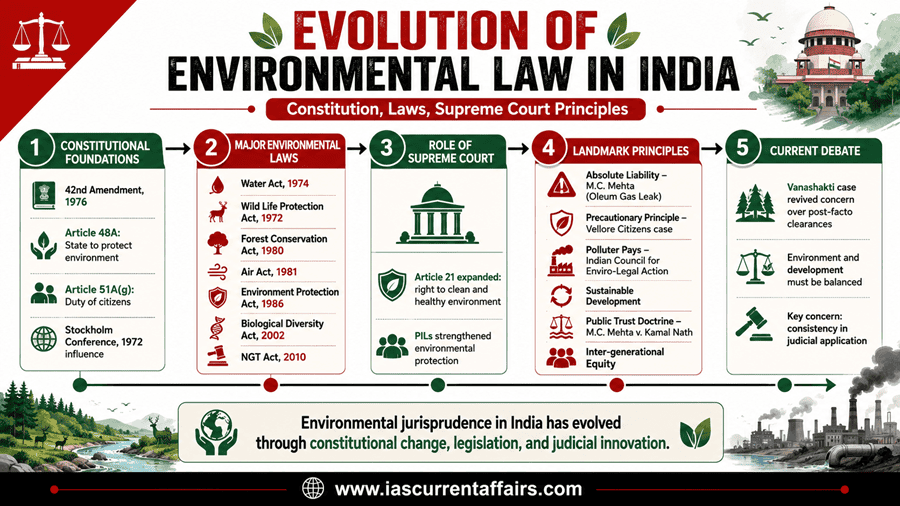
Click image to enlarge for better readability
UPSC Prelims and Mains Practice Question
With reference to environmental jurisprudence in India, consider the following statements:
- The Public Trust Doctrine holds that certain natural resources are held by the State in trust for the public.
- The Precautionary Principle requires preventive action even when there is complete scientific certainty about environmental harm.
- The Polluter Pays Principle requires the polluter to bear the cost of environmental damage and restoration.
- Article 51A(g) imposes a Fundamental Duty on citizens to protect and improve the natural environment.
Which of the statements given above are correct?
(a) 1, 3 and 4 only
(b) 1 and 2 only
(c) 2, 3 and 4 only
(d) 1, 2, 3 and 4
Answer: (a) 1, 3 and 4 only
Mains Practice Question
Q. “Environmental protection and economic development need not be conflicting objectives.” Discuss the role of sustainable development in achieving a balance between the two. (250 words)
Daily Current Affairs: Click Here