
Evolution Of Environmental Law In India
Source: Indian Express
GS III: Environment and Conservation
Overview
- Constitutional provisions, environmental laws and judicial interventions have shaped India’s environmental governance.
- The Supreme Court has strengthened environmental protection through Article 21 and developed principles such as Absolute Liability, Precautionary Principle, Polluter Pays, Public Trust Doctrine, Sustainable Development and Inter-generational Equity.
- Contemporary concerns over post-facto environmental clearances, judicial consistency and development–environment trade-offs highlight the need for stronger regulation, accountability and sustainable development.
Why in the News?
An editorial article in Indian Express, discusses the role of Supreme Court in protecting environment, and whether environmental protection and development should be treated as competing objectives.
News in Brief
- India’s environmental jurisprudence has evolved significantly through constitutional provisions, environmental legislation and Supreme Court judgments.
- The Supreme Court has developed major principles such as absolute liability, polluter pays, precautionary principle, public trust doctrine, sustainable development and inter-generational equity.
- The article also highlights concerns over consistency in judicial application of environmental principles, particularly in cases involving infrastructure and environmental clearances.
Evolution of Environmental Law In India
- India’s environmental jurisprudence has evolved through constitutional provisions, legislation and judicial decisions.
- The original Constitution did not contain a comprehensive environmental framework.
- The 42nd Constitutional Amendment Act, 1976 introduced Article 48A, directing the State to protect and improve the environment and safeguard forests and wildlife.
- It also inserted Article 51A(g), making environmental protection a Fundamental Duty of citizens.
- The Stockholm Conference, 1972 influenced India’s environmental policy and constitutional development.
Major Environmental Laws
- Water (Prevention and Control of Pollution) Act, 1974
- Air (Prevention and Control of Pollution) Act, 1981
- Environment (Protection) Act, 1986
- Forest (Conservation) Act, 1980 — now the Van (Sanrakshan Evam Samvardhan) Adhiniyam, 1980
- Wild Life (Protection) Act, 1972
- Biological Diversity Act, 2002
- National Green Tribunal Act, 2010
Role of the Supreme Court
- The Supreme Court has expanded environmental protection through Article 21, interpreting the right to life to include the right to a clean and healthy environment.
- Through Public Interest Litigation, it has developed several principles that form the foundation of Indian environmental jurisprudence.
Landmark Environmental Principles
Absolute Liability
- In M.C. Mehta v. Union of India (Oleum Gas Leak case), the Court evolved the doctrine of absolute liability.
- Enterprises engaged in hazardous or inherently dangerous activities are held absolutely liable for harm caused, without the exceptions available under the traditional rule of strict liability.
Precautionary and Polluter Pays Principles, Sustainable Development
- The Supreme Court recognised the Precautionary Principle, Polluter Pays Principle and Sustainable Development as essential features of Indian environmental law.
- The Precautionary Principle (Vellore Citizens’ Welfare Forum v. Union of India) requires preventive action where environmental damage is foreseeable, even when complete scientific certainty is absent.
- The Polluter Pays Principle (Indian Council for Enviro-Legal Action v. Union of India) requires the polluter to bear the cost of compensation and environmental restoration.
- And the Sustainable Development (Vellore Citizens’ Welfare Forum) requires the development process must balance economic growth with environmental protection
Public Trust Doctrine
- In M.C. Mehta v. Kamal Nath (Span Motel Case), the Court applied the Public Trust Doctrine, under which natural resources such as rivers, forests, lakes and other ecological assets are held by the State in trust for the public.
- The State cannot permit their arbitrary exploitation for private interests.
- The case involved the River Beas, where activities by Span Motel affected its natural flow.
- The Court applied the Public Trust Doctrine and Polluter Pays Principle, emphasising that environmental resources must be protected for present and future generations.
- The Court has also recognised inter-generational equity, which requires the present generation to use natural resources responsibly and conserve them for future generations.
- It forms an important link between environmental protection and sustainable development.
The Vanashakti Case
- The CREDAI–Vanashakti litigation has revived concerns regarding environmental compliance and post-facto environmental clearances.
- Justice Ujjal Bhuyan emphasised that the Precautionary Principle is central to environmental jurisprudence and cautioned against using retrospective clearances to legitimise environmental violations.
Environment vs Development
- Environmental protection and development should not be treated as mutually exclusive.
- Sustainable development seeks to balance economic growth with ecological protection.
- Courts should therefore examine environmental compliance, impact assessment, mitigation measures and restoration rather than automatically treating environmental concerns as anti-development.
Environmental Jurisprudence- Strength and Concerns
- The Supreme Court has strengthened environmental protection by expanding Article 21, holding industries accountable for environmental harm, developing key principles such as Precautionary Principle and Polluter Pays, enabling PILs, and promoting ecological restoration and compensation.
- The Court has sometimes taken a strong stance against environmental violations, while in other cases accommodating developmental projects.
- Such variations raise concerns about consistency, predictability, legal certainty and effective environmental protection.
Way Forward and Conclusion
India needs consistent application of environmental principles, stronger regulatory institutions, transparent EIA processes and strict compliance with prior environmental clearances.
Development projects should incorporate mitigation, restoration and public participation. A balanced approach based on sustainable development can ensure that economic growth does not compromise environmental security and the rights of future generations.
Key Takeaways
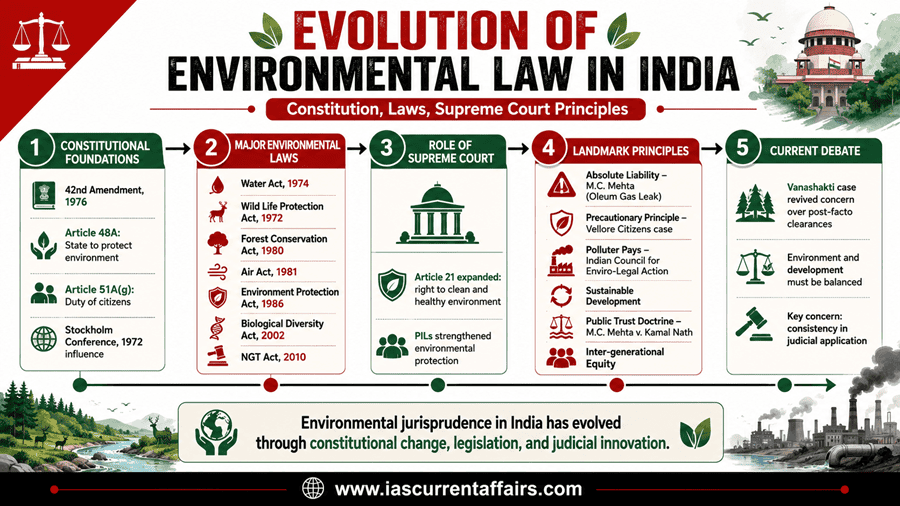
Click image to enlarge for better readability
UPSC Prelims and Mains Practice Question
With reference to environmental jurisprudence in India, consider the following statements:
- The Public Trust Doctrine holds that certain natural resources are held by the State in trust for the public.
- The Precautionary Principle requires preventive action even when there is complete scientific certainty about environmental harm.
- The Polluter Pays Principle requires the polluter to bear the cost of environmental damage and restoration.
- Article 51A(g) imposes a Fundamental Duty on citizens to protect and improve the natural environment.
Which of the statements given above are correct?
(a) 1, 3 and 4 only
(b) 1 and 2 only
(c) 2, 3 and 4 only
(d) 1, 2, 3 and 4
Answer: (a) 1, 3 and 4 only
Mains Practice Question
Q. “Environmental protection and economic development need not be conflicting objectives.” Discuss the role of sustainable development in achieving a balance between the two. (250 words)
Daily Current Affairs: Click Here