
Precision Agriculture In India
Source: PIB
GS III: Agriculture – E-technology in aid of farmers
Overview
- Precision agriculture is becoming an important approach to make Indian agriculture more productive, resource-efficient and climate-resilient.
- ICAR’s Network Programme on Precision Agriculture brings together multiple research institutes to develop technologies suited to Indian conditions.
- The approach integrates AI, IoT, sensors, drones, remote sensing, GIS and satellite data across crop production, fisheries and livestock management.
- Applications range from precision irrigation and nutrient management to disease surveillance, smart aquaculture and automated farming systems.
- ICAR and KVKs are also focusing on farmer adoption through demonstrations, training, capacity building and digital advisory services.
- Precision agriculture can support the transition towards sustainable, technology-enabled and climate-resilient farming, particularly by making advanced technologies more accessible to small and marginal farmers.
Why in the News?
ICAR’s Network Programme on Precision Agriculture brings together 16 research institutes to develop precision technologies suited to Indian farming conditions.
News in Brief
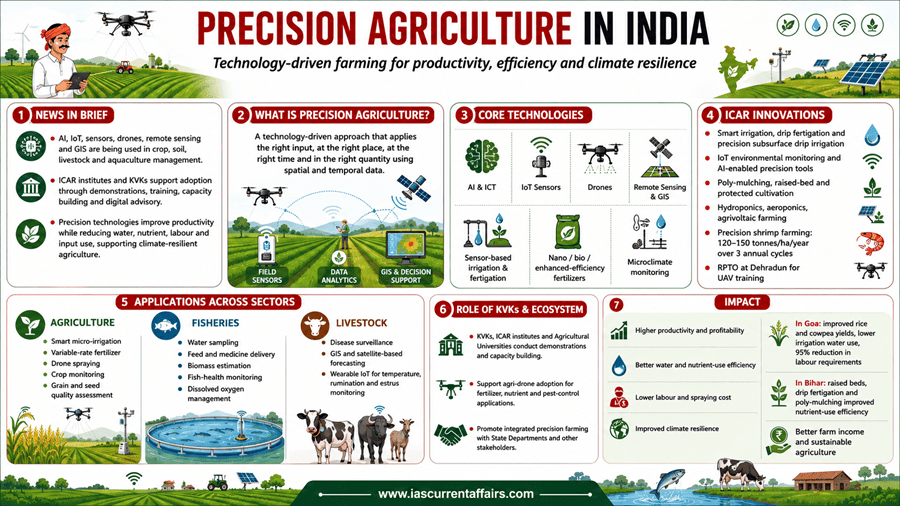
- AI, IoT, sensors, drones, remote sensing and GIS are being applied across crop, soil, livestock and aquaculture management.
- ICAR institutes and KVKs are supporting technology adoption through demonstrations, training, capacity building and digital advisory services.
- Precision technologies have improved productivity while reducing water, nutrient, labour and input requirements, strengthening climate-resilient agriculture.
Precision Agriculture
- ICAR is promoting precision agriculture by combining AI, IoT and ICT with conventional farming practices.
- These technologies are being used to monitor crops, assess crop health and manage natural resources more efficiently.
- Drones are used for crop monitoring and precise application of agricultural inputs, while remote sensing, GIS and satellite data help in crop assessment and resource mapping.
- Sensor-based irrigation and fertigation systems support better management of water and nutrients, complemented by the use of enhanced-efficiency fertilizers, nano-fertilizers and biofertilizers.
- ICAR has also developed tools such as the Dweep Microclimate Monitor and AI-based models for assessing water stress and managing livestock.
- To support wider adoption, a Remote Pilot Training Organisation (RPTO) at Dehradun has been established for UAV training, while ICAR Institutes, AICRPs and KVKs provide demonstrations, farmer training, capacity building and digital advisory services.
Precision Agriculture- A technology-driven approach that uses spatial and temporal data to apply the right input, at the right place, at the right time and in the right quantity.
Technologies Developed and Validated by ICAR
- Irrigation & Water Management– Sensor-based irrigation, drip fertigation, precision subsurface drip irrigation and other water-efficient irrigation technologies.
- Digital & Smart Technologies– IoT-enabled environmental monitoring, AI-enabled precision planters, remote sensing and GIS applications, and drone-based spraying.
- Advanced Cultivation practices– Poly-mulching, raised-bed cultivation, modified raised and sunken conservation beds, agro-aqua land configuration and low-cost protected cultivation.
- Modern Farming Systems– Hydroponics, aeroponics, agrivoltaic farming and automated livestock management systems.
- These technologies aim to improve productivity, resource-use efficiency and sustainability, particularly in smallholder farming systems.
- Precision Aquaculture- ICAR has developed and demonstrated a tank-based super-intensive precision shrimp farming system.
- It integrates smart automation, strict biosecurity and eco-efficient management and yields 120–150 tonnes/ha/year over three annual cycles.
AI, IoT and Sensor Applications in Agriculture, Fisheries and Livestock
Agriculture
- ICAR has developed AI-, sensor- and IoT-based technologies for smart micro-irrigation, variable-rate fertilizer application, jute grading, cold-room management, aflatoxin detection, banana supply-chain traceability, fruit-quality monitoring, grain analysis, seed-quality assessment and computer-vision-based crop and ginning assessment.
- Drone demonstrations covered 230 ha and benefited 2,487 farmers, while drones and mobile apps are also used to demonstrate AI-based fertilizer and pesticide spraying.
Fisheries
- AI and drones are being used for water sampling, feed and medicine distribution, biomass estimation, fish-health monitoring and transportation.
- ICAR has also developed an IoT-based dissolved oxygen management system and uses AI and Big Data for fisheries resource assessment and prediction.
- Automated systems are being used for smart production and hatcheries.
Livestock
- AI, IoT sensors, drones and satellite imagery are being used for disease surveillance, biosecurity and livestock management.
- ICAR-NIVEDI uses GIS, satellite data and machine-learning models to forecast 15 economically important livestock diseases up to two months in advance.
- Wearable IoT devices monitor body temperature, rumination and estrus cycles, enabling early detection of health problems.
Krishi Vigyan Kendra (KVK)
- The KVK scheme promotes the adoption of new technologies in agriculture and allied sectors, including agri-drones, through technology assessment, demonstrations and farmer capacity building.
- KVKs, ICAR Institutes and Agricultural Universities conduct agri-drone demonstrations for nutrient, fertilizer and pest-control applications.
- These institutions also support farmers through field demonstrations, technology assessment and capacity development to encourage wider adoption of agri-drones.
Integrated Precision Farming Ecosystem
- ICAR promotes an integrated precision farming ecosystem by developing location-specific technologies for precision irrigation, nutrient management, protected cultivation, mechanization, digital decision support and climate-smart agriculture.
- These technologies are being disseminated through field demonstrations, farmer training, capacity building programmes and collaboration with State Departments, Krishi Vigyan Kendras (KVKs) and other stakeholders to facilitate their adoption by farmers.
Impact on Productivity, Profitability and Resource Efficiency
- Precision agriculture technologies have improved productivity, profitability, resource-use efficiency and climate resilience.
- Precision irrigation, including solar-powered systems, farm ponds and micro-irrigation, has improved cropping intensity, crop diversification and farmer incomes while reducing dependence on diesel and electricity.
- In Goa, precision agriculture improved rice and cowpea yields while significantly reducing irrigation water use and 95% of labour requirements.
- Farm pond-based rainwater harvesting has increased crop yields, while polyhouse cultivation combined with automated drip irrigation and fertigation has improved farm returns.
- In Bihar, raised beds, drip fertigation and poly-mulching improved nutrient-use efficiency.
- Drip irrigation and protected cultivation have reduced water requirements, while hydroponics further improves water-use efficiency.
- Drone-based foliar nutrient application has improved crop yields, reduced spraying costs and enabled faster, more uniform application while minimizing crop damage.
- Overall, these technologies help increase farm income, optimize water and fertilizer use, reduce production costs and promote sustainable, climate-resilient agriculture.
Conclusion
Precision agriculture can help Indian farming move towards higher productivity, efficient resource use and greater climate resilience.
Wider adoption of AI, IoT, drones and other digital technologies, supported by farmer training and field-level demonstrations, can make these benefits more accessible to small and marginal farmers.
Key Takeaways
UPSC Prelims and Mains Practice Question
Consider the following statements regarding precision farming in Agriculture
- The ICAR Network Programme on Precision Agriculture (ICAR-NePPA) involves multiple ICAR research institutes and focuses on technologies such as AI, IoT, sensors and remote sensing.
- Precision agriculture applications are limited to crop production and do not extend to livestock or aquaculture.
- ICAR uses AI, IoT sensors, drones and satellite imagery for livestock disease surveillance and management.
Which of the statements given above is/are correct?
(a) 1 and 2 only
(b) 1 and 3 only
(c) 2 and 3 only
(d) 1, 2 and 3
Answer: (b) 1 and 3 only
Mains Practice Question
Q. Precision agriculture can simultaneously improve farm productivity, resource-use efficiency, and climate resilience. Discuss the opportunities and challenges of its adoption in India. (250 Words)
Daily Current Affairs: Click Here