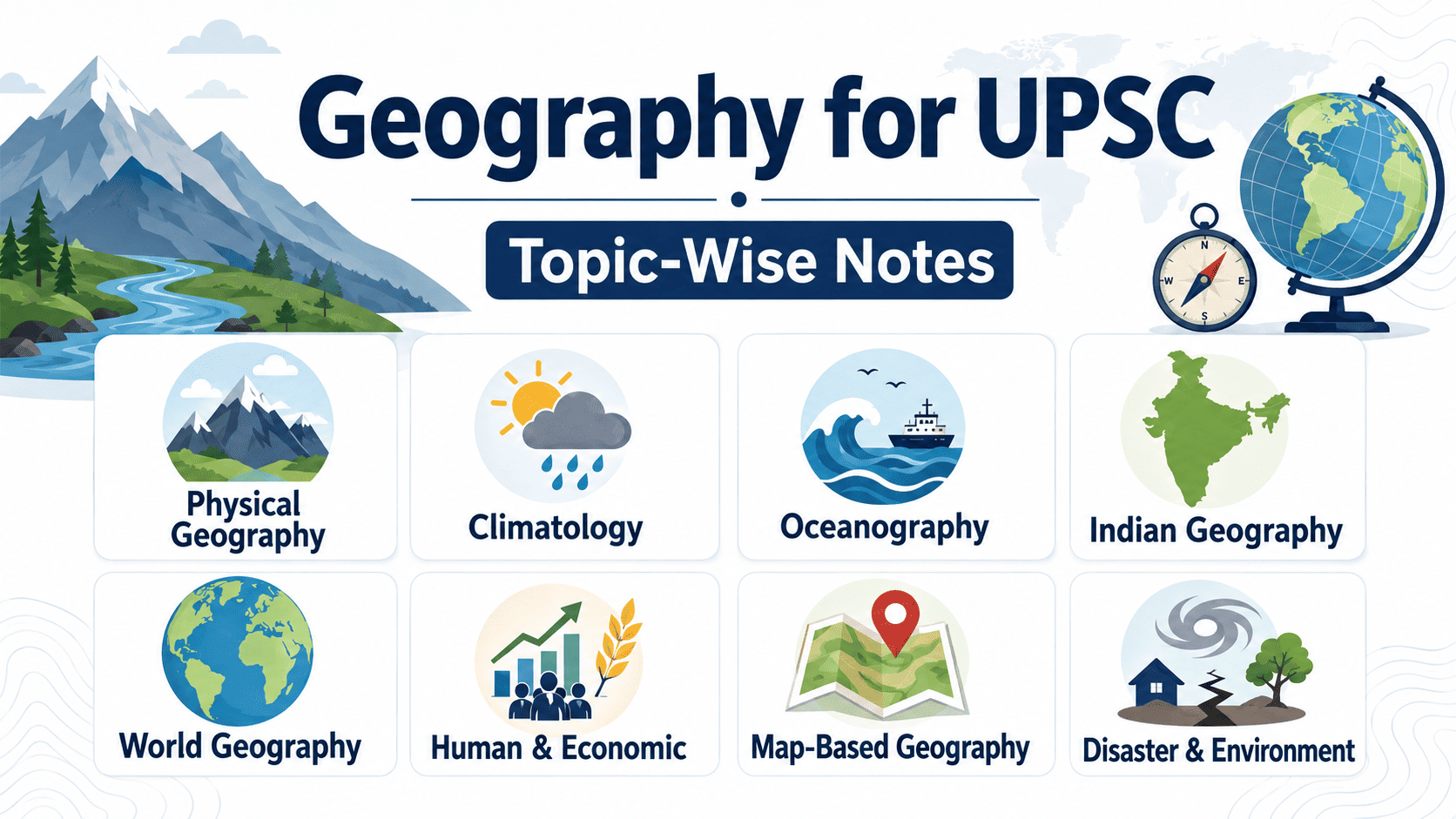
Geography for UPSC: Complete Topic-Wise Notes
GS II: Important International institutions, agencies and fora- their structure, mandate
Why Geography is Important for UPSC?
Geography helps aspirants understand the relationship between nature, resources, people and development. It is directly useful in General Studies Paper I and also supports preparation for Environment, Agriculture, Disaster Management, International Relations and Current Affairs.
In Prelims, Geography questions are often factual, conceptual and map-based. In Mains, Geography helps in writing analytical answers related to climate change, monsoon, floods, droughts, urbanisation, agriculture, resource distribution and regional development.
Geography Syllabus Coverage for UPSC
The Geography syllabus can be broadly divided into Physical Geography, Indian Geography, World Geography, Human Geography, Economic Geography and Map-Based Geography. A strong understanding of these areas helps aspirants connect static concepts with current events.
1. Physical Geography for UPSC
- Physical Geography forms the foundation of Geography.
- It explains the natural processes that shape the Earth’s surface, including the origin of Earth, internal structure, rocks, plate movements, earthquakes, volcanoes and landform formation.
- This section is important because many topics in environment, disaster management and Indian geography are connected with basic physical geography.
- For example, plate tectonics helps explain earthquakes, volcanoes and mountain formation, while landform studies help in understanding rivers, glaciers, deserts and coastal regions.
- Aspirants should study Physical Geography first because it builds the base for climatology, oceanography, Indian physical features and disaster-related topics.
Read complete notes: Physical Geography for UPSC
2. Climatology for UPSC
- Climatology deals with the atmosphere, weather systems and climate patterns.
- It includes topics such as atmospheric structure, isolation, heat budget, temperature distribution, pressure belts, winds, jet streams, rainfall, cyclones and climatic regions.
- This section is highly relevant for UPSC because it helps aspirants understand the Indian monsoon, El Nino, La Nina, Indian Ocean Dipole, heat waves, cold waves, droughts, floods and climate change.
- Many current affairs topics related to extreme weather events can be understood better through climatology.
- For Prelims, aspirants should focus on concepts, definitions and atmospheric processes.
- For Mains, climatology is useful for writing answers on climate variability, monsoon behaviour, disaster risk and climate change impacts.
Read complete notes: Climatology for UPSC
3. Oceanography for UPSC
- Oceanography studies oceans, ocean relief, ocean water, ocean movements and marine ecosystems.
- It includes topics such as continental shelf, ocean trenches, salinity, temperature, ocean currents, tides, waves, upwelling, coral reefs and marine resources.
- This section is important for understanding climate systems, marine biodiversity, fisheries, coastal processes and global trade routes.
- Ocean currents influence climate, rainfall, navigation and marine ecosystems.
- Coral reefs, mangroves and coastal zones are also important for the environment and disaster management.
- Oceanography is especially useful for UPSC questions related to the Indian Ocean, Indo-Pacific, coastal vulnerability, cyclones, sea level rise and marine resources.
Read complete notes: Oceanography for UPSC
4. Indian Geography for UPSC
- Indian Geography is one of the most important areas for UPSC preparation.
- It covers India’s location, physical divisions, drainage system, climate, soils, natural vegetation, agriculture, minerals, industries, transport and population distribution.
- This section helps aspirants understand India’s natural features and their impact on society, economy and development.
- Topics such as the Himalayas, the Northern Plains, the Peninsular Plateau, the Indian Desert, the coastal plains, islands, rivers and monsoon are highly relevant for both Prelims and Mains.
- Indian Geography should be studied with maps.
- Aspirants should regularly practise rivers, mountain ranges, passes, dams, national parks, ports, mineral belts, industrial regions and important places in the news.
Read complete notes: Indian Geography for UPSC
5. World Geography for UPSC
- Indian climate and monsoon deserve separate attention because they are central to agriculture, water resources, economy, disasters and livelihoods.
- This section covers factors affecting the Indian climate, the southwest monsoon, the northeast monsoon, the retreating monsoon, western disturbances, jet streams, El Niño, La Niña, and the Indian Ocean Dipole.
- The Indian monsoon affects cropping patterns, food security, hydropower generation, groundwater recharge and rural economy.
- Weak monsoon, delayed monsoon, excess rainfall and uneven rainfall distribution often create droughts, floods and agricultural stress.
For UPSC Mains, this section is useful for questions on climate change, monsoon variability, disaster management, agriculture and water security.
Read complete notes: Indian Climate and Monsoon for UPSC
6. Human and Economic Geography for UPSC
- The drainage system of India includes Himalayan rivers, Peninsular rivers, drainage patterns, river basins, lakes, dams and river water disputes.
- It is important for understanding water resources, agriculture, floods, irrigation, hydropower and regional development.
- The Himalayan rivers are generally perennial and carry large volumes of water and sediment. The Peninsular rivers are mostly seasonal and flow through hard rock terrain.
- Understanding these differences helps aspirants analyse floods, river erosion, delta formation, interlinking of rivers and interstate water disputes.
- This section is useful for both map-based Prelims questions and Mains answers related to water management, river basin planning and flood control.
Read complete notes: Drainage System of India for UPSC
7. Soils and Natural Vegetation of India for UPSC
- Soils and natural vegetation are important parts of Indian Geography.
- Soil influences agriculture, cropping patterns, irrigation needs and rural economy.
- Natural vegetation reflects the relationship between climate, relief, rainfall and biodiversity.
- This section covers major soil types such as alluvial soil, black soil, red soil, laterite soil, desert soil, mountain soil and saline soil.
- It also covers tropical evergreen forests, deciduous forests, thorn forests, montane forests, mangroves and grasslands.
For UPSC, this section is useful for questions related to agriculture, land degradation, desertification, forest conservation, biodiversity and climate adaptation.
Read complete notes: Soils and Natural Vegetation of India for UPSC
8. Agriculture Geography for UPSC
- Agriculture Geography studies the spatial distribution of crops, farming systems, irrigation, cropping seasons, agricultural regions and factors affecting agricultural productivity.
- It connects Geography with economy, food security and rural development.
- This section covers kharif, rabi and zaid crops, rice, wheat, millets, pulses, oilseeds, sugarcane, cotton, jute, tea, coffee, rubber, spices, irrigation, dryland farming, shifting cultivation, watershed management and land use pattern.
Agriculture Geography is highly important for UPSC because it links static geography with current issues such as climate change, MSP, food security, water stress, soil degradation and sustainable farming.
Read complete notes: Agriculture Geography for UPSC
9. Mineral and Energy Resources for UPSC
- Mineral and energy resources are important for industrial development, infrastructure, energy security and economic growth.
- This section covers the distribution of minerals and energy resources in India and the world.
- Important topics include coal, petroleum, natural gas, iron ore, manganese, bauxite, copper, mica, limestone, uranium, thorium, solar energy, wind energy, hydropower, nuclear energy and critical minerals.
For UPSC, this section is useful for understanding resource distribution, industrial location, energy transition, renewable energy, mining issues, environmental concerns and strategic minerals.
Read complete notes: Mineral and Energy Resources for UPSC
10. Industries and Transport Geography for UPSC
- Industries and transport are closely linked with resources, markets, labour, energy, infrastructure and regional development.
- This section explains the location of industries, industrial regions, transport networks and communication systems.
- Important areas include iron and steel industry, the cotton textile industry, the jute industry, the cement industry, the petrochemical industry, the automobile industry, IT industry, food processing, industrial corridors, ports, railways, roads, inland waterways and pipelines.
This section is useful for Mains questions on industrial development, logistics, regional imbalance, infrastructure planning and economic geography.
Read complete notes: Industries and Transport Geography for UPSC
11. Population and Settlement Geography for UPSC
- Population and settlement geography explains the distribution of people, population density, migration, demographic transition, urbanisation and settlement patterns.
- It connects Geography with society, economy and development planning.
- This section covers population growth, sex ratio, literacy, age structure, migration, rural settlements, urban settlements, smart cities, slums, urban sprawl, urban heat island and metropolitan regions.
For UPSC, this section is useful for questions related to demographic dividend, urbanisation challenges, migration, regional inequality, planning and sustainable development.
Read complete notes: Population and Settlement Geography for UPSC
12. World Geography for UPSC
- World Geography is important for understanding continents, oceans, major landforms, climate regions, resources, trade routes and countries in news.
- It is especially useful for Prelims map-based questions and International Relations.
- This section covers major mountains, rivers, lakes, deserts, seas, gulfs, bays, straits, canals, islands, peninsulas, world resources, climatic regions and important geopolitical regions.
Aspirants should connect World Geography with current affairs. Whenever a country, sea, strait, island, conflict zone or trade route is in news, it should be revised on the map.
Read complete notes: World Geography for UPSC
13. Map-Based Geography for UPSC
- Map-based Geography is very important for UPSC Prelims.
- Many questions can be solved by having a clear understanding of the location of rivers, mountains, passes, seas, straits, islands, countries, ports, national parks and reserves.
- For India, aspirants should practise states, neighbouring countries, rivers, dams, passes, national parks, tiger reserves, biosphere reserves, Ramsar sites, mineral belts, industrial regions and ports.
For World Geography, aspirants should focus on important straits, canals, seas, gulfs, islands, peninsulas, rivers, lakes, deserts, conflict zones and countries in news.
Read complete notes: Map-Based Geography for UPSC
14. Disaster and Environmental Geography for UPSC
- Disaster and Environmental Geography connects physical geography with real-world challenges.
- It includes earthquakes, tsunamis, landslides, floods, cyclones, droughts, heat waves, cloudbursts, glacial lake outburst floods, forest fires, climate change, wetlands, mangroves and coral reefs.
- This section is useful for both GS Paper I and GS Paper III. It helps aspirants understand hazard vulnerability, risk reduction, climate adaptation, environmental degradation and disaster management.
Many disaster-related topics are linked with current affairs. Therefore, aspirants should study this section along with recent examples from India and the world.
Read complete notes: Disaster and Environmental Geography for UPSC
15. Human and Economic Geography for UPSC
- Human and Economic Geography studies the relationship between people, resources, economic activities and space.
- It includes population, migration, settlement, agriculture, industries, trade, transport, services and regional development.
- This section helps aspirants understand why people live in certain regions, why industries are concentrated in specific areas, how resources influence development and how economic activities shape human life.
For UPSC Mains, Human and Economic Geography is useful for writing answers on development, inequality, urbanisation, migration, industrialisation and sustainable planning.
Read complete notes: Human and Economic Geography for UPSC
Key Takeaways

How to Use These Geography Notes?
- Aspirants should first complete Physical Geography because it builds the foundation for climatology, oceanography, environment and disaster management.
- After that, Indian Geography should be studied along with maps.
- World Geography should be revised with current affairs and international locations in the news.
For better preparation, aspirants should revise each topic with maps, diagrams, examples and previous UPSC question trends.
Geography is not only a static subject but also a connecting subject in UPSC preparation. A good understanding of Geography helps aspirants understand the environment, economy, agriculture, disaster management, international relations and current affairs in a better way. This page will be regularly updated with detailed topic-wise Geography notes for UPSC Prelims and Mains.
Daily Current Affairs: Click Here