
Daily Current Affairs 22 July 2026 – IAS Current Affairs
Current Affairs 22 July 2026 focuses on the Prelims-Mains perspective. Major events are :
Chandra Shekhar Azad Freedom Fighter
Source: PIB
GS I: The Freedom Struggle — important contributors from different parts of the country.
Overview
- News in Brief
- Chandra Shekhar Azad- His Legacy
- Revolutionary Contributions
- Martyrdom
Why in the News?
Prime Minister Shri Narendra Modi paid homage to Chandra Shekhar Azad on his birth anniversary.
News in Brief
- The Prime Minister highlighted Azad’s fearless courage and unwavering patriotism.
- He noted his role in inspiring youth to join the freedom movement.
- The occasion recalls the contribution of revolutionary nationalists in India’s struggle for independence.
Chandra Shekhar Azad – His Legacy
- Chandrashekhar Azad (born Chandra Shekhar Tiwari, July 23, 1906 – February 27, 1931) was one of the most prominent revolutionary freedom fighters.
- Adopted the name “Azad” after declaring himself free during the Non-Cooperation Movement.
- His life remains a symbol of courage, sacrifice, and commitment to national freedom.
- He vowed never to be captured alive and martyred himself in Allahabad during a police encounter.
- Inspired generations through his determination to never surrender.
Revolutionary Contributions
- He participated in the Non-Cooperation Movement in 1920–21 and was arrested at just 15 years old.
- Following the suspension of the Non-Cooperation Movement, Azad turned to armed revolution to secure India’s independence.
- He became the chief strategist and a prominent leader of the HSRA, working closely with other revolutionaries like
- Bhagat Singh
- Sukhdev Thapar
- Shivaram Rajguru
- He successfully masterminded and evaded capture in major anti-British actions, including the 1925 Kakori Conspiracy.
Kakori Conspiracy
- Also known as the Kakori Train Action, took place on 9 August 1925 near Kakori, close to Lucknow in present-day Uttar Pradesh.
- It was carried out by members of the Hindustan Republican Association (HRA).
- The revolutionaries seized government treasury money being transported by train to fund revolutionary activities against British rule.
- Key Revolutionaries
- Ram Prasad Bismil
- Ashfaqulla Khan
- Rajendra Nath Lahiri
- Roshan Singh
- Chandra Shekhar Azad (escaped arrest)
- Sachindra Nath Sanyal (founder of HRA)
Martyrdom
- On February 27, 1931, Azad was surrounded by British police at Alfred Park in Allahabad (now Prayagraj) after being betrayed by an informant.
- Refusing to surrender, he engaged in a fierce gunfight and famously chanted his motto, “We will face the enemy’s bullets; we have lived free and will remain free”.
- He ultimately used his last bullet to take his own life, fulfilling his vow.
Conclusion
As India advances towards becoming a developed nation, remembering Chandra Shekhar Azad is not merely a tribute to a national hero but a reaffirmation of the values of courage, responsibility, resilience, and selfless service.
His enduring legacy continues to inspire responsible citizenship and strengthen national unity.
Key Takeaways

UPSC Prelims and Mains Practice Questions
With reference to Chandra Shekhar Azad, consider the following statements:
- He was associated with the Hindustan Socialist Republican Association (HSRA).
- He was involved in the Kakori Conspiracy of 1925.
- He played an important role in reorganising the revolutionary movement after the Kakori Conspiracy Case.
Select the correct answer:
(a) 1 and 2 only
(b) 1, 2 and 3
(c) 2 and 3 only
(d) 1 and 3 only
Answer: (b)
Mains Practice Question
Q. “Discuss the role of revolutionary leaders in India’s freedom struggle. How do their ideals continue to inspire contemporary India?” (150 Words)
Bharat 6G Alliance: India’s Spectrum Roadmap
Source: PIB
GS III: Science & Technology
Overview
- News in Brief
- Bharat 6G Alliance
- Spectrum Roadmap for 6G in India
Why in the News?
The Bharat 6G Alliance (B6GA) has expanded to 90 members, strengthening India’s 6G innovation ecosystem.
News in Brief
- The Department of Telecommunications (DoT) has released the Spectrum Roadmap for 6G after stakeholder consultations.
- A 6G Terahertz Testbed has been approved under the Telecom Technology Development Fund (TTDF).
- India is actively shaping global 6G (IMT-2030) standards through participation in international standard-setting bodies.
Bharat 6G Alliance
About
- The Bharat 6G Alliance is a collaborative, industry-led and academia-driven platform launched in July 2023 to design, develop, and deploy next-generation wireless technologies.
- Brings together telecom operators, equipment manufacturers, startups, research institutions, academia, and government stakeholders.
Key Features
- It has grown to 90 member organizations and operates under seven core working groups to position India as a global leader in telecommunications by 2030.
- Partnered via international memorandums of understanding (MoUs) with bodies like the NextG Alliance (USA), 6G IA (Europe), and the European Space Agency.
Objectives
- Aims to contribute roughly 10% of all global 6G patents, having already advanced thousands of preliminary contributions.
- Strengthens India’s 6G ecosystem by promoting indigenous research, innovation, intellectual property (IPR), technology development, and advanced testbeds.
- Focuses on creating secure, affordable, and trusted communication technologies to bridge digital divides globally.
Seven Working Groups
- 6G Technologies
- Spectrum
- Applications, Use Cases and Revenue Streams
- Devices and Components
- Green and Sustainability
- Outreach
- Research and Innovation Collaboration
Spectrum Roadmap for 6G in India
- Provides a phased strategy for short-, medium-, and long-term spectrum planning, including regulatory sandboxes and early 6G trials.
- A 6G Terahertz Testbed (3 year project) has been established under the Telecom Technology Development Fund (TTDF) of Digital Bharat Nidhi at SAMEER (Society for Applied Microwave Electronics Engineering & Research), Kolkata, in collaboration with IIT Madras, IIT Guwahati, and IIT Patna.
- Aligns with the ITU’s IMT-2030 (6G) framework and supports India’s active participation in international standard-setting, including recognition of “ubiquitous connectivity” as a key 6G usage scenario.
- To strengthen India’s global leadership in 6G, the Government is also supporting active participation of Indian stakeholders in international standardisation bodies.
- Such as 3rd Generation Partnership Project (3GPP), ITU and oneM2M through initiatives under the Department of Telecommunications’ Technology Development and Investment Promotion (TDIP) scheme.
6G Terahertz Testbed
- Demonstrated a high-data-rate line-of-sight Terahertz communication link during India Mobile Congress (IMC) 2025.
Significance
-
- Advances indigenous 6G hardware and communication technologies.
- Supports research in ultra-high-speed wireless communication.
- Reduces dependence on imported telecom technologies.
Technology Development and Investment Promotion (TDIP) scheme
Objectives
- Strengthen India’s participation in global telecom standards.
- Support telecom innovation by startups and MSMEs.
Key Support Provided
- Financial assistance for international standardisation, membership, pilot testing, product validation, and hosting global telecom meetings.
Significance
- Promotes indigenous telecom innovation and self-reliance.
- Enhances India’s role in global 6G standard-setting.
- Strengthens the telecom R&D, startup, and IPR ecosystem.
Conclusion
The Bharat 6G Alliance and the Spectrum Roadmap lay the foundation for India’s transition from a technology adopter to a global leader in 6G innovation.
Sustained investment in research, standardisation, spectrum planning, and indigenous innovation will be crucial to achieving the Bharat 6G Vision and building a secure, inclusive, and future-ready digital ecosystem.
Key Takeaways

UPSC Prelims and Mains Practice Question
Consider the following statements regarding the Bharat 6G Alliance:
- It is an industry- and academia-led collaborative platform supporting India’s 6G Vision.
- It functions under the International Telecommunication Union (ITU).
- It promotes indigenous research, innovation, and intellectual property creation in 6G technologies.
Which of the statements given above is/are correct?
(a) 1 and 3 only
(b) 2 only
(c) 1, 2 and 3
(d) 3 only
Answer: (a)
Mains Practice Question
Q. “India’s success in the 6G era will depend not only on technology adoption but also on leadership in research, spectrum management, and global standardisation.” Discuss. (15 Marks)
AI Data Centres: Need, Challenges And Way Forward
Source: Indian Express
GS III: Infrastructure, Environment, Science & Technology
Overview
- News in Brief
- Need for Responsible Data Centre Regulation
- Challenges
- Global Best Practices
Why in the News?
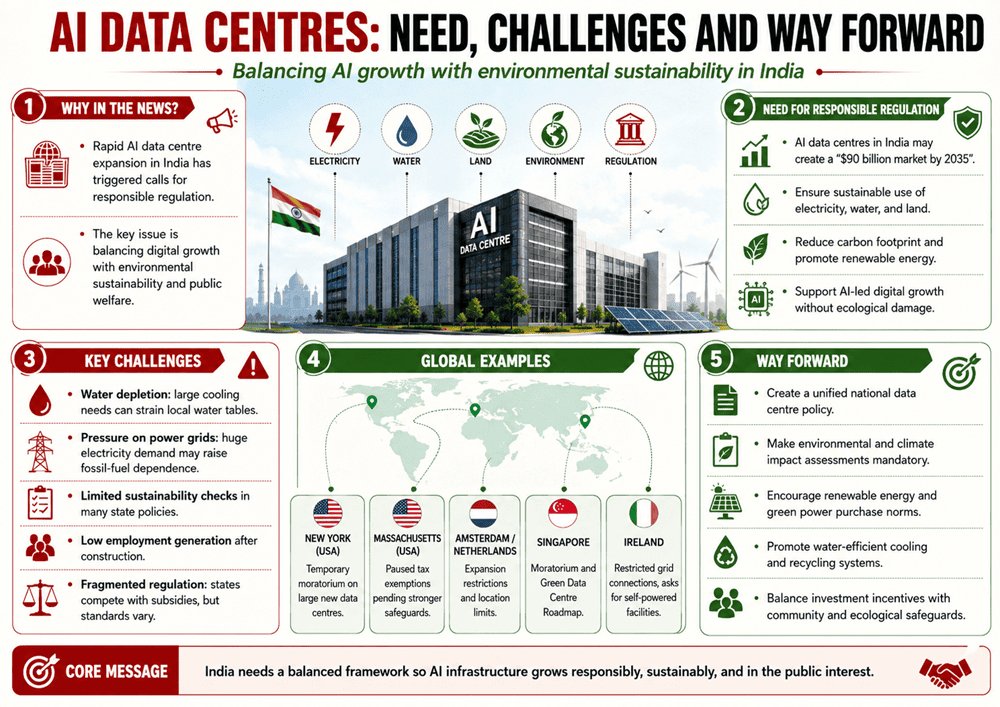
The rapid expansion of AI data centres in India has sparked debate on the need for a responsible regulatory framework to balance digital growth with environmental sustainability.
News in Brief
- Several countries are tightening regulations due to concerns over electricity, water use, and environmental impacts.
- India is encouraging investments through state incentives but needs safeguards to ensure responsible and sustainable expansion.
- The issue raises concerns over balancing AI growth with environmental sustainability and public welfare.
Need for Responsible Data Centre Regulation
- India urgently needs responsible data centre regulation in the AI era.
- Rapid AI-driven data centre expansion is projected to create a $90 billion market by 2035.
- Unchecked state-level incentives are prioritising infrastructure expansion over ecological sustainability.
- A balanced regulatory framework is needed to,
- Ensure sustainable use of electricity, water, and land.
- Minimise environmental and carbon footprint.
- Promote renewable energy and resource-efficient infrastructure.
- Support AI-led digital growth.
Challenges
Environmental and Resource Pressures
- Water depletion– Data centres require large amounts of water for liquid cooling, which threatens local communities in a water-stressed nation.
- For example, facilities in Uttar Pradesh have drastically depleted local water tables from 30 meters down to 250 meters.
- Pressure on power grids– AI Data Centres demand massive amounts of electricity, increasing fossil-fuel reliance and higher consumer power costs unless strict green energy mandates are enforced.
- Limited Sustainability Checks- Most state policies lack strong environmental and climate impact assessments.
Socio-Economic Realities
- Low Employment Generation– Hyperscale data centres demand huge footprints of land and resources, but create very few long-term, permanent local jobs after construction is complete.
- Fragmented Regulation– India lacks a unified national data centre framework, leaving individual states to compete through aggressive subsidies without uniform environmental standards.
Global Best Practices
- New York (USA) – Imposed a one-year moratorium on large new data centres due to concerns over power costs, water use, and local infrastructure.
- Massachusetts (USA) – Paused data-centre tax exemptions until stronger safeguards and a responsible regulatory framework are established.
- Amsterdam (Netherlands) – Banned new data centres and expansions until at least 2030.
- Netherlands – Restricted hyperscale data centres to only two designated locations nationwide.
- Singapore – Imposed a moratorium (2019–2022) and later adopted a restrictive quota system under its Green Data Centre Roadmap.
- Ireland – Suspended new data-centre grid connections around Dublin and requires new facilities to provide their own on-site power generation.
Way Forward & Conclusion
India should adopt a balanced regulatory framework that promotes AI innovation while ensuring efficient use of energy, water, and land.
Sustainable data-centre policies will strengthen digital growth, environmental protection, and long-term economic resilience.
Key Takeaways
UPSC Prelims and Mains Practice Question
Consider the following statements regarding AI Data Centres:
- They provide computing infrastructure for AI applications and cloud services.
- They require significant electricity and water for operation.
- India already has a dedicated law regulating AI data centres.
Which of the statements given above are correct?
A. 1 and 2 only
B. 2 and 3 only
C. 1 and 3 only
D. 1, 2 and 3
Answer: A
Mains Practice Question
Q. Rapid expansion of AI data centres presents both opportunities and sustainability challenges. Discuss the need for a balanced regulatory framework for AI data centres in India. (15 Marks)
Daily Current Affairs: Click Here